Lec 7 - microcirculation and the lymphatic system
 Call Kai
 Learn
 Practice Test
 Spaced Repetition
 Match
 Flashcards
 Knowt Play
1/31

There's no tags or description
Looks like no tags are added yet.
Name | Mastery | Learn | Test | Matching | Spaced | Call with Kai | Chat |
|---|
No analytics yet
Send a link to your students to track their progress
32 Terms
what does microcirculation function to do?
Functions to transport nutrients to tissues and remove cell waste
what are the components of microcirculation
Arterioles → highly muscular, controls blood flow to capillaries
Capillaries → thin-walled vessels, most blood-tissue exchange occurs
Most cells are 50μm of a capillary
how do capillaries affect cross-sectional area
Successive branching from artery to arterioles to capillaries inc. total cross-sectional area
Individual capillaries are small, but combining them → larger

how does cross-sectional area of capillaries affect velocity
Velocity slows down (i.e. blood flow is slower) with inc. in area
In order to max exchange so that it is more efficient

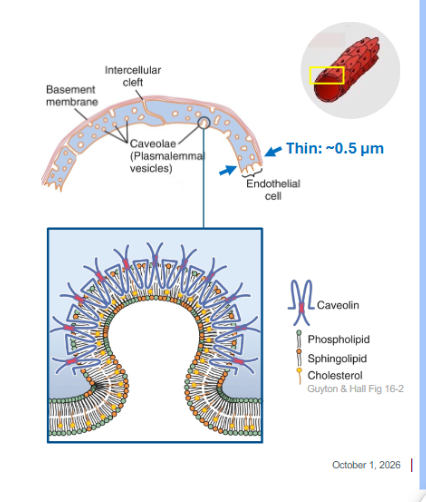
describe the structure of a capillary in the blood
single layer of endothelial cells → surrounded by basement membrane (ex. Collagen, proteins etc.)
Intracellular clefts → between endothelial cells allow small solutes, ions and water to cross, not proteins though
Caveole → facilitate transcytosis of large macrom/
What energy gradients influence exchange between blood and cells (gases and lipophilic substances) in peripheral tissues?
gas → partial pressure
lipophillic → conc. gradient
What part of the capillaries do gases and lipophilic substances cross?
entire cap surface
Lipophilic m/ are not charged, they can pass through CM, so they can pass through entire surface
What energy gradients influence exchange between blood and cells (small water soluble solutes including ions and glucose) in peripheral tissues?
Concentration
Sometimes voltage, but capillaries are very thin and have lots of opening due to clefts, therefore voltage is not very different between inside and outside as such concentration drives exchange of small solutes
what part of the capillary do small water soluble solutes like ions and glucose cross?
intracellular clefts
What energy gradients influence exchange between blood and cells (water soluble proteins) in peripheral tissues?
Rely on other mechanism for exchange
What part of the capillary do water soluble proteins cross?
Caveolae
Proteins enter into space, pinch off to turn into vesicle, vesicle transported to other side of membrane
What energy gradients influence exchange between blood and cells (water) in peripheral tissues?
Hydrostatic pressure and can rely on other mechanism for exchange (osmosis)
What part of the capillary does water cross?
Through clefts
Cant pass through cm (therefore not entire surface)
Cant pass via caveolae
what E gradients determine the movement of water across blood capillaries
hydrostatic pressure (P) and osmotic pressure (pi)

colloid osmotic pressure
osmotic pressure driven by water soluble plasma proteins

describe the two pressure gradients that affect movement of water across capillaries
Hydrostatic pressure gradient
Pc > Pif, drives H2O out (filtration)
Colloid osmotic pressure gradient
𝛱p > 𝛱if, drives H20 in (reabsorption)
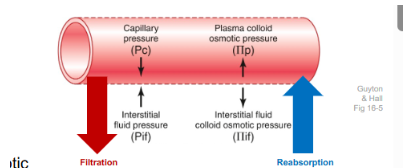
what does the magnitud and direction of water flow depend on, when water moves along blood capillaries?
depend on P and π gradients
there are hydrostatic pressures inside and outside of vessel (interstitial space) and same for osmotic pressure

net filtration pressure (NFP)
driving force of water flow along capillaries
NFP = Net hydrostatic pressure - Net osmotic pressure
= (Pc-Pif)-(πp - πif)
Net filtration rate
= Kf x NFP
Kf = capillary filtration coefficent
coefficent changes based on capillary bed
might be higher at sites of high gas exchange
example calculation attached in image*
for lecture explanation, go to 36:42 - oct 1st lecture

What determines magnitude and direction of net water flow between capillary and interstitial space?
pressure gradients between hydrostatic and oncotic pressure
hydrosttaic pressure in capillary pushes water out
intersitial fluid pushes water in (weaker compred to hydrostaatic pressure)
oncotic pressure inside capillary pulls water in
intersistial oncotic pressure pulls water out (weaker)
during a heart beat,
At the Beginning (Arterial End): bp from the heart is very high. The outward push completely beats the inward pull. Result: Water leaks out into the tissues to deliver nutrients.
At the End (Venous End): As blood moves along, the pushing pressure drops drastically because it is further from the heart. Now, the internal protein "sponges" win the tug-of-war. Result: Water gets sucked back in, carrying away waste.
The total amount (magnitude) of water that moves depends on how strong these pressures are and how "leaky" or large the blood vessel walls are.
What determines the magnitude and direction of water flow from artery to vein?
pushing gradient
hydrostatic pressure is higher at artery end
lower P at vein end
pulling graident
water pulls inward bsed on osmotic pressure
pressure remains stable
Direction: At the artery end, the pushing gradient (35) beats the pulling gradient (25), so water flows out into the tissue. At the vein end, the pushing gradient drops (18) and loses to the pulling gradient (25), so the flow reverses and water is sucked back into the blood.
Magnitude: The amount of water that moves is directly determined by the size of the net pressure difference. Because the net pressure gradient is slightly stronger at the artery end (+10 mmHg) than the vein end (-7 mmHg), a little more water is pushed out than is pulled back in. (The leftover fluid is safely collected and returned to the blood by your lymphatic system).
how do blood capillaries differ in the brain?
endothelial cells close together, intracellular clefts closed by tight junctions, allow small uncharged m/ to pass (ex. Water, O2, CO2, etc.)
ions/proteins don’t move freely

how do blood capillaries differ in the kidney
Glomerular capillaries → very permeable
Channels (fenestrae) in cells allow small m/ and ions to pass easily (high Kf and filtration rate)
how do blood capillaries differ in the liver?
Intracellular clefts are wider, allow large macrom/ to pass
Allows bigger nutrients to enter into liver
how do capillaries change in high altitudes
↓10% per km in barometric pressure leading to drop in available O2
↓5-10°C per km
Endotherms need to maintain high rate of body heat generation but are limited in available O2to support higher metabolism
What is the physiological response in animals that live in high altitudes to meet these demands?
Animals at higher altitudes (deer mouse, bar headed goose, andean duck) have more capillaries to maximize exchange to get available O2 (since O2 is low in high altitudes)
what is the function of the lymphatic vessel
Because filtration exceeds absorption in most capillaries, ~3L/day of fluid leaves the circulatory system in humans
Lymphatic vessels collect excess interstitial fluid and drain it into major veins near the heart
describe lymphatic capillaries
highly permeable
Junctions between adjacent endothelial cells can flap open acting like valves
Interstitial fluid pressure (Pif) drives everything in the fluid into lymph capillaries
No colloid pressure gradient.
why is their no colloid pressure gradient in the lymphatic system?
Proteins move freely through the gaps
describe the function of the lymphatic pump
Valves exist all along lymphatic vessels to direct lymph fluid towards the heart
Lymphatic vessels contract, valves ensure its one way
After contraction, anchoring filaments pull valves open again, reducing inside pressure and drawing fluid in
Skeletal muscle contraction also squeezes the lymph vessels and helps pump lymph fluid
what is lymphatic edema?
Excess extracellular fluid in body tissues that lymph can't filter out
what are potential causes of lymphatic edema?
Hypertension (inc. Pc)
Dec plasma protein (dec. IIp)
Endothelial dysfunction (inc. permeability)
Lymph vessel abnormality
