1 - Pharmacology and Pharmaceutic Principles of Drugs for HF
 Call Kai
 Learn
Learn Practice Test
 Spaced Repetition
 Match
Match Flashcards
 Knowt Play
1/33

Earn XP
Description and Tags
4 questions
Name | Mastery | Learn | Test | Matching | Spaced | Call with Kai | Chat |
|---|
No analytics yet
Send a link to your students to track their progress
34 Terms

What is the vicious cycle in heart failure?
Myocardial failure causes decreased cardiac output and tissue perfusion → activating the SNS and decreasing PNS
This causes arteriolar constriction, increased systemic vascular resistance, and increased resistance to ejection
Key → The body tries to compensate for low cardiac output by activating the SNS, but this compensation increases SVR and makes it harder for the failing heart to pump
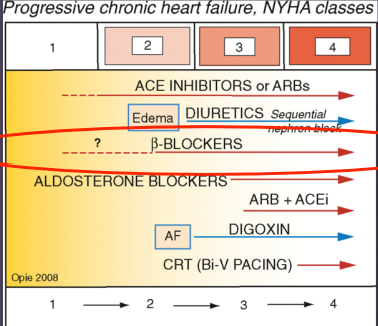
Why do beta blockers seem counterintuitive in HF?
They initially decrease HR and contractility
But chronic SNS blockade reduces harmful cardiac stress and improves HF outcomes
Why does lowering heart rate help in CHF?
Lower heart rate decreases oxygen demand and gives the heart more time to fill during diastole
This increases EDV, which increases stroke volume and cardiac output
Key → Lower HR → more filling time + less O₂ demand → better cardiac output
What are the benefits and drawback of beta-blockers in CHF?
They lower HR, oxygen demand, and afterload
But also decrease contractility (negative inotropy)
What is important and different about Ivabradine in CHF?
Approved for CHF in 2015
It decreases HR without changing anything in contractility!
Cardiac Glycosides?
Positive inotropic agents
Prepared from digitalis plants → foxglove
Ex → Digoxin, Digitoxin
What is the major response of Cardiac Glycosides?
Improves contractility / cardiac output
Positive inotropic agent!!!
What are the 3 major beneficial secondary responses of cardiac glycosides?
Sympathetic tone decreases → less “fight-or-flight” stimulation of the heart
Increases Urine production → gets rid of excess fluid
Decrease Renin release → less sodium and water retention
How do Cardiac Glycosides affect renin and sodium?
They directly suppresses renin release in the kidney
Decreasing renal sodium reabsorption and promoting natriuresis → excrete sodium into the urine
How do cardiac glycosides increase contractility?
They inhibit Na⁺/K⁺ ATPase → normally pumps 3 Na⁺ out and 2 K⁺ in
This increases intracellular Na⁺ and ultimately increases intracellular Ca²⁺!!!
Why does increased intracellular Ca²⁺ from Cardiac Glycosides increase contractility?
More Ca²⁺ is available during systole to activate contractile proteins → producing a stronger contraction!
Positive inotropic effect!!
What are the electrical effects of cardiac glycosides?
Na/K Atpase inhibition redistributes → Na and K
Causing depolarization in all cells of every organ → increased automaticity/excitability!!
What are cardiac glycosides effects on the PNS?
They increase vagal / parasympathetic activity
This decreases SA-node automaticity and slows AV-node conduction → increasing the PR interval
overall slows heart rate / activity !!!
What do cardiac glycosides do to Purkinje fibers?
They increase Purkinje fiber automaticity
Making them more likely to fire on their own → potentially causing dysrhythmias
Pharmacokinetics of Digoxin ?
T1/2 → super long → 40hrs!
Therapeutic plasma concentration → 0.5-2ng/ml → narrow therapeutic index!
Toxic plasma concentration → >2 ng/ml
What should be considered when dosing digoxin?
Monitor plasma levels because about 2/3 is excreted unchanged by the kidneys
Adjust the loading dose based on patient health
How does digoxin toxicity cause arrhythmias?
Excess intracellular Ca²⁺ causes delayed afterdepolarizations, leading to abnormal cardiac firing and arrhythmias
What arrhythmias can digoxin toxicity cause, and what increases the risk?
Atrial tachycardia is most common
Ventricular tachycardia and fibrillation are less common but potentially deadly
Hypokalemia increases the risk → especially with diuretics!!!!
Most common GI side effects with Digoxin?
Anorexia
Nausea
Vomiting
Diarrhea
CNS side effects of Digoxin Toxicity?
Disorientation and CNS stimulation → can include hallucinations
Visual disturbances → yellow-green halos
Agitation and convulsions → due to depolarization
How does K⁺ affect digoxin?
K and Digoxin inhibit each other’s binding to Na/K-ATPase
Hyperkalemia → decreases digoxin binding and effect
Hypokalemia → increases digoxin effect and toxicity
How does Ca²⁺ affect digoxin?
Hypercalcemia → increases the risk of arrhythmias due to Ca²⁺ overload
Even modest increase of Ca2+ increase the risk!!!
How does Mg²⁺ affect digoxin?
Directly opposite the effect of Ca2+
Protective against the arrhythmia-promoting effect of excess Ca²⁺
DDI of Digoxin and Diuretics?
They can lower K⁺ or Mg²⁺ and increase Ca²⁺ → which increases digoxin toxicity!!
DDI of corticosteroids and Digoxin?
Lower serum K+ → increase digoxin toxicity!!
DDI of Verapamil and Loperamide (OTC anti-diarrheal) with Digoxin?
Slows GI motility → can increase plasma digoxin levels and suppress myocardial contractility
DDI of Antacids and Dixogin?
Decreased absorption of cardiac glycosides
Mavacamten / Camzyos ?
Approved by FDA in 2022 for Obstruction Hypertrophic Cardiac-Myopathy
Allosteric inhibitor of cardiac myosin ATP-ase
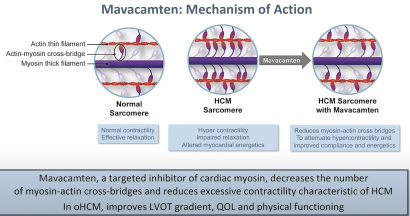
MOA of Mavacamten / Camzyos ?
Targets the cardiac sarcomere and reduces excessive actin-myosin crossbridge formation
Improving LV compliance and reducing left ventricular outflow tract obstruction
Improves exercise tolerance and general fatigue symptoms
What is Nesiritide?
Recombinant b-natriuretic peptide BNP
It acts on vascular smooth muscle and the nephron to cause vasodilation and increased diuresis through increased cGMP
T1/2 → 18min, usually bolus IV followed by continuous infusion
Adverse effects of Nesiritide?
Excessive hypotension most common
Renal damage and increased mortality have been reported with the drug
Use with caution and only in acute HF
What does neprilysin do to BNP?
Matrix metallo-endopeptidases in extracellular matrix
Breaks down BNP → making it inactive
What is Entresto and how does it work?
Entresto combines sacubitril and valsartan
Sacubitril inhibits neprilysin
While valsartan blocks AT1 receptors
What happens when neprilysin is inhibited by Sacubitril?
BNP breakdown decreases → so BNP remains active longer, promoting vasodilation and diuresis