Fluid electrolyte balance and intravenous therapy
 Call Kai
 Learn
 Practice Test
 Spaced Repetition
 Match
 Flashcards
 Knowt Play
1/78

There's no tags or description
Looks like no tags are added yet.
79 Terms
What proportion of total body fluid is stored as intracellular fluid (ICF)?
Intracellular fluid (ICF) accounts for 2/3 of total body fluid and is located inside the cells.
What visible physical signs indicate that a patient is experiencing IV Fluid Overload?
• Shortness of breath, dyspnea, orthopnea, elevated RR • Crackles in lung fields (pulmonary edema) • High blood pressure and bounding pulse • Jugular vein distension (JVD) and peripheral edema • Rapid weight gain and decreased urine output
What is the normal serum reference value for Bicarbonate (HCO3−)?
22–26 mEq/L.
When selecting a vein for venipuncture, should you start at the proximal or distal portion of the extremity?
Start at the DISTAL portion of the extremity first, saving more proximal veins for future insertions.
What specific positioning intervention is required if a patient experiences a suspected Air Embolism from a central venous catheter?
Place the patient on their LEFT side in the Trendelenburg position (head down).
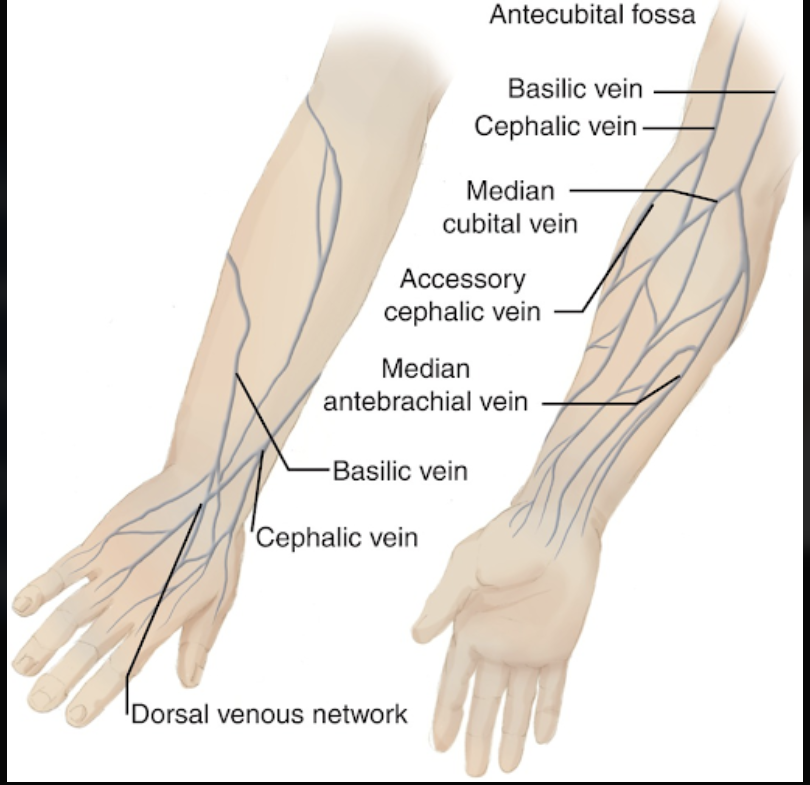
Which peripheral upper extremity veins are illustrated below for venipuncture?
Cephalic vein, Basilic vein, Median cubital vein, and Dorsal venous network.
What percentage of overall body weight is made up of fluid?
50% to 60% of total body weight.
Vesicant
Any medication or fluid capable of causing tissue necrosis, severe chemical burns, or blistering if it leaks out of the vein.
How do local signs of an IV site infection differ from systemic infection signs?
Local Signs: Redness, warmth, swelling, and purulent drainage at the insertion site.
• Systemic Signs: Fever, chills, malaise, and elevated white blood cell count (WBCs).
What are the core differences between Total Parenteral Nutrition (TPN) and Peripheral Parenteral Nutrition (PPN)?
• TPN: Complete solution, can provide more than 2000 kcal/day, hypertonic (contains >10% dextrose, >5% amino acids), infused via Central Vein, used >7 days.
• PPN: Incomplete solution, provides less than 2000 kcal/day, isotonic (contains no more than 10% dextrose, 5% amino acids), infused via Peripheral Vein, short-term use.
Under what clinical conditions is Parenteral Nutrition (PN) indicated?
When a patient's gastrointestinal (GI) tract is non-functional, or when they cannot consume sufficient calories orally/enterally.
What essential safety rule applies to adding medications or extra solutions directly into a TPN or PPN bag?
Never add any solutions or medications directly into a TPN or PPN bag or infusion line.
Phlebitis
Inflammation of the inner vein wall, characterized by pain, warmth, redness, and a hard, cord-like feeling along the vein.
ex:Pain and a red streak developing along a vein above an IV site
What feature allows Midline Catheters to be used longer than short peripheral catheters?
Midlines are longer peripheral catheters placed for intermediate duration, though thrombosis and phlebitis remain risks.
What is the normal serum reference value for Sodium (Na+)?
135–145 mEq/L.
How does kidney function change in older adults after age 30?
Kidney mass, renal blood flow, and glomerular filtration rate (GFR) decrease by approximately 10% per decade after age 30.
Which fluid compartment is most tightly regulated to maintain blood pressure?
Intravascular fluid (plasma volume inside the blood and lymphatic vessels).
What is a main disadvantage of Short Peripheral Catheters compared to central lines?
Inability to infuse hyperosmolar solutions and higher rates of infiltration and phlebitis.
Why should Lactated Ringer's solution be avoided in patients with liver disease or metabolic acidosis?
The liver cannot convert the lactate in Lactated Ringer's into bicarbonate, worsening metabolic imbalances.
What is the normal serum reference value for Phosphate (HPO4−/H2PO4−)?
1.7–2.6 mEq/L (or 2.5–4.5 mg/dL).

In the body fluid diagram below, which compartment represents two-thirds (32) of total body water?
Intracellular fluid (ICF), which is located inside the body cells.
Colloid solution
An intravenous solution containing large, non-diffusible molecules that expand intravascular volume by drawing fluid into the blood vessels.
Name the specific non-coring needle required to access an Implanted Central Port.
Huber Point Needle.
Isotonic solution
An intravenous solution with the same solute concentration as normal body fluids, causing no net fluid shift across cell membranes.
What it does: It just hydrates the body and expands blood volume without shrinking or bursting your cells.
What clinical factors can alter the manual flow rate of a gravity-fed IV infusion?
• Height of the IV solution bag • Position of the patient's extremity • Obstruction or kinking in the tubing • IV catheter position or patency • Clogged air vents

Examine the three fluid shift diagrams below: Which solution type causes fluid to move into cells and interstitial spaces?
Hypotonic solution (0.45% NaCl).
Central venous catheter (CVC)
A venous access device inserted into a large central vein with its tip terminating in the superior vena cava.
How is Filtration defined in body fluid movement?
The transfer of water and dissolved solutes through a permeable membrane from a region of higher pressure to a region of lower pressure.
What is the normal serum reference value for Chloride (Cl−)?
95–108 mEq/L.
Hypertonic solution
An intravenous solution with a higher solute concentration than normal body fluids, drawing water out of cells into the vascular space.
it pulls water out of your cells, causing them to shrink.
What main fluid shift occurs when a Hypertonic IV solution (3% NaCl) is infused?
Fluid is drawn from the intracellular compartment into the intravascular space (blood vessels).
What immediate nursing actions are required if IV Infiltration is detected?
Discontinue the IV catheter immediately.
Restart the IV line in another location.
Apply warm soaks to reduce local swelling.
Which severe complications are uniquely associated with Central Venous Access Devices compared to peripheral lines?
• Pneumothorax • Air Embolism • Central Catheter–Related Bloodstream Infection (CRBSI)
Total parenteral nutrition (TPN)
A hypertonic, nutritionally complete IV solution infused through a central vein for patients requiring long-term or high-calorie nutrition.
Which upper body conditions require a nurse to strictly avoid placing an IV on that same side of the body?
• Dialysis shunt / Arteriovenous fistula • History of Mastectomy
The passive movement of fluid through a semipermeable membrane from lower solute concentration to higher solute concentration is called _____.
Osmosis
What formula defines Net Filtration Pressure in capillaries?
Filtration Pressure=Hydrostatic Pressure−Osmotic Pressure
What force pushes fluid outward across a capillary membrane into tissue spaces?
Hydrostatic Pressure
What main fluid shift occurs when a Hypotonic IV solution (0.45% NaCl) is infused?
Fluid shifts out of the blood vessels and moves into the cells and interstitial space.
What is the standard flow rate for a Keep Vein Open (KVO) infusion?
30 mL/hr.
Which IV solution examples are classified as Isotonic?
• Normal Saline (0.9% NaCl) • Lactated Ringer's (LR)
Osmolarity
The concentration of dissolved solute particles per volume of fluid, expressed as milliosmoles per liter
The movement of solute molecules from an area of higher concentration to lower concentration is called _____.
Diffusion
What clinical signs characterize IV Phlebitis, and what action is strictly prohibited?
• Signs: Pain, warmth, redness/erythema, and a vein that feels hard and cord-like. • Prohibited Action: Do NOT irrigate the line.
What is the normal serum reference value for Magnesium (Mg++)?
1.5–1.9 mEq/L (or 1.8–2.3 mg/dL).

In the tunneled catheter diagram below, what structure anchors the line under the skin and serves as a barrier to infection?
Dacron cuff.
Infiltration
The unintentional leakage of non-vesicant IV fluid into the surrounding tissue around a catheter insertion site.
Example: Swelling, tightness, and cool skin
Which central venous access device features a Dacron cuff inside a tissue tunnel to anchor the line and reduce infection?
Tunneled Central Venous Catheter (CVC).
Peripherally inserted central catheter (PICC)
A long central venous catheter inserted through a peripheral vein in the arm and threaded until the tip reaches the superior vena cava.
Hypotonic solution
An intravenous solution with a lower solute concentration than normal body fluids, causing fluid to shift out of blood vessels and into cells.
Water rushes into your cells, causing them to swell up and potentially burst.
What standard drop factors are provided by Macro drip IV tubing sets?
10, 15, or 20 gtts/mL (used for flow rates >100 mL/hr).
Why are Hypotonic IV solutions strictly contraindicated in patients at risk for increased intracranial pressure (ICP)?
Hypotonic fluids cause fluid to shift into brain cells, increasing cerebral swelling and dangerously elevating ICP.
What is the primary treatment and patient safety priority for hypovolemia?
Oral or IV replacement of sodium, chloride, and water (e.g., 0.9% NaCl normal saline or broth). • Safety: Protect patient from injury/falls secondary to orthostatic hypotension, dizziness, and weakness.
Intravenous (IV) therapy
The delivery of liquid substances directly into a vein to correct fluid/electrolyte imbalances or deliver drugs, nutrition, or blood.
What process moves molecules across cell membranes against a concentration gradient using energy?
Active Transport
What is the normal serum reference value for Calcium (Ca++)?
4.3–5.3 mEq/L (or 8.9–10.1 mg/dL)
Needleless connectors
Devices attached to IV catheter hubs that allow needle-free syringe attachment, reducing needle-stick injuries.
What is the normal serum reference value for Potassium (K+)?
3.5–5.0 mEq/L.
What is the difference between osmolality and osmolarity?
• Osmolality: Dissolved particles per weight of fluid (measured in mOsm/kg).
• Osmolarity: Dissolved particles per volume of fluid (measured in mOsm/L)
Extravasation
the inadvertent leakage of a vesicant medication or fluid from a blood vessel into surrounding subcutaneous tissue.
What major metabolic complication must be closely monitored when starting parenteral nutrition in malnourished patients?
Refeeding Syndrome (as well as hyperglycemia and hypoglycemia)

Identify the device and needle insertion technique shown in this diagram:
Implanted Port accessed with a non-coring Huber point needle through a self-sealing septum.
What key steps must a nurse take when discontinuing a peripheral IV catheter?
Inspect the catheter site.
Carefully inspect the integrity of the catheter tip after removal to ensure it is intact.
Document the discontinuation and site condition.
Thrombophlebitis
Inflammation of a vein accompanied by the formation of a blood clot (thrombus) within the vessel.
Electronic infusion device (EID)
A powered electronic pump used to deliver intravenous fluids and medications at a precisely controlled flow rate.
Parenteral nutrition (PN)
The intravenous infusion of a specialized nutritional solution containing dextrose, amino acids, lipids, electrolytes, vitamins, and minerals.
Hemolysis
The destruction or rupture of red blood cells, causing the release of hemoglobin into surrounding plasma.
Which brain structure monitors serum osmolality and controls antidiuretic hormone (ADH) secretion?
The Hypothalamus. It senses osmotic changes and regulates ADH release to adjust water excretion in urine.
What is the normal reference range for serum osmolality in the human body?
280 to 300 mOsm/kg.
What pressure opposes outward fluid flow by keeping water inside blood vessels?
Osmotic Pressure (or Colloid Osmotic Pressure)
What hardware features are mandatory when infusing parenteral nutrition (TPN)?
Use of an Electronic Infusion Device (EID / infusion pump) and filtered tubing.
What drip factor calibration does Micro (mini) tubing deliver?
60 gtts/mL (used for rates <100 mL/hr, high-precision drips, or pediatric administration).
What immediate nursing actions should be taken when a patient develops fluid overload during an IV infusion?
Slow the IV infusion to a Keep Vein Open (KVO) rate.
Notify the healthcare provider immediately.
Place the patient in high or semi-Fowler position.
Administer supplemental oxygen as needed.
Which patient medical histories significantly increase the risk of IV fluid overload?
A history of Congestive Heart Failure (CHF) or Renal Insufficiency.
What proportion of total body fluid is extracellular fluid (ECF), and what are its two main divisions?
Extracellular fluid (ECF) accounts for 1/3 of total body fluid. Its two main divisions are:
Intravascular fluid (plasma inside blood vessels)
Interstitial fluid (fluid between cells)
What are the common clinical names for extracellular fluid volume deficit?
• Hypovolemia • Saline deficit • Isotonic dehydration
Air embolism
A blockage of a blood vessel caused by an air bubble entering the vascular system.
Venipuncture
The puncture of a vein using a needle or catheter to establish intravenous access or withdraw blood samples.
Crystalloid solution
An aqueous intravenous solution composed of mineral salts or other water-soluble molecules that readily pass through semipermeable membranes.