Lab 5: Endocrinology
 Call Kai
 Learn
 Practice Test
 Spaced Repetition
 Match
 Flashcards
 Knowt Play
1/48

There's no tags or description
Looks like no tags are added yet.
49 Terms
Thyroid gland function
Release T3 and T4 hormones
Increase basal metabolic rate (BMR): ↑ O2 and energy consumption, ↑ thermogenesis
Increase sensitivity to adrenergic receptors: ↑ heart rate and cardiac output, ↑ vasodilation

Thyroid gland location
Located on both sides of the trachea below the larynx
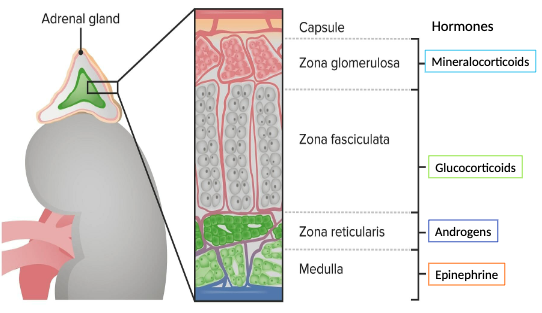
Parts of the adrenal gland and what they make
zona glomerulosa: mineralocorticoids
zona fasciculata: glucocorticoids
zona reticularis: androgens
medulla: epinephrine


Mineralocorticoids purpose
↑ water and Na+ reabsorption; K+ excretion
↑ blood pressure
Glucocorticoids purpose
↑ blood glucose (via gluconeogenesis and inhibiting glucose utilization)
↑ sensitivity to adrenergic receptors (BP)
↓ immune response (anti-inflammatory response)
Enhance effects of norepinephrine on blood pressure
Androgens purpose
Least understood function
Possible source of sex hormones during menopause
Epinephrine purpose
Fight or flight response
Endocrine Pancreas composition and function
Beta cells secrete insulin
↓ blood glucose
Alpha cells secrete glucagon
↑ blood glucose (via glycogenolysis)
↑ release of fatty acids from triglycerides


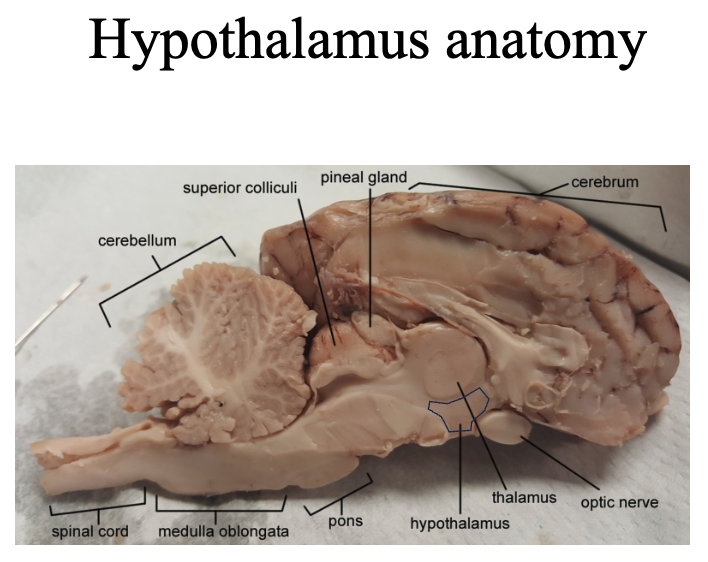


Nuclei
Neurons involved in a specific center that are organized in functional clusters
Hypothalamic nuclei regions and functions:
Anterior: circadian rhythm, thermoregulation)
Medial/tuberal: eating habits, satiety, regulation of BP and HR
Posterior: memory, energy balance, shivering, sleep, learning

Hypothalamus-pituitary connection
Hypothalamus is connected to the anterior pituitary via a portal vascular system
Hypothalamic hormones travel a short distance through the blood vessels to bind to receptors on cells in the anterior pituitary


Portal Vascular System

Hypothalamic Pituitary Thyroid Axis steps
TRH released from hypothalamus and acts on anterior pituitary
TSH released from anterior pituitary and acts on thyroid
T3/T4 released from thyroid and acts on hypothalamus (feedback) and various tissues

Hypothalamic-pituitary adrenal axis steps
CRH released from hypothalamus and acts on anterior pituitary
ACTH released from anterior pituitary and acts on adrenal glands
Cortisol released from adrenal glands and acts on hypothalamus, anterior pituitary (feedback) and various tissues

Hypothalamic-pituitary gonadal axis
GnIH(-) or GnRH(+) released from hypothalamus acts on anterior pituitary
LH/FSH released from anterior pituitary acts on gonads
Sex hormones released from gonads acts on hypothalamus, anterior pituitary (feedback), and various tissues

Hypothalamic-Pituitary Growth Hormone Axis
GHRH(+) or GHIH (-) released from hypothalamus
GH released from anterior pituitary acts in liver, various tissues, hypothalamus (feedback)
Liver released from IGF-I acts on hypothalamus (feedback) and various tissues

Hypothalamic-Pituitary Prolactin Axis
TRH(+) or Dopamine(-) released from hypothalamus acts on anterior pituitary
Prolactin released from anterior pituitary acts on breast and other tissues (also responsible for brooding in hens)

Hypothalamus role in integrated axes
integration centre
Posterior pituitary role in integrated axes
Neural connection to hypothalamus
Neuroendocrine cells in the hypothalamus release neurotransmitters into capillary network in the posterior pituitary
Anterior pituitary in integrated axes
Connected to the hypothalamus via portal vascular system
Neuroendocrine cells in the hypothalamus secrete neuropeptides into the capillaries, stimulate/inhibit endocrine cells in the anterior pituitary to release trophic hormones
How is anterior pituitary regulated
Very small amount of neuropeptides needed to stimulate the anterior pituitary
Neuropeptides are only active for a short period
System allows for multiple levels of regulation

Long loop feedback
endocrine gland hormone has inhibitory (or stimulatory) effects on hypothalamus/pituitary gland
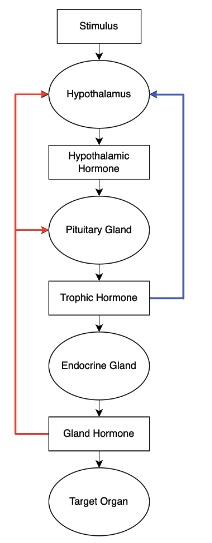
Short Loop Feedback
trophic hormone (from pituitary) has inhibitory (or
stimulatory) effects on hypothalamu

Hormonal axes diagram


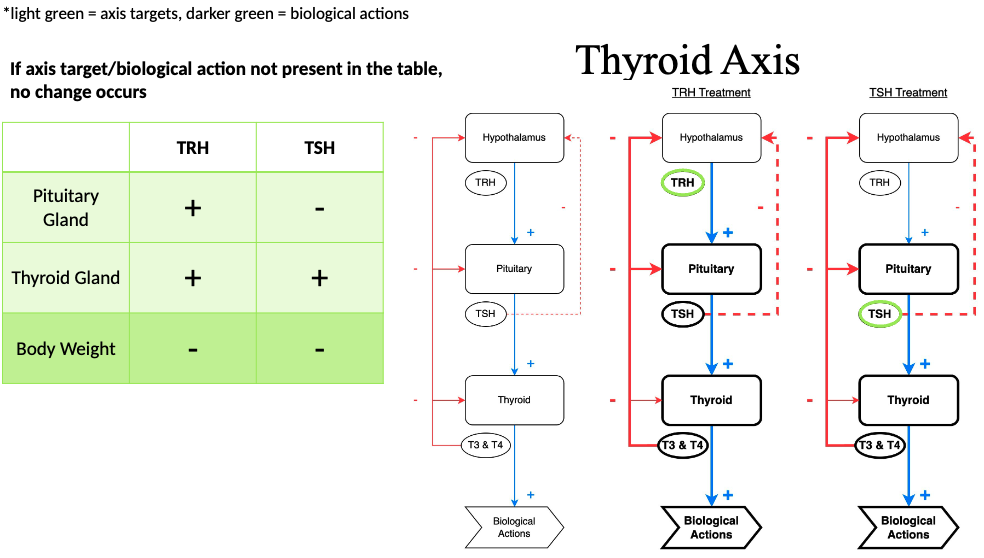

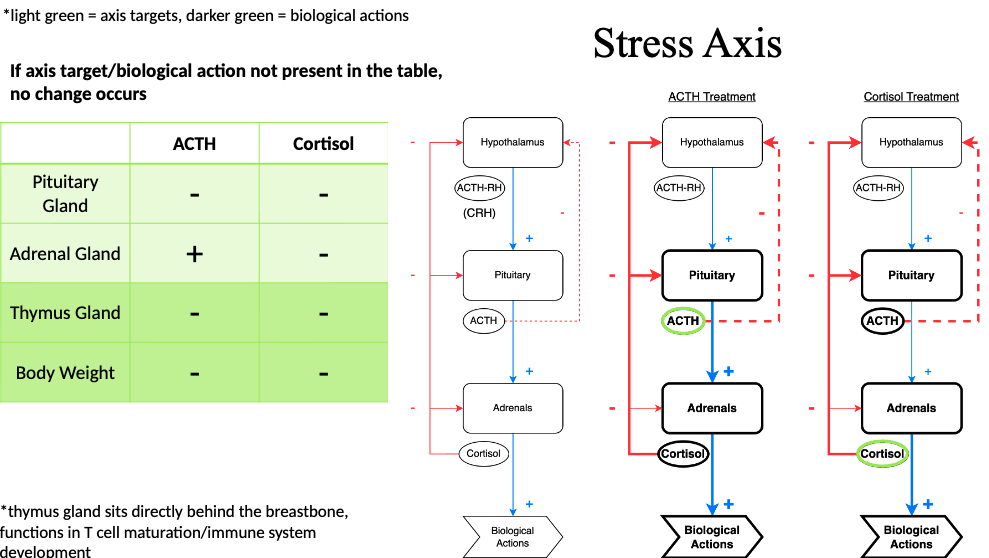


What is activated and inhibited when you treat with a hormone
You activate all the levels below that hormone, all the way to the biological actions
You inhibit all levels above that hormone, including the producing gland, by means of negative feedback
Adrenal gland location
Paired organs that are located on top of the kidneys
Adrenal gland function
Cortex is composed of the zona glomerulosa, zona fasiculata and zona reticularis and produces mineralcorticoids, glucocorticoids, androgens, respectively
Endocrine pancreas location
Located in the abdominal cavity alongside the duodenum
Endocrine pancreas function
Produces insulin and glucagon
Insulin function
Upregulates glucose transporters and incorporates glucose into storage molecules
Glucagon function
Increase blood glucose in response to metabolite levels by promoting glycogenolysis to release glucose from glycogen
Stimulates the release of fatty acids from triglycerides
What does each hormone produced by the hypothalamus produce or inhibit in the pituitary
LH/FSH →GnRH/GnIH
ACTH → ACTH-RH
TSH → TRH
GH → GH-RH/GH-IH
Prolactin →Dopamine
Which hormones produced by the hypothalamus have an inhibitory effect on hormones produced by the pituitary
GnIH
Dopamine
GH-IH
Using the concept of negative feedback control, what effect would exogenous TRH have on different organs
Stimulated:
thyroid gland
pituitary gland
Inhibited:
body weight
No change:
testes
adrenal gland
seminal vesicles
prostate
thymus gland
Using the concept of negative feedback control, what effect would exogenous TSH have on different organs
Stimulated:
thyroid gland
Inhibited:
body weight
pituitary gland
No change:
thymus gland
prostate
adrenal gland
testes
seminal vesicles
Using the concept of negative feedback control, what effect would exogenous ACTH have on different organs
Stimulated:
adrenal gland
Inhibited:
thymus gland
pituitary gland
body weight
No change:
seminal vesicles
prostate
testes
thyroid gland
Using the concept of negative feedback control, what effect would exogenous cortisol have on the different organs
Inhibited:
body weight
thymus gland
adrenal gland
pituitary gland
No change:
seminal vesicles
prostate
testes
thyroid gland
Using the concept of negative feedback control, what effect would exogenous testosterone have on the different organs in an intact male
Stimulated:
prostate
body weight
seminal vesicles
Inhibited:
pituitary gland
testes
No change
thyroid gland
adrenal gland
thymus gland
Using the concept of negative feedback control, what effect would exogenous testosterone have on the different organs in a castrated male
Stimulated
seminal vesicles
body weight
prostate
Inhibited
pituitary gland
No change
adrenal gland
thyroid gland
thymus gland
Using the concept of negative feedback control, what effect would exogenous LH have on the different organs in a castrated male
No change
body weight
seminal vesicles
thymus gland
prostate
adrenal gland
thyroid gland
Almost no change
pituitary gland
Using the concept of negative feedback control, what effect would exogenous LH have on the different organs in a intact male
Stimulated
prostate
testes
body weight
seminal vesicles
Inhibited
pituitary gland
No change
adrenal gland
thymus gland
thyroid gland
Steps of long-loop negative feedback that regulates the production of testosterone starting with the hormone produced in the hypothalamus
release of GnRH
GnRH binds to receptors on pituitary
Release of LH
LH binds to receptors on the testes
Release of testosterone
Testosterone feeds back to pituitary and hypothalamus
Once sufficient levels of testosterone are achieved production is stopped at the level of the hypothalamus or pituitary
Short loop negative feedback is when..
hormones produced by the pituitary feedback to the hypothalamus to stop the production of hormones from the hypothalamus.