Chapter 13: Host Defenses Adaptive Immunity Part 1 (Down to
 Call Kai
 Learn
 Practice Test
 Spaced Repetition
 Match
 Flashcards
 Knowt Play
1/18

There's no tags or description
Looks like no tags are added yet.
19 Terms
What type of immunity do B and T cells provide?
Hummel immunity: B cells (produces antibodies)
Cell-mediated: T cells (Helper T cells, Th and Cytotoxic T cells, Tc)
What are the 10 things I must know when it comes to distinguishing between innate and adaptive immunity?
Acquired or Intrinsic
Time
Specificity
Diversity
Recognition of target antigen
Receptors used
Maturation/Training of key players
Effect of vaccination
Memory response
Quality of response with repeat encounters
For lymphocyte development what are the two types of white blood cells? where do they arise from? What is HSC?
The two types, are B & T cells
All B and T lymphocytes arise from the same hematopoietic stem cell in bone marrow
HSC: hematopoietic stem cell can you create red blood cells, white blood cells, platelets, etc.

Where do B and T cells mature? bone marrow and thymus are the primary what structures and what does this mean?
B cells mature/train in bone marrow
T cells mature/train in the thymus
Bone marrow and Thymus are primary lymphoid structures (maturation/training Areas)

What is colonial deletion?
Clonal deletion: process by which any auto-reactive clones/autoimmune cells are destroyed during development/maturation
After maturation of B and T cells, where do they migrate to? By the time they reach lymphoid tissues, what has happened?
After maturation, B and T cells migrate to secondary lymphoid structures (e.g. LN, Spleen)
By the time B and T cells reach lymphoid tissues, each one is equipped to respond to a single unique antigen

What do B and T Cells constantly do
B and T cells constantly recirculate through the circulatory (blood) system and lymphatics (lymphatic system), migrating into and out of the lymphoid organs

In summary, For B cells what are the four steps in production of a humoral response?
Activation of a B lymphocyte when it encounters its specific epitope. (Clonal Selection)
Proliferation of activated B lymphocyte (Clonal Expansion); Expands its number
Differentiation of activated, proliferating B lymphocytes into effector Plasma cells and Memory cells
Secretion of antibodies by Plasma cells
Each B cell has a what with unique what towards a specific type of what?
Each B-cell has a BCR with unique specificity towards a single type of epitope (Antigen)
example: 1000,000 B cells and all receptors are different
In detail, what is the first step of a production of humoral response? (First encounters what and what happens? Then after it is bound, what does it seek?)
When a particular B-lymphocyte encounters its specific epitope/antigen, it uses its BCR to bind to that epitope/antigen
A B-cell that is bound to its specific antigenic epitope, seeks help from a Helper-T cell that has already recognized the same antigen (Tfh or Follicular Helper T cell subtype)

When a B cell is bound to its specific antigenic Epitope, what do Tfh cells do (or Follicular Helper T cell subtype)
Help me cells to produce better, humoral response, and antibodies

What is the final thing that occurs because of the combination of the stimuli of B cells?
A combination of the stimuli activates the B cell (clonal selection)

What occurs after clonal selection?
Colonial expansion where activated B cells undergo proliferation, and multiply
When differentiation of B cells occurs what are the two pathways that they can differentiate into? Of these two pathways which are short-lived /long-lived? Approximately what percent of both types make up Differentiated B cells?
Effector cells called plasma cells (Short lived/temporary and this is ~90% of differentiated B cells)
Memory cells (Long lived/decades and this is ~10% of differentiated B cells)

When B cells are differentiated, what are the functions of these two pathways?
Some of the proliferating B-cells differentiate into effector cells called as Plasma cells. Plasma cells actively secrete antibodies but are short lived.
Some of the proliferating B-cells differentiate into Memory cells (long-lived) that are helpful in protecting against the repeated future encounters by the same pathogen

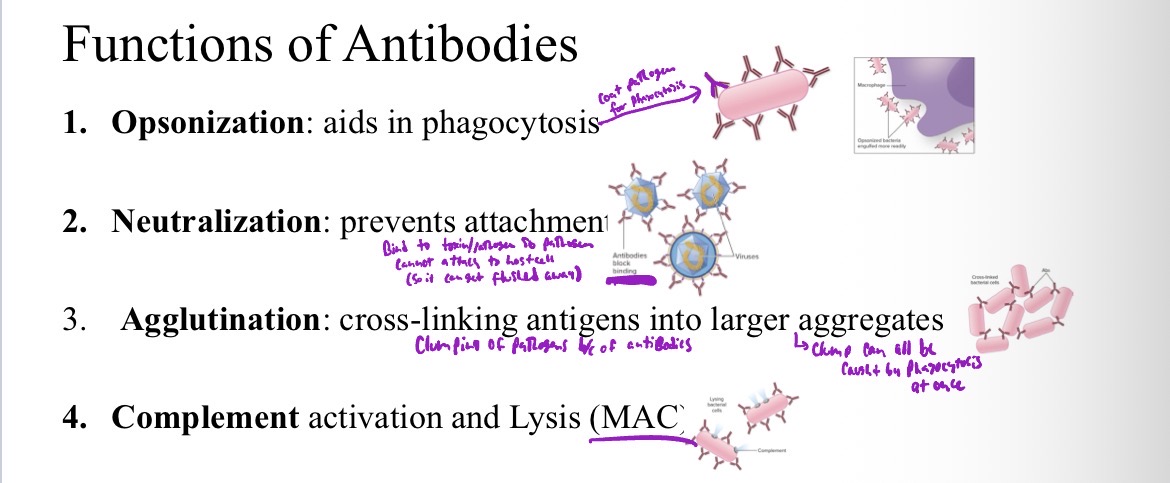
What are the four functions of antibodies?
Opsonization
Neutralization
Agglutination
Complement activation and Lysis (MAC)

What are the four functions of antibodies? (What is opsonization?)
Opsonization: aids in phagocytosis (coats pathogens for phagocytosis)

What are the four functions of antibodies? (What is neutralization? Also what is the result)
Neutralization: prevents attachment
Binds to toxin/pathogen so pathogen cannot attach to host cell
As a result, pathogens are flushed away

What are the four functions of antibodies? (What is agglutination? This creates what? which can all be caught by what at once?
Agglutination: cross-linking antigens into larger aggregates
clumping of pathogens because of antibodies
Clump can all be caught by phagocytosis at once