Redox Electrode Potential
 Call Kai
 Learn
 Practice Test
 Spaced Repetition
 Match
 Flashcards
 Knowt Play
1/31

There's no tags or description
Looks like no tags are added yet.
32 Terms

What does a negative E° value mean?
The reduction shown is not very favourable.
So Zn²⁺ is not keen to gain electrons and become Zn.
Therefore the reverse reaction is relatively favoured:
(picture)
Zinc tends to lose electrons and form Zn²⁺.

How do I tell whether a metal prefers to exist as the metal or the ion?
Look at the E° value of the metal ion/metal couple.
Very negative E° → metal prefers to form ions.
Very positive E° → ions prefer to form the metal.
Examples:
Zn²⁺/Zn = −0.76 V → prefers Zn²⁺
Au⁺/Au = +1.68 V → prefers Au

Zinc has a standard electrode potential of (picture)
What does this tell us about whether zinc prefers to exist as Zn or Zn²⁺?

ROPE and ONE acronym meaning
ROPE - Reduction on positive electrode
ONE - Oxidation negative electrode
Does an electrode increase or decrease in mass during reduction?
Increase in mass. Using OIL RIG, reduction is gain of electrons, so metal ions gain electrons and become metal atoms that are deposited on the electrode.
e.g. (picture)

Does an electrode increase or decrease in mass during oxidation?
Decrease in mass. Using OIL RIG, oxidation is loss of electrons, so metal atoms lose electrons and leave the electrode as ions.
e.g. (picture)

What is an oxidising agent?
A substance that causes oxidation by accepting electrons. It is reduced itself.
What is a reducing agent?
A substance that causes reduction by donating electrons. It is oxidised itself.
In a Fe²⁺/MnO₄⁻ titration, what are the key conditions and observations?
Acidify with dilute H₂SO₄, no indicator needed, endpoint is a pale permanent pink.
In a Fe²⁺/MnO₄⁻ titration, what is the mole ratio of Fe²⁺ to MnO₄⁻?
5 : 1.
In an I₂/S₂O₃²⁻ titration, what are the key conditions and observations?
The iodine solution starts yellow-brown. When it becomes pale straw, add starch, which turns the solution blue-black. Continue titrating with thiosulfate until the blue-black colour disappears (colourless) at the endpoint.
In an I₂/S₂O₃²⁻ titration, what is the mole ratio of I₂ to S₂O₃²⁻?
1 : 2
What are the standard conditions used when measuring E° values?
100 kPa pressure, 298 K (25°C), and all ion concentrations at 1 mol dm⁻³.
What is a metal electrode & metal ions half-cell?
A metal electrode in a solution containing its ions.

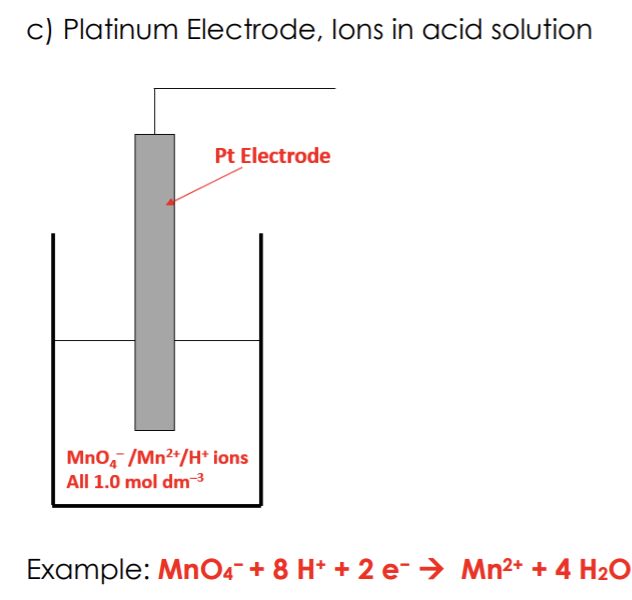
When is a Pt electrode used with metal ions?
When there is no solid metal electrode present because both species are ions, so an inert conductor is needed to transfer electrons

When is a Pt electrode used in acidic solutions?
When only ions are present and a conducting electrode is needed.
Which electrode is used in gas systems?
A platinum (Pt) electrode is used because gases cannot act as electrodes, so an inert conductor is needed to transfer electrons

What is the Standard Hydrogen Electrode (SHE)?
The SHE is the reference half-cell used to compare and measure the E° values of other half-cells. It consists of H₂ gas at 100 kPa, 1 mol dm⁻³ H⁺ ions, and a Pt electrode, and is assigned an E° value of 0.00 V.


The standard hydrogen electrode is attached to the electrode system you are investigating. For example, a piece of zinc in a solution containing zinc ions.
a) What is happening to the atoms at the zinc electrode?
b) Where do the electrons initially accumulate?
c) Which is the positive electrode
a) Zn atoms are being oxidised to Zn²⁺ ions, releasing electrons.
b) The electrons initially accumulate on the zinc electrode because they are released when zinc atoms are oxidised.
c) The standard hydrogen electrode (SHE) is the positive electrode because electrons flow from the zinc electrode to the SHE, where H⁺ ions are reduced to H₂ gas.
2H+ +2e− → H2
What does a positive E° value mean?
Reduction is favoured, so the equilibrium lies to the right.
What does a negative E° value mean?
Oxidation is favoured, so the equilibrium lies to the left. ✅
If a half-cell has a very positive E° value, what does it prefer to form?
It prefers to form the metal/reduced species.
If a half-cell has a very negative E° value, what does it prefer to form?
It prefers to form the ions/oxidised species.
How can E°cell be used to predict whether a reaction is feasible?
If E°cell is positive, the reaction is feasible. If E°cell is negative, the reaction is not feasible
What are the limitations of using E°cell to predict feasibility?
E° values only apply under standard conditions and do not show the rate of reaction, so a feasible reaction may still be very slow.
What is one benefit of lithium-based cells?
They have a high energy density and produce a high voltage.
What are the risks of lithium-based cells?
Toxicity and fire hazards.
What is the main difference between a fuel cell and a battery?
A fuel cell requires a continuous supply of fuel and oxygen, whereas a battery contains a fixed amount of reactants
How does a fuel cell create a voltage, and what happens at each electrode?
A fuel cell creates a voltage using the energy released when a fuel reacts with oxygen. At the negative electrode, the fuel is oxidised (loses electrons), and at the positive electrode, oxygen is reduced (gains electrons).
What’s the purpose of the salt bridge
to allow the flow of ions
NO PR acronym meaning
(if more) negative (value) = oxidised
(if more) positive (value) = reduced
When writing redox half-equations, when do you use a metal atom and when do you use a metal ion?
✅ Oxidation = loss of electrons
Metal atom → Metal ion + electrons
Example: Mg → Mg²⁺ + 2e⁻
✅ Reduction = gain of electrons
Metal ion + electrons → Metal atom
Example: Cu²⁺ + 2e⁻ → Cu