Fetal Pig Digestive and Respiratory
 Call Kai
 Learn
 Practice Test
 Spaced Repetition
 Match
 Flashcards
 Knowt Play
1/50

There's no tags or description
Looks like no tags are added yet.
51 Terms
falciform ligament
attaches liver to anterior abdominal wall and diaphragm
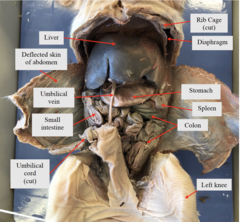
greater omentum
a fatty sheet that hangs like an apron over the abdominal viscera
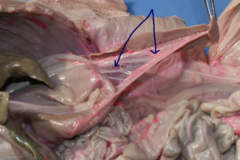
lesser omentum
Structure attached to the lesser curvature of the stomach that connects it to the liver

mesocolon
anchors colon to posterior body wall

the mesentry
a fused double layer of the parietal peritoneum that attaches parts of the intestine to the interior abdominal wall

paratoid gland
The largest of the three main parts of salivary glands, located on either side of the face, just below and in front of the ears

paratoid duct
also known as stensens duct, is accompanied by the facial artery

hard palate
roof of the mouth

soft palate
muscular posterior (back) portion of the palate

Esophagus
A muscular tube that connects the mouth to the stomach.

cardiac portion of stomach
area that surrounds the superior opening of the stomach

body of stomach
main central region of stomach
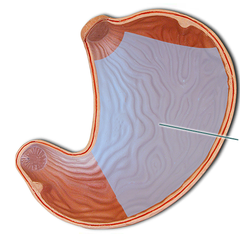
pyloric region of stomach
lower portion of the stomach
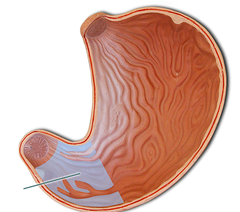
pyloric sphincter
Controls passage of food from stomach to small intestine

greater curvature of stomach
convex lateral surface of the stomach

lesser curvature of stomach
concave medial surface of the stomach

gastric rugae of stomach

small intestine
Digestive organ where most chemical digestion and absorption of food takes place

duodenum
first part of the small intestine

jejunum
second part of the small intestine

ileum
third part of the small intestine

ileocecal valve
Valve at the junction of the small and large intestines

colon
large intestine

cecum
first part of the large intestine

ascending colon
travels upward from the cecum to the undersurface of the liver

transverse colon
passes horizontally from right to left toward the spleen

descending colon
portion of the colon that extends downward from the transverse colon

liver
produces bile and stores glycogen

quadrate lobe of the liver
Bounded on left by round ligament of liver, Bounded on right by gallbladder

right medial lobe of the liver
large lobe to the right of the falciform ligament; contains the gall bladder

right lateral lobe of liver
lobe of liver that is divided into anterior and posterior lobule, smaller than left lateral and hidden by media lobe

caudate lobe
smallest lobe of the liver situated on the posterosuperior surface of the left lobe; the ligamentum venosum is the anterior border

left medial lobe of liver
lobe to the left of the falciform ligament

galbladder
small pouch like organ that stores bile

common bile duct
Carries bile from the liver and gallbladder to the duodenum. Also called the choledochus.

Pancreas
Regulates the level of sugar in the blood

Spleen
Organ near the stomach that produces, stores, and eliminates blood cells

Pharynx
the membrane-lined cavity behind the nose and mouth, connecting them to the esophagus.

nasopharynx
region of the pharynx at the back of the nose and above the soft palate

oropharynx
central portion of the pharynx between the roof of the mouth and the upper edge of the epiglottis
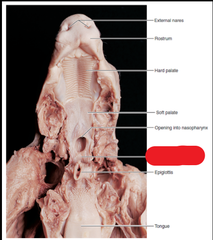
laryngopharynx
lower part of the pharynx, just below the oropharyngeal opening into the larynx and esophagus

Larynx
voice box; passageway for air moving from pharynx to trachea; contains vocal cords

Trachea
Allows air to pass to and from lungs

tracheal cartilage
C shaped rings of cartilage that give support to the trachea
lungs
Main organs of the respiratory system
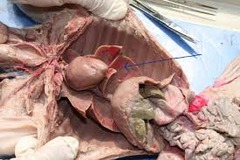
Right Apical Lobe of the Lung

Right Intermediate lobe of the Lung

Left Apical Lobe of the Lung

Left Cardiac Lobe of the Lung
(middle of the two lobes)

Left Diaphragmatic Lobe of the Lung
(the opposite side, but same position)

Diaphragm
Large, flat muscle at the bottom of the chest cavity that helps with breathing
