a level biology: lipids and proteins (biological molecules part 2)
 Call Kai
 Learn
 Practice Test
 Spaced Repetition
 Match
 Flashcards
 Knowt Play
1/42

There's no tags or description
Looks like no tags are added yet.
43 Terms
are lipids polar or non-polar?
non-polar
the electrons in the outer orbitals (the electrons that form bonds) are more evenly distributed than in polar molecules, so there are no negative or positive areas in the molecules
this also means that lipids are insoluble if solid (don’t dissolve in water) and immiscible if liquid (don’t mix with water)
what are the uses of lipids in biology?
energy storage (adipose cells) (because lipids are insoluble in water and are hydrophobic (do not form hydrogen bonds with water), so they make good storage molecules in aqueous body environments)
energy source for respiration
water source for respiration
protection of vital organs
thermal or electrical insulation
plasma membranes of cells
waterproofing feathers or leaves
buoyancy for aquatic animals (as they are less dense than water)
what is the structure of a triglyceride?
one glycerol (an alcohol) and three fatty acid (a carboxylic acid) tails (which can be saturated or unsaturated)
the glycerol and fatty acids are joined by an ester bond (which occurs via the condensation reaction, esterification)
(they are non-polar)

what is meant by monounsaturated?
there is one double C=C bond in the hydrocarbon chain
what is meant by polyunsaturated?
there are two or more double C=C bonds in the hydrocarbon chain
are unsaturated fats liquid or solid at room temperature, and why?
liquid (oil)
because: the double bond(s) mean the molecule can kink or bend, so the molecules cannot pack closely together to form a solid
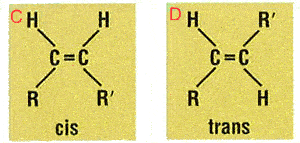
what are cis fats?
fats where hydrogens appear on opposite sides of the molecule


what are trans fats?
fats where the hydrogens appear on the same sides of the molecule
what is the structure of a phospholipid?
one glycerol molecule with two fatty acid tails and a phosphate ion

what are the properties of phospholipids?
amphipathic/amphiphilic (have both hydrophobic and hydrophilic regions):
the phosphate group is polar and so is hydrophilic
the fatty acid tails are non-polar and so are hydrophobic
since there are both hydrophobic and hydrophilic parts, phospholipid molecules form monolayers or bilayers (where a hydrophobic core is formed) when in water
what is the purpose of phospholipids?
they make up the plasma membrane
because: their amphipathic properties allow them to form a hydrophobic core as a barrier against water-soluble molecules
+ the hydrophilic phosphate heads form hydrogen bonds with water so the cell membrane can contain water-soluble molecules while keeping them separate from the outside molecules)
why are some of the fatty acid tails in the plasma membrane unsaturated?
for flexibility:
the tails can change shape and so the lipids are fluid at lower temperatures, allowing the membrane proteins to move + it allows small molecules to pass through the membrane
how many water molecules do both phospholipids and triglycerides release when formed via a condensation reaction?
3
what are sterols?
steroid alcohols (molecules with 4 C rings and an OH group)
they are amphiphilic (the hydroxyl group is polar and hydrophilic; the rest of the molecule is non-polar and hydrophobic)
E.g. cholesterol
where is cholesterol produced and found? what is its purpose?
produced in the liver and intestines
found in plasma membranes, in between phospholipids
regulates stability and fluidity of the membrane
what is the test for lipids (when the sample is solid)?
crush the solid samples and put them in separate test tubes
use a pipette to add ethanol to each sample so there is a layer of liquid above the sample (the layer should be about the same volume in each test tube)
shake the tubes with bungs in
allow the solid to settle to let the lipid dissolve in the ethanol
record observations
add a set volume of distilled with with a pipette to each sample and shake gently to mix, then record observations
positive result: a milky white emulsion forms
negative result: solution remains clear and colourless
what is the test for lipids (when the sample is liquid)?
put the same volume of each sample into a different test tube
use a pipette to add a set volume of ethanol to each sample
shake the tubes with bungs in
record observations
add a set volume of distilled with with a pipette to each sample and shake gently to mix, then record observations
positive result: a milky white emulsion forms
negative result: solution remains clear and colourless
what are the purposes of proteins in biology?
cell growth and repair
cell structure (carrier proteins in plasma membranes)
hormones
enzymes
immunoproteins (e.g. immunoglobulins)
transport proteins (e.g. haemoglobin)
structural proteins (e.g. collagen, keratin)
contractile proteins (e.g. myosin)
how many different amino acids are there?
20
what is the general structure of an amino acid?
amino group (basic) (NH2 and sometimes a H+ too)
carboxyl group (acidic) (COOH, when in solution it loses the H+ to leave O-)

what are peptide bonds?
covalent bonds between amino acids
what is the primary structure of a protein?
the sequence in which the amino acids are joined, determined by the info carried in DNA
what does the sequence of amino acids affect?
the way the polypeptide folds to give the protein’s shape
what is the secondary structure of a protein?
the 3d folding of the polypeptide, determined by the hydrogen bonds formed between negatively-charged nitrogen and oxygen atoms with positively-charged hydrogen atoms
what are the two types of secondary structure?
alpha helix
beta-pleated sheet
where are the hydrogen bonds formed in an alpha helix?
between every 4th peptide bond
where are the hydrogen bonds formed in a beta-pleated sheet?
between parallel peptide bonds (because the protein is folded so that two parts of the polypeptide chain are parallel to each other)
what is the tertiary structure of a protein?
the further conformational changes to shape of the secondary structure, which results in additional bonds forming between R groups (side chains)
what are the four types of bonds formed in the tertiary structure of a protein (excluding peptide bonds, since those are also in primary structure)?
disulphide bridge: (most rare) very strong covalent bonds formed between sulphur-containing side chains
ionic bond: (less common) weak-ish bonds between oppositely-charged side chains
hydrophobic interactions: (common) weak interactions between non-polar side chains
hydrogen bond: (most common) weak bonds between very polar side chains

what is the quaternary structure of a protein?
the 3d arrangement of two or more polypeptides (in proteins that have more than one polypeptide chain)
what are the four types of bonds in the quaternary structure?
same as in tertiary structure:
disulphide bridge: (most rare) very strong covalent bonds formed between sulphur-containing side chains
ionic bond: (less common) weak-ish bonds between oppositely-charged side chains
hydrophobic interactions: (common) weak interactions between non-polar side chains
hydrogen bond: (most common) weak bonds between very polar side chains
what is an example of a protein with a quaternary structure?
haemoglobin
what are the two types of proteins?
globular (e.g. insulin, catalase, haemoglobin)
fibrous (e.g. keratin, elastin, collagen)
what are the properties of globular proteins?
compact
roughly spherical (because their non-polar/hydrophobic side chains are orientated towards the centre of the protein, away from the aqueous surroundings, while their polar/hydrophilic side chains face the outside of the protein)
soluble in water
what are conjugated proteins?
globular proteins containing a non-protein component called a prosthetic group
(as opposed to simple proteins, which don’t have a prosthetic group)
E.g. haemoglobin
what are the properties of haemoglobin?
quaternary structure (two alpha helixes and two beta-pleated sheets)
globular protein
conjugated protein
each polypeptide chain has one haem prosthetic group
haem contains Fe2+ and so binds to oxygen (each haemoglobin molecule can bind to 4 O2 molecules)
soluble in water
what is the function of catalase?
breaks down hydrogen peroxide (a common by-product of metabolism)
how many haem prosthetic groups are in catalase?
4
what are the properties of fibrous proteins?
long
very organised structure (due to repeating sequence of amino acids)
insoluble in water (due to having a lot of hydrophobic side chains in their primary structures)
strong
what is the purpose of keratin?
making up hair, nails, horns, feathers
because: there is a lot of cysteine amino acids forming many disulphide bridges, making it very strong
what is the purpose of elastin?
making up tendons, bones, skin
because: it is made up of many stretchy tropoelastin molecules, allowing it to stretch and rebound to the original size
what is the purpose of collagen?
tendons, bones, cartilage, walls of arteries
because: the triple helix quaternary structure gives it a lot of strength and flexibility
how do you test for proteins?
put a set volume of each sample into separate test tubes
hold one of the tube’s at a 45 degree angle and slowly add a small volume of Biuret’s reagent using a syringe, making sure the reagent forms a layer on top of the sample
record any colour changes seen at the interface between the reagent and the sample
shake gently and record observations again
repeat for the other sample
positive result: solution turns from blue to lilac, so there are peptide bonds present
negative result: solution remains blue