Clinical Exam 2
 Call Kai
 Learn
Learn Practice Test
 Spaced Repetition
 Match
Match Flashcards
 Knowt Play
1/96

There's no tags or description
Looks like no tags are added yet.
Name | Mastery | Learn | Test | Matching | Spaced | Call with Kai | Chat |
|---|
No analytics yet
Send a link to your students to track their progress
97 Terms
Where does the blood enter the heart through?
super and inferior vena cava.
What atrium does the blood first go into?
right atrium
What valve does the blood goes through on the right side?
tricuspid valve
What ventricle does the blood goes to after going through the tricuspid valve?
right ventricle
What valve does the blood go through to leave the heart to the lung?
pulmonary valve
What vein or artery does the blood leave to go to the lungs?
left pulmonary artery
What vein or artery does the blood come from the lung back to the heart?
left pulmonary vein
What atrium does the blood renters the heart?
left atrium
What valve does the blood goes through when they leave the left atrium?
mirtal valve
What ventricle does the blood enter into after leaving the mitral valve?
left ventricle
What valve does the blood enter into leaving the left ventricle?
aorta valve
What tube does the blood enter in and goes to the rest of the body?
aorta
What part of the brain control the cardiovascular system?
brain system
What sensory signals is sent to the heart?
carotid and aortic baroreflex
What sensory signals is sent to the muscles?
muscle mechano and metaboreflex
What does the parasympathetic and sympathetic efferent do foe the heart?
All the of above
True or false does the sympathetic increase nerve activity in the cardiovascular system?
True
What is cardiac output?
total amount of blood ejected from the ventricle.
What is stroke volume?
difference in end-diastolic volume and end-systolic volume.
What is ejection fraction?
amount of blood ejected from the left ventricle as a percentage of the total volume in the left ventricle prior to contraction.
What is arterial endothelial fucntions?
is the ability for the cells that line the arteries to constrict or dilate.
What cell cause the gradual depolarization due to slow sodium influx during the cardiac contractility phases?
pacemaker
What cell is during the plateau of the action potential the voltage-gates sodium channel close and the slow calcium channels open.
cardiac myocytes
What muscle does the actional potential depolarizes at a very short rate?
skeletal muscle
how to calculate the HR of a ECG with the 1500 method?
count the number of tiny squares between r waves and divide that number by 1500.
How to calculate the HR of a ECG when it comes to triplet method?
1 big box apart is 300, 2 part 150, 3 apart 100, 4 apart is 75,5 apart 60 and 6 apart 50.
How to calculate the HR of a ECG when it comes to total QRS complexes?
count the number of r waves and multiply by 6

What is the dot on the right side 4th intercostal?
V1

What is the for on the left side of the 4th intercostal
V2

What is at the midpoint of a straight line?
V3

What is at the midclavicular line in the fifth intercostal space?
V4

What on the anterior axillary line?
V5

What on the midaxillary line?
V6
Which two precordial leads are on the septum heart?
V1 and V2
What precordial leads on anterior on the heart?
V3 and V4
What is the precordial leads on the lateral on the heart?
V5 and V6
What lead is lateral?
Lead I and aVL
What lead is inferior?
All of the above
How many seconds is tiny boxes?
0.04 sec
How many seconds is the big boxes?
0.20 sec

What rhythm is this?
normal rhythm

What rhythm is this?
arrhythmia

What rhythm is this?
Sinus Bradycardia

What rhythm is this?
Sinus Tachycardia

What rhythm is this?
Sinoatrial pause/arrest

What rhythm is this?
Sinoatrial Block

What rhythm is this?
Premature atrial contraction

What the rhythm is this?
Wandering Atrial Pacemaker

What rhythm is this?
Multifocal Atrial Pacemaker

What rhythm is this?
Atrial Flutter

What rhythm is this?
Atrial Fibrillation

What rhythm is this?
Premature junctional contraction

What rhythm is this?
Junctional escape rhythm

What rhythm is this?
Accelerated junctional rhythm

What rhythm is this?
Junctional rhythm

What rhythm is this?
Premature Ventricular contraction
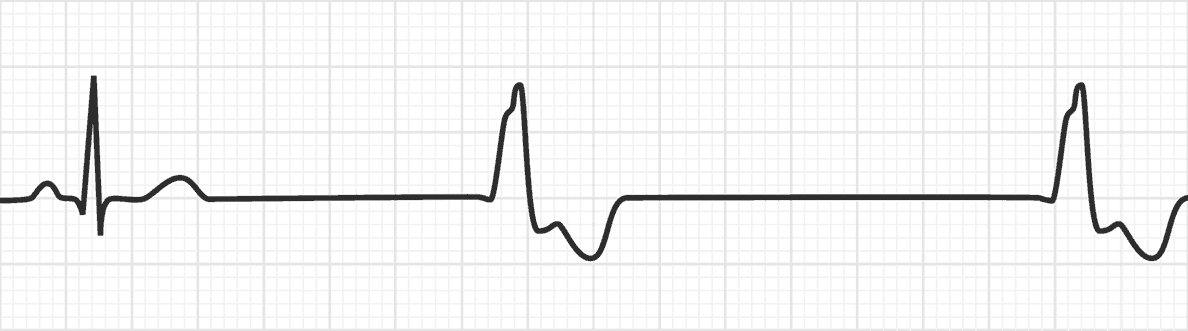
What rhythm is this?
Ventricular escape rhythm

What rhythm is this?
Idioventricular rhythm

What rhythm is this?
Accelerated idioventricular rhythm

What the rhythm is this?
Ventricular tachycardia

What the rhythm is this?
Torsade de pointes
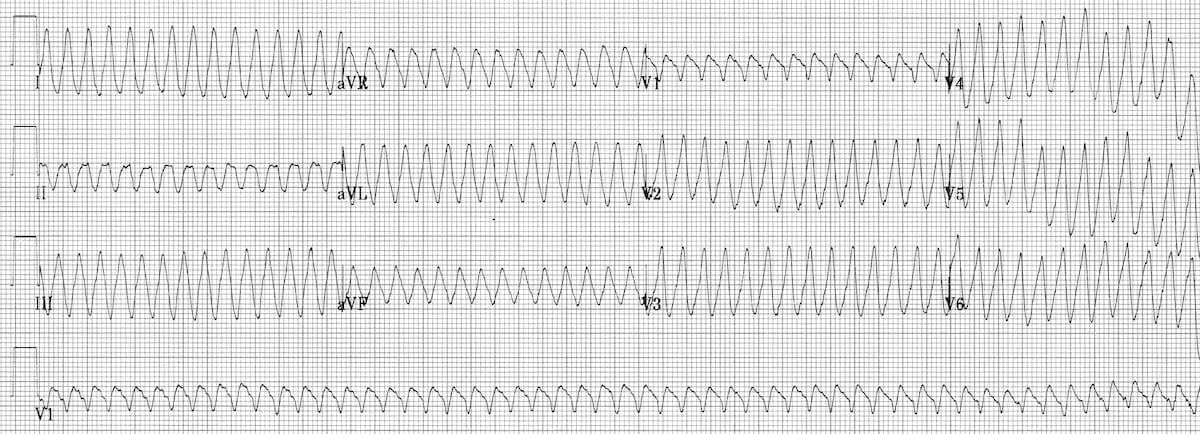
What rhythm is this?
Ventricular flutter

What rhythm is this?
Ventricular fibrillation

What rhythm is this?
First Heart Block degree

What rhythm is this?
Mobitz I Second Heart Block degree

What rhythm is this?
Mobitz II second heart block degree

What rhythm is this?
Third degree heart block
What is inpatient cardiac rehab? What does it focus one?
In hospital
1. Clinical assessment via chart review and individual interview.
2. Physical ambulation and mobilization,
3. Identification and education regarding modifiable risk factors and self care.
4. Discharge planning for transitional care and a home program for activities fo daily living.
5. Referral to outpatient CR.
What is outpatient cardiac rehab? What are the components?
In a clinic
1. Cardiovascular risk factor assessment and counseling on life-style management.
2. Education and support to reduce risk of secondary CV event.
3. Implementation of a safe & effective exercise plan.
4. Monitoring/improving, BP, lipids/cholesterols and diabetes mellites.
5. Psychological/stress assessment and counseling
6. Communication with physician/health care provider.
7. Return to appropriate vocational and recreational activities.
What are the indications of cardiac rehab?
· Medically stable post myocardial infarction (MI)
· Stable angina
· Coronary artery bypass graft surgery
· Percutaneous transluminal coronary angioplasty.
· Stable heart failure caused by either systolic or diastolic dysfunction.
· Heart transplantation
· Valvular heart disease/surgery
· Peripheral arterial disease
· At risk for coronary artery disease with diagnosis of diabetes mellitus, dyslipidemia, hypertension, of obesity.
· Individuals benefit from structured exercise based on physician referral.
What are the contraindications of cardiac rehab?
· Instable angina
· Uncontrolled hypertension
· Orthostatic SBP drop of >20 mm Hg with symptoms
· Significant aortic stenosis
· Uncontrolled atrial or ventricular arrythmias
· Uncontrolled sinus tachycardia
· Uncompensated heart failure
· Third-degree atrioventricular block without pacemaker.
· Active pericarditis or myocarditis
· Recent embolism
· Acute thrombophlebitis
· Acute dissection
· Acute systemic illness or fever
· Uncontrolled diabetes mellitus
· Severe orthopedic conditions that would prohibits exercise
· Other metabolic conditions
· Severe psychological disorder.
What the parameters for inpatient cardia rehab?
· No new or recurrent chest pain in previous 8 hours
· Stable or falling creatine kinase and troponin values.
· No indication of decompensated heart failure.
· Normal cardia rhythm and stable electrocardiogram.
What is chronic heart failure?
characterized exertional dyspnea and fatigue in the setting of heart failure with reduced ejection fraction or preserved left ventricular ejection fraction or both. Exercise training is recognized as a valuable adjunct.
What are signs and symptoms of heart failure?
All of the above
What is filling of the enlarged ventricles and the heart pumps little blood into the circulation?
systolic dysfunction
What is little blood flow into the stiff ventricle but too little blood is pumped out of the the barely-filled ventricle?
diastolic dysfunction
What medicine treat symptoms of heart failure but does not decrease mortality?
Digoxin
What helps decrease the conversion of angiotensin I to angiotensin II which can lead to dilation of the blood vessels and a lower blood pressure?
ACE I
What block the receptor site for epinephrine and norepinephrine in the sympathetic system?
Beta-blockers
What are used to increase the body’s excretion of fluids and can decrease the symptoms in heart failure patients?
Diuretics
What is Acute coronary syndrome?
Prolonged restricted coronary blood flow; causing myocardial ischemia.
What is the widow maker?
heart attack occurs when a blood clot or cholesterol plaque completely blocks the LAD artery
The most common cause of ACU is progressive?
myocardial maximal oxygen uptake difference
What can quickly relieve or prevent pain by widening the blood vessels?
Nitrates
What is peripheral artery disease?
caused by atherosclerotic lesions in the arteries of the lower extremities that restrict blood flow distally.
What are the typical symptom of PAD?
claudication
What tool is used to classify individual for PAD?
ankle brachial index
What is hypertension?
Consistently elevated blood pressure is a multifactorial disorder associated with several pathologies and increased mortality. Elevated blood pressure is 120-129 mmhg systolic and <80 mmhg diastolic.
What are the risk factor for hypertension?
aging, obesity, sedentary lifestyle, renal failure, insulin resistance, stress, genetics, and high-sodium diet.
What lower heart rate response to any given work load?
Beta-blockers
What can cause a drop in blood pressure?
All the above
FITT principle for hypertension: Aerobic
1. Frequency: 2 days a week
2. Intensity: moderate
3. Time: 20 mins
4. Type: swimming
FITT principle for coronary: Resistance
3 days a week
RIR of 3
2 sets
barbell back squats
FITT principle for coronary artery disease: Flexibility
3 days a week
stretch to the point of tightness
30 secs for 4 reps
static stretches
FITT principle at hypertension: Resistance
5 days a week
moderate
3 sets of 10 reps
Using dumbbells
FITT principle for coronary artery disease: aerobic
3 days a week
3 level of intensity
20 mins
cycling on a stationary
FITT principle for hypertension: Flexibility
3 days a week
stretching to point of feeling tightness
hold 10 sec
dynamic stretches