L14: Standing posture, Spinal loads, and Injury
 Call Kai
 Learn
 Practice Test
 Spaced Repetition
 Match
 Flashcards
 Knowt Play
1/27

There's no tags or description
Looks like no tags are added yet.
28 Terms
Mechanical definition of posture
Position of body segments
Is there a single posture?
No, because we have a multisegmented body
Most posture research has been related to…
Populations’ volitional (voluntary) standing position, which stems as a reference point/convention of other postures (standing vs. sitting)

What would be “good” posture
What is the ideal posture
“Good” posture is relative to the person’s morphology
The ideal posture is achieving vertical alignment of weight-bearing segments, as sticking minimizes the rotary effect of gravitational forces

What happens when a person has a “fatigue” posture
The greater the distance the spine is from the plumb line, the longer the resistance arm. Therefore, there is a greater bending rotational force of gravity.
What is the rotational force of gravity in ideal vs.. fatigue posture?
IP: no bending force forwards or backwards, only stacked downwards
FP: the “zig-zag” alignment of weight-bearing segments increases the rotary effect as gravity pulls down and bends
Fatigue posture is generally caused by….
The muscles are turned off, so they are not being used to maintain the integrity of body segments in line. So, ligaments take the load, preventing a collapse, but their plastic region is quickly reached.
What are the rotary forces in ideal posture (4)?
1) The spinal column is curved, so all the weight-bearing segments can’t be on top of the plumb line
2) Support base (feet) projects forward, shifting the center of mass forward
3) The spinal column is curved anteroposterior, so the load of the trunk is more anterior, shifting the CoM forward
4) Chest forms an anterior load
What is the anterior load of women?
Breasts are an additional anterior load. Therefore, on average, the rotation pull of gravity is higher than in males; So, women are more susceptible to kyphosis and back pain.
What are the neuromuscular mechanisms for maintaining erect posture.
Proprioceptive involvement, in addition to muscular, is necessary to maintain erect posture.
somatosensory: Pacinian corpuscles, muscle spindles, etc.
Visual: postural sway increases with eyes closed; helps us maintain upright posture
Labyrinthine system: important to know head’s orientation with respect to gravity for upright posture
What is minimal energy expenditure
Maintaining good posture with minimal muscular activity. However, metabolic economy is desirable to a point, and good posture should not be sacrificed for it. W
What are the factors related to standing posture?
Energy cost and age
Factors: Energy in fatigue posture
what is usually seen?
Low energy cost, as the person is not utilizing their muscles to hold their body segments up with respect to gravity
Head→ forward
Increased thoracic curve
Trunk → posterior lean
Hips → forward
Knees → hyperextended
Factors: Age
Babies
At first, babies have a flat back because the curves of the spine don’t evolve until they can stand upright against gravity independently (neurologically and physically)
Aging adults
As they fear instability, their muscles become weaker, and their bone density decreases (vertebral compression). They give in to the pull of gravity and lose their curves as they move into kyphosis
Posture Screening: Describe the ideal posture
In the ideal posture, the plumb line falls through the body’s center of mass
anterior to lateral malleolus
midline of knee joint center
slightly posterior to hip joint center
anterior to sacroiliac joint
slightly anterior to the acromion process
What is a good sitting posture?
Spine and head are erect, and the three natural spinal curves are maintained.
What is the normal thoracic curve? lumbar?
TC: 20-40°
LC: 60-70°
What is lordosis? How can it happen?
Exaggeration of the lumbar spine. It can happen naturally, but it could also be due to overtraining hyperextension of the lumbar spine
What is kyphosis? How can it happen?
Increases anterior curve. It can develop naturally, and is commonly seen in swimmers (overtraining) and elderly women (anterior load stress)
Scoliosis: How does it happen?
It tends to be congenital, but some people may develop it from training
One part of the musculature is pulling too much or there is a leg length discrepancy
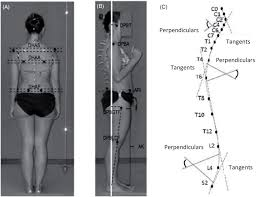
What is the desired frontal plane alignment?
Right-left symmetry
Head and vertebral column are aligned vertically
Shoulders, pelvis, hips, and knees are at the same height
Knee in slight valgus (take weight bearing)
Feet in subtalar neutral
Scoliosis regions
Usually in at least 2 spinal regions
right thoracic and left lumbar, with a rib hump on the right side

Scoliosis- how may it be seen
It is easier to see scoliosis when they bend over; the ruler placed on their back will not be straight
Total body CoM is slightly anterior to the spinal column, therefore there is always…
There always is a bending movement of gravity that needs to be counteracted by a posterior torque of the erector spinae/extensor muscles.
this causes compression forces to go down
What is the torque at L5-S1
Trunk extensor muscles have a small moment arm. So, the muscles need to generate large forces to generate enough torque to counteract the weight of body segments and any external load.
makes these muscles very susceptible to injury because they are under a lot of stress, generating large forces to move a relatively small load.
Compression force on lumbar spine
→ Standing in best posture
→ Laying down
→ Sitting down with best posture
→ Standing in fatigue posture
→ Slouch sitting posture
100% marker of load
Load decreases by 25%
Load increases to 140%
Load increases to 150%
Load increases to 180%
How does standing and sitting well help with overall spine health?
Decreases the force the erector spinae muscles are under, decreasing the amount of force they need to generate
Discs stay healthy as they are not getting abnormal friction forces
Not getting arthritis in the column and lower extremities
Helps ligaments stay within their elastic region
What is the flexion relaxation phenomenon?
When the spine is in full flexion, spinal extensors completely relax, and the torque generated by gravity is supported by ligaments.
From full flexion intrinsic muscles and the recoil of ligaments are used to lift you up