BIO001 Midterm 2 Review
 Call Kai
 Learn
 Practice Test
 Spaced Repetition
 Match
 Flashcards
 Knowt Play
1/124

There's no tags or description
Looks like no tags are added yet.
125 Terms
At what scale do humans beings differ in their genetic makeup?
Alleles
Synonymous Mutations
Mutations with no change to the amino acid which results in no phenotypic changes
Non-Synonymous Mutations
Mutations with change to the amino acid which results in phenotypic changes.
Each of your cells has the same information on how to make proteins. How do they end up looking so different?
Different genes are turned on/off at different times.
Lactase persistence is a result of a _________ in the regulatory region of the lactase gene.
Mutation
Any single human has (at most) _______ of any gene but at the population level, humans have ________ genes.
2 alleles; many
What is the order from allele to phenotype?
Allele → Genotype → Protein → phenotype
What type of base pair mutations has the largest phenotypic effect?
Any type of frameshift mutations (Insertion or deletion)
Between frameshift, non-synonymous, and synonymous, place them in the order of smallest to largest phenotypic effect.
Synonymous, non-synonymous, frameshift
Do you expect base pair or chromosomal mutations to have larger phenotypic effects?
Chromosomal mutations because it can affect many genes at once while base pair mutations only affect one gene at a time.
Diploid
2 copies of every chromosome
Haploid
1 copy of every chromosome
Allele
a particular variant of a gene (within a population there may be many alleles for a gene)
Genotype
an individual’s partuclar alleles at a specfiic locus
Phenotype
an individual’s observable trait
locu/loci
location of a gene
homozygous
2 of the same alleles at a given locus
heterozygous
2 different alleles at a given locus
Mendel’s First Law
Also known as the law of segregation — when any individual produces gametes, the two copies of a gene separate so that each gamete receives only one copy. (Ex: Parent (AA) → Gamete (A), Parent (Aa) → Gamete (A or a), Parent (aa) → Gamete)
gamete
reproductive cell (sperm or eggs) — haploids
Simple/complete dominance
a single dominant allele produces the dominant phenotype. The homozygous dominant and heterozygous genotypes have the same phenotype. (PP = Pp)
Incomplete dominance
the heterozygous phenotype is intermediate between the two homozygous phenotypes. (“blending”)
Codominant
the heterozygous phenotype is both of the homozygous phenotypes expressed simultaneously; this is rare at large scales but very common at molecular scales.
Mendel’s second law
Also known as Law of Independent Assortment. This law states that alleles of different genes assort independently of one another during gamete formation. (Ex: AaBb → AB, Ab, aB, ab)
What are the typical patterns for a dihybrid cross?
4 phenotypes, 9:3:3:1 ratio, 9 genotypes
What is the criteria for Law of Independent Assortment to occur?
If and only if the two genes are on different chromosomes
Linkage
When genes are located on the same chromosomes
If two genes are close on the same chromosome such as allele A with allele B and allele a with allele b, then only _________ are produced.
AB and ab
Alleles on the same chromosome TEND to be inherited together but can be separated through _________.
Recombination
Recombination
When chromosomes exchange genetic material

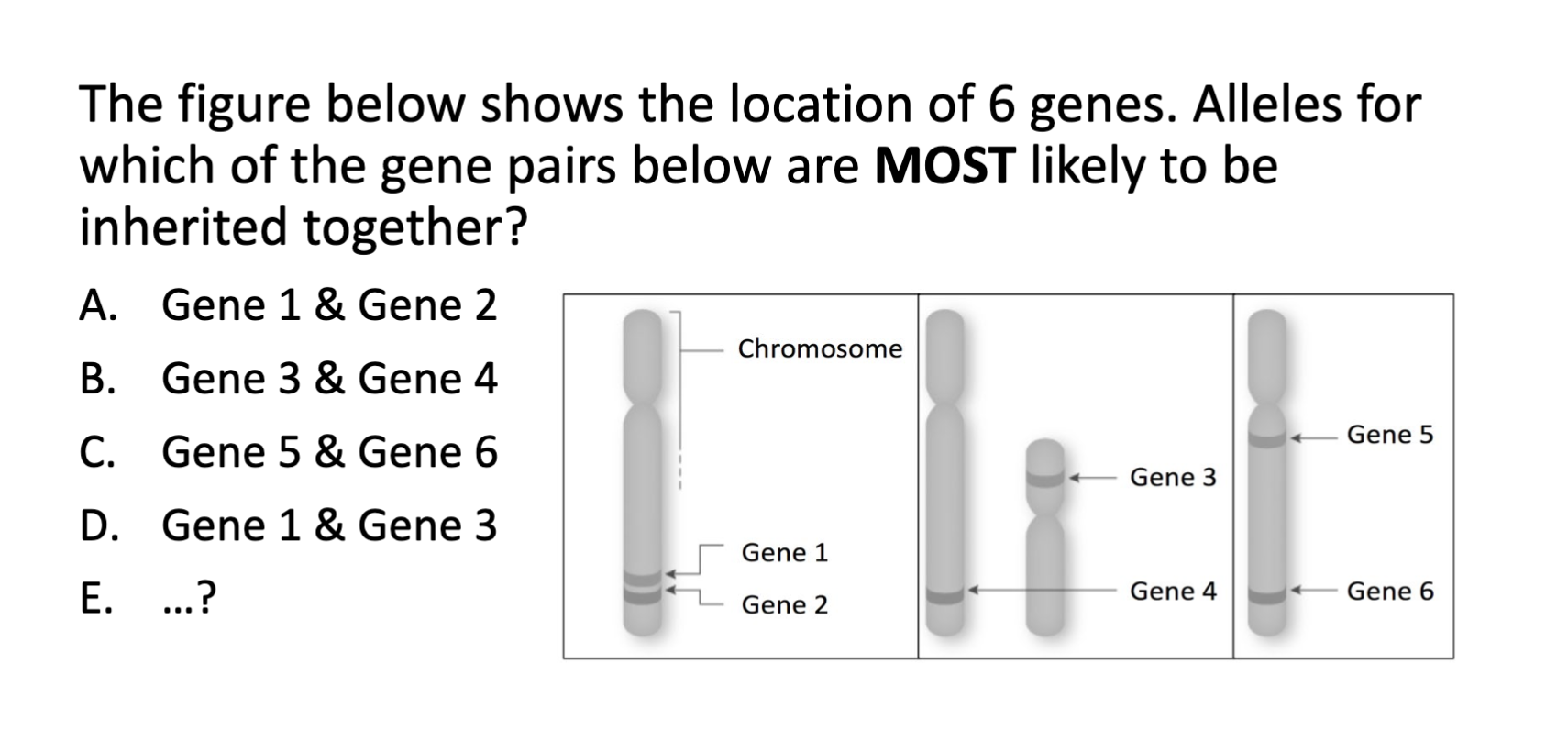
Which of the gene pairs are MOST likely to be inherited together?
Gene 1 & Gene 2
Pleiotropy
a single gene that influences many traits (Ex: Gene → trait 1, trait 2, trait 3)
Epistatis
a genetic phenomenon where the effect of one gene (the epistatic gene) masks, suppresses, or modifies the physical expression (phenotype) of another, separate gene (the hypostatic gene)
Why can’t fathers pass on X-linked genes to their son?
Because they have to pass on their Y genes to make their offsprings a male.
Most phenotypes are not discrete but rather show __________.
Continuous variation
Additive inheritance
a type of polygenic inheritance; many genes contribute to a phenotype, often these effects are additive whereby each allele can contribute to the phenotype. (Ex: A or B add 1 unit of color, a or b does not add color).
Traits with continuous variation typically have __________ inheritance. When graphed, the __________ of these traits follows a _________ curve.
polygenic; phenotypic distribution; normally distributed curve
Can individuals evolve?
No, only populations evolve.
Natural selection ____ on individuals by determining _________.
acts; who survives and who doesn’t, who reproduces (how much) and who doesn’t
How do populations evolve?
Through changes in allele frequency and changes in mean and variance of traits.
Evolution
Change in the heritable properties of populations over the course of generations.
What are some evolutionary processes?
Mutation drifts, migration, non-random mating, natural selection
Genotypic frequency
the proportion of individuals with a genotype in the population
Allele frequency
the proportion of an allele across all individuals or potential gametes in the population.
What is transmitted from parents to offspring? Genotypes or alleles?
Alleles because only one copy is being passed.
What are the assumptions of Hardy-Weinberg Equilibrium?
No mutations
No Natural Selection
No gene flow (no migration)
No genetic drift (which requires an infinitely large population size)
Random mating
Hardy-Weinberg Equilibrium
A non-evolving population where genotype and allele frequencies reach equilibrium after one generation and remain constant at specific values/frequencies in subsequent generations
How is Hardy-Weinberg Equilibrium a null hypothesis?
By providing a baseline model of what happens when a population is not evolving to compare real populations to and individual genes are affected by these factors differently.
Gene flow (migration)
Transfer of alleles through movement of fertile individuals or their gametes.
Immigration
movement into a population
Emigration
movement out of a population
Gene flow can change ___________.
genotype frequencies
What happens when there is HWE happening and what is the result of it?
Random mating, no migration, no genetic drift, no mutation, no natural selection, and allele frequencies do not change.
What happens when there is a mutation and what is the result of it?
A red allele becomes an orange allele and so a new genetic variant appears in the population.
What happens when there is gene flow (migration) and what is the result of it?
Individuals with a new allele enter the population and new alleles are rare as homozygotes at first, but then might become more common over time.
Drift
changes in allele frequency due to sampling error
In small population: A2 allele is very rare, after a single generation, it could be lost entirely
In large population: A2 allele is rare, but with enough individuals carrying even one A2, the allele persists in future generations.
What are the chances of alleles losing in small populations?
Alleles are easier to lose in small populations. Many would be lost (frequency = 0) and others would be fixed (frequency = 1)
What size of populations are more susceptible to drift or lose genetic diversity?
Small
Drift is ______ in small populations and ________ in large populations.
strongest; weakest
What happens when there is genetic drift and what is the result of it?
Imperfect sampling causes some alleles to be underrepresented relative to others and so lower frequency alleles (ex: purple) would be lost.
Founder effect
a new population is created by only a few individuals from the initiated population. Alleles that are common in the founder population will likely grow in frequency over time.
Genetic Bottlenecks
When a population size is drastically reduced which results in a major loss of genetic diversity
Consequences of Drifts
Lost of diversity through time (lost alleles)
Increases in deleterious recessive conditions (alleles may reach nearly 100% frequency by chances even if they have low fitness.
Increased susceptibility to futures stressors
Doesn’t affect genotypic frequency deviations from HWE in a predictable way, though it will causes allele frequencies to change randomly through generations.
What does Hardy-Weinberg Equilibrium state?
Genotype frequencies are a purely probabilistic outcome of the available alleles.
Positive assortative mating
When individuals prefer to mate with similar individuals. When based on genetic relatedness, this is call “Inbreeding.”
Disassortative mating (Negative assortative mating)
When individuals prefer to mate with dissimilar individuals. When based on genetic relatedness, this is call “outbreeding.”
If each individual self-fertilizes, what happens to the frequency of heterozygotes?
It divides by half through each generation until it reaches 0. In other words, inbreeding results in a much lower frequency of heterozygotes than you expect.
If you start out with allele frequencies being p = 0.5 and q = 0.5 under HWE, what would be the allele frequencies after inbreeding (non-random mating)?
Also p = 0.5 and q = 0.5; the alleles frequencies don’t change, it’s genotypic frequencies that are changing.
Inbreeding depression
When inbreeding exposes an individual to deleterious recessive alleles. Some important consequences include:
Human genetic diseases
Conserving small populations of rare species
Other than inbreeding (non-random mating), what else can also cause high frequencies of deleterious alleles in small populations?
Genetic drift
If each individual mates with dissimilar individual, what happens to the frequency of heterozygotes?
The frequency of heterozygotes will increase compared to HWE.
What does natural selection acts on and how does this affect the frequency of alleles?
Natural selection acts on phenotypes and so when the beneficial allele is recessive, its effects can be hidden by other alleles causing it to increase slower in terms of allele frequency whereas when the beneficial allele is dominant, its effect can be seen easier causing it to increase faster in terms of allele frequency.
What happens when there is natural selection and what is the result of it?
Environmental factors are unfavorable for a certain allele (ex: red) so as a result, red alleles become less common and the other two allele (ex: green and purple) become more common.
What is it called when an interaction has a negative effect on both species A and species B?
Competition (everybody loses)
What is it called when an interaction has no effect on neither species A or species B?
Neutral
What is it called when an interaction has no effect on one species and negatively affects another species?
Amensalism
What is it called when an interaction has a positive effect on Species A and a negative effect on Species B or vice versa?
Exploitation
What is it called when an interaction has a positive effect on one species and a no effect on another species?
Commensalism
What is it called when an interaction has a positive effect on both species involved?
Mutualism (everybody wins)
Obligate
required
Facultative
optional
Facilitation
One or both species benefits, and neither is harmed (Commensalism and mutualism)
Symbiosis
an interaction between two species living in close associations with each other