Movement Science Biomechanics Unit
 Call Kai
 Learn
 Practice Test
 Spaced Repetition
 Match
 Flashcards
 Knowt Play
1/26

There's no tags or description
Looks like no tags are added yet.
27 Terms
What is deformation?
Change in body configuration in response to imposition of stress
What is strain?
Strain is a “normalized” measure of deformation
Strain = Deformation/Original length
What is the toe region in the stress-strain relationship?
Region where not much stress/force can cause deformation
Elastic region
Linear region; doesn’t matter which point to quantify stiffness
As soon as stress is relieved, shape returns back to normal (minimal damage)
Nonelastic (Plastic) region
Will not return to original shape
Yield point
Point of change from linear → plastic
Optimal Strength
The highest stress/force that can be handled
Failure/Fracture Point
End of test; tissue fails/fractures
Elastic (Young’s) Modulus
A measure of the stiffness of an elastic material
Elastic Modulus = ΔStress/ΔStrain = (Force/Area)/Ratio of original length
Measured in Pascals (Pa = N/m2)
Stiffness
Slope of the curve
Ductile material
Plastic range energy absorption
Long plastic region (takes more to break)

Brittle material
Short plastic region (takes less to break)

Viscosity
The property of fluids regarding the resistance to flow
Elasticity
The property of a solid object to return to its original shape after being unloaded
Viscoelasticity in human tissues
Collagen + Elastin
Ground substance (largely water)
Time Dependent Material Properties
1) Loading rate
2) Hysteresis
3) Creep
4) Stress relaxation
1) Property depends on loading rate
Change how fast you apply a stress
Faster = more stiff and more brittle
Ex: Haliburton achilles rupture

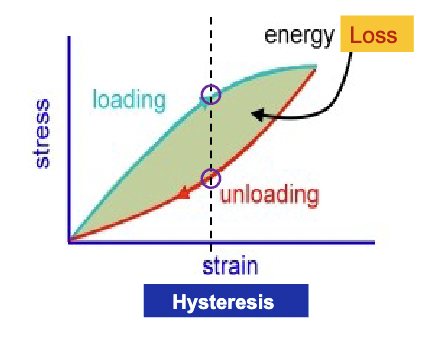
2) Hysteresis
Energy loss during a loading cycle
Some of the loaded energy gets lost to friction and heat
Ex: a squishy returning back to original shape after being stretched (very slow)
3) Creep
Force stays the same, time changes (deformation increases with time)
Ex: stretching a hamstring
Slowly stretch to max length (creep) → hold → tissue will continue to stress or deform

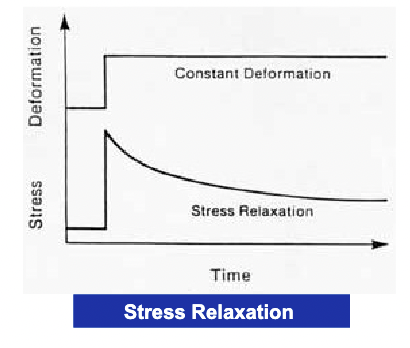
4) Stress relaxation
Constant deformation → stress will DECREASE over time
Ex: Serial casting for kids w/ cerebral palsy
Anisotropic Behavior
Material properties depend on loading direction
Bone is good for compression and tension, but not shear

Effects of Stress

Types of Bone Fractures

Collagen Fibril Matrix
Anisotropic: depends on loading direction
Strong in tension
Little resistance to compression

Tendons
Attach muscle to bone
Transmit muscle tensile forces to bone
Contribute to or restrain joint motion
Typical Tendon Load Elongation Curve
1 = Toe
2 = Linear
3 = End of linear region, failure occurring (yield point)
4 = Maximum load followed by complete failure (failure point)
