24. Bacteria and Synthetic Biology
 Call Kai
 Learn
 Practice Test
 Spaced Repetition
 Match
 Flashcards
 Knowt Play
1/124

There's no tags or description
Looks like no tags are added yet.
125 Terms
define synthetic biology
the design and construction of new biological parts, devices and systems, or the re design of existing biological systems for useful purposes
key idea for synthetic biology
Synthetic biology treats living cells as engineerable systems, combining biology and engineering principles to control cellular behaviour.
applications of synthetic biology in energy
hydrogen fuel production
artificial photosynthesis
applications of synthetic biology in medicine
drug manufacture
vaccine production
diagnostic agents
tissue engineering
application of synthetic biology in environment
pollutant detection
pollutant degradation and removal
application of synthetic biology in the chemical industry
Bulk chemical production
Fine chemical production
Alternative synthetic fibres
application of synthetic biology in agriculture
novel food additives
development of synthetic biology: 3 stages
foundational period
intermediate period
modern engineering biology
what was found in the foundational period in the development of synthetic biology
discovery of regulatory circuits - 1960s
DNA manipulation technologies developed (1970s-1980s)
regulatory circuits?
A network of interacting genes, proteins, and regulatory molecules that controls gene expression. Common circuit types include negative feedback loops, positive feedback loops, feed-forward loops, toggle switches, and oscillators.
what was the intermediate period in the development of synthetic biology
Genome and proteome sequencing available
Construction of designed genetic circuits
what was the modern engineering biology development of synthetic biology
Cheap DNA synthesis
Genome editing technologies
Biological network engineering
why is gene regulation important in synthetic biology
Synthetic biology relies on understanding how cells control gene expression so that regulatory systems can be engineered to perform desired functions
what is the lac operon
a bacterial gene regulation system that controls expression of genes involved in lactose metabolism and acts as a biological switch
what does the lacI gene encode
the lac repressor protein
function of the lac repressor
it binds to the operator region and blocks transcription of the lac operon genes
what molecule acts as the inducer in the lac operon
allolactose
what happens when allolactose binds the lac repressor
the repressor undergoes a conformational change and dissociates from the operator
what happens after the lac repressor leaves the operator
RNA polymerase can bind and transcribe the lac genes
how does the lac operon function as biological switch
gene expression if OFF when the repressor is bound to the operator and ON when allolactose causes the repressor to dissociate
why is the lac operon important in synthetic biology
it provides a well-characterised, inducible regulatory system that can be engineered to control expression of synthetic genes
which scientists discovered the principles underlying the lac operon
Jacques Monod and Francois Jacob
describe how the lac operon is regulated
The lacI gene produces the Lac repressor, which binds the operator and prevents transcription.
When allolactose is present, it binds the repressor, causing a conformational change that releases it from the operator.
RNA polymerase can then transcribe the lac genes.
This inducible system acts as a biological switch and forms the basis of many synthetic regulatory circuits.
one of the first major successes of synthetic biology
recombinant human insulin production
what is recombinant human insulin production
the process of using genetically engineered microorganisms (usually bacteria or yeast) to produce human insulin
why is it called recombinant insulin
The DNA is recombined from different sources:
Human insulin gene
Bacterial or yeast plasmid
This creates recombinant DNA, hence the term recombinant human insulin.
recombinant human insulin production method
Human insulin gene inserted into plasmid
Plasmid transformed into E. coli
Bacteria produce insulin/proinsulin
Insulin purified for medical use
advantages of E.Coli in recombinant human insulin production
Fast growth
High yields
Easy purification
Safer than extracting from animal tissue
limitations of using E.Coli in recombinant human insulin production
No eukaryotic post-translational modifications
Possible endotoxin contamination requiring purification
what is the pathway engineering for drug production
Pathway engineering is the transfer and optimisation of an entire metabolic pathway, rather than a single gene, in a microorganism so that it can produce a desired drug or valuable compound.
This allows engineered microbes to act as biological factories for complex molecules.
how does pathway engineering differ from recombinant protein production
Recombinant protein production usually involves expressing a single gene to produce one protein (e.g., insulin), whereas pathway engineering introduces multiple genes encoding an entire metabolic pathway to synthesise a complex product.
why is pathway engineering important in synthetic biology
it enables microbes to produce pharmaceuticals, biofuels, and other valuable chemicals that would otherwise be difficult or expensive to obtain
what is the goal of pathway engineering
to redesign cellular metabolism so that resources are directed towards efficient production of a desired compound
define pathway engineering for drug production
Pathway engineering involves transferring and optimising entire metabolic pathways in microorganisms so they can produce complex drug molecules.
Unlike recombinant protein production, which typically involves a single gene, pathway engineering uses multiple genes working together to create a desired product.
what is artemisinin
an important anti-malarial drug used to treat infections caused by malaria parasites
natural source of artemisinin
artemisinin is naturally produced by Artemisia annua (sweet wormwood).
Which plant produces artemisinin naturally?
Artemisia annua (sweet wormwood).
what synthetic biology strategy was used to improve artemisinin production
genes from the mevalonate pathway were engineered into E.Coli to increase production of artemisinin precursors
Why was the mevalonate pathway engineered into E. coli?
To increase the production of precursor molecules needed for artemisinin biosynthesis
What is a major advantage of producing artemisinin precursors in engineered E. coli?
Higher yields compared with relying solely on natural plant production.
how does synthetic biology reduce dependence on Artemisia annua?
engineered microbes can produce artemisinin precursors without requiring large-scale cultivation of the plant
how does synthetic biology improve the artemisinin supply chain
it provides a more reliable and consistent source of artemisinin precursors
why is artemisinin production an example of pathway engineering
multiple genes from an entire metabolic pathway were introduced into E.Coli to increase production of a useful pharmaceutical compound
Explain how synthetic biology has improved artemisinin production.
Artemisinin is an anti-malarial drug naturally produced by Artemisia annua (sweet wormwood).
Synthetic biologists engineered genes from the mevalonate pathway into E. coli, increasing production of artemisinin precursors.
This results in higher yields, reduced dependence on plant growth, and a more reliable supply chain.
benefits of synthetic biology approach in artemisinin production
higher yields
less dependence of plant growth
more reliable supply chain
what is daptomycin
Daptomycin is a clinically important antibiotic that is active against MRSA (methicillin-resistant Staphylococcus aureus)
what key property of biosynthetic pathways is exploited in daptomycin engineering
Biosynthetic pathways are modular, meaning their components can be rearranged, exchanged, or combined
modular biosynthetic pathway meaning
Biosynthetic pathways are modular, meaning their components can be rearranged, exchanged, or combined
what can scientists do with modular biosynthetic pathways
rearrange modules, swap modules, and combine pathways to create new products
what is meant by rearranging modules in a biosynthetic pathway
changing the order of pathway components to alter the final product produced
what is the purpose of swapping modules between pathways
to generate new molecules with altered structures and potentially improves properties
what can result from combining different biosynthetic pathways
novel natural products and new drug analogues can be produced
what are drug analogues
compounds that are structurally similar to an existing drug but have modified properties
how can pathway engineering improve antibiotics
it can generate novel antibiotic variants that may have enhanced activity or overcome resistance
what is one major pharmaceutical advantage of pathway engineering
increased production of valuable pharmaceutical compounds
how does pathway engineering contribute to drug discovery
it enables the creation of entirely new compounds not found in nature
why is simultaneous expression of multiple genes important in pathway engineering
complex biosynthetic pathways often require many enzymes that must be expressed together to produce the desired product
how can pathway engineering lead to the discovery of new chemistry
combining and modifying biosynthetic pathways can generate novel biochemical reactions and previously unknown molecules
Describe how daptomycin engineering demonstrates the advantages of pathway engineering.
Daptomycin engineering exploits the modular nature of biosynthetic pathways.
Scientists can rearrange, swap, and combine pathway modules to create new drug analogues, novel natural products, and potentially improved antibiotics.
This demonstrates key advantages of pathway engineering, including increased pharmaceutical production, simultaneous expression of multiple genes, creation of new compounds, and discovery of new chemistry
what are synthetic genetic circuits
synthetic genetic circuits are engineered gene networks that behave similarly to electronic circuits, allowing programmed control of gene expression
what is the repressilator
The repressilator is a synthetic genetic circuit consisting of three repressors that inhibit one another in a loop, producing oscillating gene expression
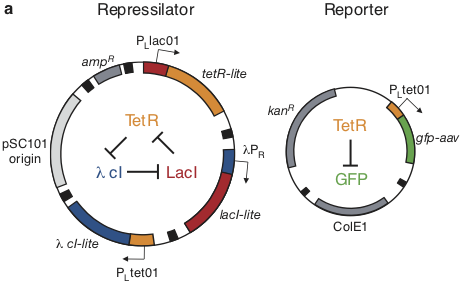
which three repressors make up the repressilator
Tet repressor, Lac repressor, and CI repressor.
how are the repressors arranged in the repressilator
each repressor inhibits the expression of the next repressor in a continuous loop
what type of gene expression pattern does the repressilator generate
oscillating gene expression
what is meant by oscillating gene expression
gene expression levels rise and fall repeatedly over time, producing regular cycles of activity
what is a key outcome of the repressilator circuit
regular pulses of protein production
why is the repressilator considered analogous to an electronic circuit
it uses interacting regulatory components to generate a predictable dynamic output, similar to an electronic oscillator
how can synthetic genetic circuits be used for timed gene expression
they can control when genes are switched on and off, allowing protein production at specific times
how can synthetic genetic circuits function as biological sensors
they can detect environmental signals and produce a measurable response such as fluorescence or protein production
how can synthetic genetic circuits contribute to pattern formation
oscillating and regulated gene expression can generate organised spatial or temporal biological patterns
describe the repressilator and its applications
The repressilator is a synthetic genetic circuit composed of three repressors (Tet, Lac, and CI) that inhibit one another in a loop, creating oscillating gene expression and regular pulses of protein production. Applications include timed gene expression, biological sensing, and pattern formation

shows the Tet, Lac, and CI repressors arranged in a regulatory loop that generates periodic pulses of gene expression
define quorum sensing
bacterial communication through secreted signalling molecules
how do bacteria communicate during quorum sensing
bacteria release signalling molecules into their environment, which can be detected by other bacteria
what happens to signalling molecules as bacterial population density increases
the concentration of signalling molecules accumulates in the environment
what is meant by the detection threshold in quorum sensing
it is the concentration of signalling molecules required to trigger a cellular response
what happens when the quorum-sensing threshold is reached
Bacteria alter gene expression in a coordinated manner across the population
describe the steps of quorum sensing
Bacteria secrete signalling molecules.
As the population grows, signalling molecules accumulate.
A threshold concentration is reached.
The signal is detected by bacteria.
Coordinated gene expression occurs across the population
explain how quorum sensing regulated bacterial gene expression
Quorum sensing is bacterial communication through secreted signalling molecules.
As bacterial population density increases, these molecules accumulate in the environment.
When a threshold concentration is reached, the signal is detected and triggers coordinated gene expression across the bacterial population, allowing collective behaviours to occur.
where does Vibrio fischeri live
in the hawaiian bobtail squid
what is vibrio Fischeri
Vibrio fischeri is a bioluminescent bacterium that lives symbiotically in the Hawaiian bobtail squid (Euprymna scolopes)
What type of communication does Vibrio fischeri use to regulate light production?
quorum sensing
What is the first step in quorum sensing by Vibrio fischeri?
The bacteria produce and release signalling molecules into their environment
What happens as the population density of Vibrio fischeri increases?
Signalling molecules accumulate and their concentration rises.
what happens when the signalling molecule concentration reaches a threshold
Quorum sensing activates coordinated gene expression, including genes involved in bioluminescence
What phenotype is activated in Vibrio fischeri at high cell density?
Bioluminescence (light production)
Why is bioluminescence only activated at high bacterial density?
Sufficient signalling molecules must accumulate to trigger quorum sensing and coordinated gene expression
How does the Hawaiian bobtail squid benefit from Vibrio fischeri?
The bacterial bioluminescence helps camouflage the squid by matching moonlight and reducing its silhouette
How does Vibrio fischeri benefit from the squid?
The squid provides a protected habitat and nutrients for bacterial growth
Describe quorum sensing in Vibrio fischeri.
Vibrio fischeri cells produce signalling molecules.
As bacterial density increases, the signals accumulate.
A threshold concentration is reached.
Quorum sensing activates coordinated gene expression.
Bioluminescence is switched on
Explain how quorum sensing controls bioluminescence in Vibrio fischeri.
Vibrio fischeri lives in the Hawaiian bobtail squid and produces signalling molecules.
As bacterial density increases, these signals accumulate.
When a threshold concentration is reached, quorum sensing activates coordinated gene expression and bioluminescence.
This symbiotic relationship benefits both the bacterium and the host squid
what is engineering quorum sensing
the use of bacterial quorum-sensing systems in synthetic biology to create controlled communication and coordinated behaviours between cells
why are quorum-sensing systems useful in synthetic biology
they allow engineered cells to communicate and coordinate gene expression across a population
what are the main applications of engineered quorum sensing
cell-to-cell communication, biosensors, pathogen detection, and coordinated behaviour of bacterial populations
which quorum-sensing systems are commonly exploited in synthetic biology
the Lux system and the Las system
how can engineered quorum sensing enable coordinated behaviour
cells respond collectively to signalling molecules, allowing synchronised gene expression across a population
describe how quorum sensing can be engineered for synthetic biology
Synthetic biologists repurpose quorum-sensing systems such as Lux and Las to enable cell-to-cell communication, biosensing, pathogen detection, and coordinated behaviour in bacterial populations.
How can engineered quorum-sensing systems detect Pseudomonas aeruginosa?
They detect quorum-sensing molecules produced by P. aeruginosa and generate a measurable response.
what samples can be used to detect P. aeruginosa with quorum-sensing biosensors?
sputum samples
sputum sample
collection of thick mucus (phlegm) coughed up from deep inside the lungs and airways to test for bacterial, fungal, or mycobacterial infections like pneumonia or tuberculosis
What are the clinical applications of P. aeruginosa biosensors?
Sputum testing, infection diagnosis, and rapid biosensingw