ORGO MECHY trends
 Call Kai
 Learn
Learn Practice Test
 Spaced Repetition
 Match
Match Flashcards
 Knowt Play
1/5

There's no tags or description
Looks like no tags are added yet.
Name | Mastery | Learn | Test | Matching | Spaced | Call with Kai | Chat |
|---|
No analytics yet
Send a link to your students to track their progress
6 Terms
SN1
carbocation rearrangement
Relies of leaving group ability to carry out reaction (Rate=k[elec])
better LG, faster reaction
only tertiary and secondary substitution can occur, with tertiary as most stable
primary can only occur if resonance stability of carbocation is possible
needs POOR nucleophiles and WEAK bases
best when reacted under polar protic solvents
stabilizes carbocations and increases rate
better in room temp
SN2
Influenced by LG ability but does not rely on it
reaction can still occur with a strong base, but its not as fast
the less substituted the alpha carbon, the more preference for an SN2 reaction
methyl, primary, secondary can occur
tertiary cannot occur because a tertiary carbon has too many groups around it
occurs fastest with methyl and slowest with secondary
for primary and methyl, prefer GOOD nucleophile
for secondary, needs a GOOD nucleophile and a GOOD base
faster in polar aprotic solvents
Better in room temp
E1
Relies on LG ability (Rate=k[substrate])
only tertiary and secondary can occur
primary can occur if carbocation can participate in resonance
methyl cannot occur
needs POOR nucleophiles and POOR bases
best under polar protic conditions
Better in High temp
E2
is influenced by LG ability but does not rely on it (rate=k[base][substrate]); is bimolecular
Primary, Secondary, and Tertiary can all occur (cannot occur with methyl)
primary is preferred with STRONG, BULKY bases
secondary and tertiary are preferred with STRONG, REGULAR bases
Needs GOOD nucleophile
prefers polar aprotic solvents
Better in High temp
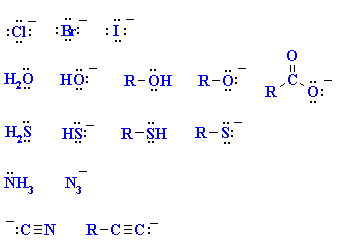
Good nucleophiles
typically have a negative charge or are attached to a metal
nucleophilicity follows basicity trends
the more basic the anion, the stronger the nucleophile
different with protic/aprotic solvents
the trend for nucleophilicity is F−>Cl−>Br−>I− in aprotic solvent, but in protic solvent, it is I−>Br−>Cl−>F− (F− is now larger than others in size because it is solvated.)
good leaving groups
weak bases that can accept electrons
-as electronegativity increases, basicity increases
which is why F- is a terrible leaving group but I- is a good one