Lecture 18: Male infertility
 Call Kai
 Learn
Learn Practice Test
 Spaced Repetition
 Match
Match Flashcards
 Knowt Play
1/47

There's no tags or description
Looks like no tags are added yet.
Name | Mastery | Learn | Test | Matching | Spaced | Call with Kai | Chat |
|---|
No analytics yet
Send a link to your students to track their progress
48 Terms
- testes should be in the scrotum by 10 days postpartum
- both testes should be descended by 16 weeks of age
What is the timeline of testicular descent like?
- testicle does not descend
- consider this after 6 months of age
- hereditary issue
What is cryptorchidism?
- administer human chorionic gonadotropin (hCG)
- get a baseline testosterone, 4 hours and 8 hours after
- should be more than double baseline testosterone if testes are present
How do you diagnose bilateral cryptorchidism?
- test testosterone
- anti-mullerian hormones test = single test (can be inconclusive sometimes)
- administer human chorionic gonadotropin (hCG) and test testosterone --> double baseline = bilaterally cryptorchid
How do you diagnose cryptorchidism?
- a rare extremely painful condition that can occur in any breed of dog
- need to pay attention to orientation of testicle
What is testicular torsion?
- bilateral orchidectomy
What is the treatment for testicular torsion?

- testicular tumors
What is the most common tumor after skin tumors in male dogs?
- Sertoli tumors = MOST COMMON
- seminoma tumor
- Leydig tumor
What are the types of testicular tumors in dogs?
- paraneoplastic syndrome (hormonal effect)
- enlargement of 1 testi and atrophy of the opposite testis
- bilateral in 45% of cases
- hyperestrogenism
How can sertoli tumors present?
- pancytopenia, anemia and bone marrow hypoplasia
- bilateral symmetrical alopecia
- comedones and hyperpigmentation of the inguinal area
- dry skin
- gynecomastia
- prostatic cysts
- pendulous prepuce and testicular atrophy
What can be seen with hyperestrogenism, caused by sertoli cell tumors?
- paraneoplastic syndrome (hormonal effect)
How can leydig tumors present?
- lack of pain on palpation
- ultrasound
- biopsy
How do you differentiate testicular tumors from Brucellosis?
- increases incidence by 13.6 times for all tumors
- increased by 23 times for Sertoli cell tumors
What are tumors in the retained testis/cryptorchidism like?
- a condition in which there are no sperm present in the ejaculate
What is azoospermia?
- retrograde ejactulation (into bladder)
- incomplete ejaculation
- bilateral cryptorchidism
- testicular injury (trauma, heat, orchitis)
- spermatogenic arrest
- testicular neoplasia
What are the 6 causes of azoospermia?
(not the entire list just come to remember if she asks)
- 200
There needs to be ______ million progressively motile spermatozoa to insure good conception rates
- transmissible venereal tumors
What is the most common penile tumor?
- penis, prepuce, vagina, mucous membranes
Where are transmissible venereal tumors seen?
- contact with mucous membranes (mouth, genitals, etc)
How are transmissible venereal tumor transmitted?
- squamous cell carcinoma
- Histiocytoma on cytology (round cells)
What is a common differential diagnosis for transmissible venereal tumor?

- round cells with more cytoplasms than lymphome
- can look like many round cell tumors --> histiocytoma
- LOCATION LOCATION LOCATION
Why is TVT hard to diagnose?
- Vincristine
How do you treat transmissible venereal tumors?
- idiopathic or sexual arousal induced
- genetic predilection in English Bulldogs
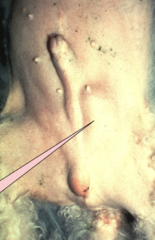
- pathognomonic "red pea" appearance at tip of penis
What is a urethral prolapse?
- urethral prolapse
What is wrong with this bulldog penis?

- surgical removal of prolapsed tissue --> urethropexy
How do you treat a urethral prolapse?

- unnatural penile tumescence that is rare
- looks like an erection that won't go away
- get neuro exam since could be neuro or back issue
What is a priapism? what should you do next?
- neurologic exam since can be neurologically caused
- look at back issues as well
What type of exam should you do on a dog with a priapism?
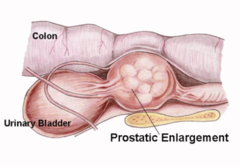
- benign prostatic hyperplasia (BPH)
What is the most common diagnosed prostatic disease in dogs?
- older, intact male dogs (8 years old)
- can occur in castrated males treated with androgens
What is the clinical presentation for benign prostatic hyperplasia (BPH)?
- may be asymptomatic
- serous to serosanguinous urethral discharge in primary complaint
- hematuria, dysuria
- rectal tenesmus (skinny ribbon poops)
- caudal abdominal pain
- infertility
What are the clinical signs seen with benign prostatic hyperplasia (BPH)?
assess by digital trans-rectal palpation
- uniform enlargement with no lumps or bumps
- often non-painful
- palpate the bony pelvis and pelvic urethra caudally
How do you diagnose benign prostatic hyperplasia (BPH)?
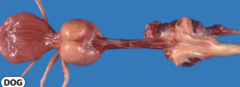
true
- in older dogs may need to elevate the prostate with one hand via the abdomen
- younger dogs = lies on pelvic floor
- 8-12 completely abdominal
True or false
with age the normal position of the prostate changes
- acute bacterial prostatitis
- chronic bacterial prostatitis
- prostatic adenocarcinoma
- prostatic and paraprostatic cysts
What are differential diagnoses for benign prostatic hyperplasia (BPH)?
- typically associated with fever, depression, pain on rectal palpation, neutrophilia, pyuria, bacteriuria
- it may occur concurrently with BPH
- often caused by E. coli
What is acute bacterial prostatitis like?
- typically associated with recurrent lower urinary tract infections
- it may occur concurrently with BPH
- often caused by E. coli
What is chronic bacterial prostatitis like?
- typically associated with poor appetite, weight loss, hind limb weakness, dysuria, hematuria, dyschezia
- carcinoma cells may be seen in urine sediment
- more common in castrated males
What is prostatic adenocarcinoma like?
- can cause palpable abdominal cystic mass filled with yellow to orange fluid
What are prostatic and paraprostatic cysts like?
- palpation
- prostatic wash
- CBC, cultures of seminal fluid and urine, U/S guided FNA, biopsy, rads
How do you diagnose prostate disease?
- BPH: uniform cells
- Neoplasia: variable cells
- Septic: inflammatory cells (neutrophils)
What does a prostatic wash differential and how?
- castration = tx of choice
- may use hormonal therapy also
How do you treat prostate disease?
- symmetrical, mild enlargement, slightly mottled, small cysts IN parenchyma
What does benign prostatic hyperplasia (BPH) look like on U/S?
- symmetrical, slightly mottled, often concurrent cystitis, hypoechoic areas with small cysts
What does acute prostatitis look like on U/S?
- symmetrical to asymmetrical, poorly marginated, multifocal mixed echogenicity, may have areas of mineralization
What does chronic prostatitis look like on U/S?
- asymmetrical and mottled parenchyma
What does a prostatic abscess look like on U/S?
- located next to prostate, not in it = looks like second bladder
- usually thin walled, but can have variable wall thickness and fluid echogenicity
What does a paraprostatic cysts look like on U/S?
- Finastreide (Proscar)
- definitive and preferred treatment is castration
How do you medically treat a dog with benign prostatic hyperplasia (BPH)?
- 5a-reductase inhibitors
- blocks the action of testosterone and/or dihydrotestosterone
What is the MOA for Finastreide (Proscar)?
- can take many months or even years to disappear
- often it lasts indefinitely because masculinization of the brain begins early in fetal life and is essentially innate in males; only modified by castration
Why can there be sexual behavior post castration?