Microbiology Chapter 9: Microbial Growth
 Call Kai
 Learn
 Practice Test
 Spaced Repetition
 Match
 Flashcards
 Knowt Play
1/83

There's no tags or description
Looks like no tags are added yet.
Name | Mastery | Learn | Test | Matching | Spaced | Call with Kai | Chat |
|---|
No analytics yet
Send a link to your students to track their progress
84 Terms
Microbial Growth
Increase in number of cells (population)
Biofilms
Colonies of microorganisms (bacteria, fungi, algae) in slimy matrixes on surfaces (ponds and wet rocks) that communicate via cell signaling
What is the most notable characteristic of Biofilms?
Highly resistant to antibiotics and host immune defenses
Form on medical devices, as dental plaque, in cystic fibrosis lungs, and on heart tissue (endocarditis)
Binary Fission
Asexual reproduction - the most common cell replication mechanism in bacteria ; 3 steps
What is the first step of Binary fission?
DNA replication - origin of replication; cell elongates
What is the second step of Binary fission?
Division septum formation = cytokinesis
→ directed by protein FtsZ; forms Z ring (center of cell) → recruits proteins forming divisome that builds the peptidoglycan septum
What is the third step of Binary fission?
Cell separation - two daughter cells; 1 chromosome each
Generation time (doubling time)
Time for a population to double by one round of binary fission
Ex. E. coli: as little as 20 minutes in optimal lab conditions
M. tuberculosis: 15-20 hours; M. leprae: 14 days
Generation growth
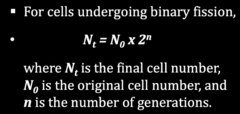
Exponential growth → cells = 2^n (n - number of generations)
1 cell dividing every 30 min for 24 h → 48 generations
→ 2^48 ≈ 2.8 × 10^14 cells
Closed (batch) culture
A system where there are no additions (nutrients) or removals (waste products) during the period of incubation | 4 phases

What is the first phase of Closed (batch) culture?
Lag → cell number stagnant; cells create proteins and repair damage
What is the second phase of Closed (batch) culture?
Log (exponential) → binary fission (intrinsic growth rate); susceptible to antibiotics
What is the third phase of Closed (batch) culture?
Stationary - nutrients run out, waste builds → new cells become dying cells (carrying capacity); endospore formation
What is the fourth phase of Closed (batch) culture?
Death - decrease in living cells; persisters survive
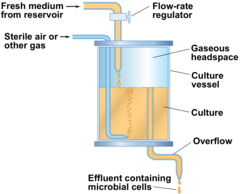
Chemostat
Continuous culture (nutrients added, waste removed) → keep cells in log phase
Bacterial counts
Indicate the extent of an infection
→ used for quality control of water, food drugs and cosmetics
Direct Method of Bacterial Counts
Measure cell activity/presence by counting
What are the 3 direct methods for bacterial counts?
Direct microscopic count (Petroff-Hausser chamber) and Coulter counter
Viable plate count (pour plate, spread plate)
Most probable number (MPN)
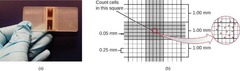
Petroff-Hausser Chamber
Known volume on a calibrated grid; cells counted under a microscope → easy, fast, inexpensive
Ex: 10 cells in 0.000008 mL → 1,250,000 cells/mL; poor for dilute cultures
Coulter Counter
Each cell passing through small aperture changes electrical resistance → counted (cannot tell live from dead)

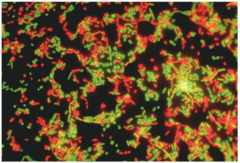
Viability (live/dead) stains
Green enters all cells, red only cells with damaged membranes → live = green, dead = red
Viable plate count
Live cells (visible colonies) → reported as CFU/mL (colony-forming units)
Colony might come from multiple cells, possibly some nonculturable cells → low estimate
Count plates with 30-300 colonies (< 30 unreliable; > 300 overcrowded)

Serial Dilution
Multi-step sequence of single dilutions
1.0 mL into 9.0 mL broth, repeated → 1:10, 1:100, 1:1000 ..., then plate each dilution
Ex: 50 colonies from 0.1 mL of the 1:10,000 dilution → 50 × 10 × 10,000 = 5,000,000 CFU/mL
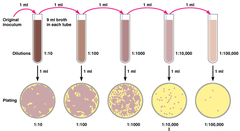
Pour plate method
Method where liquid sample microorganisms are mixed into melted agar (45-50°C) before solidification in sterile dish

Spread plate method
Diluted sample placed onto solid medium and spread on solid agar with sterile spreader

Most Probable Number (MPN)
Statistical estimate of viable cells; growth seen as turbidity or color change
Example: Coliforms (gram-negative lactose fermenters → sign of fecal contamination) in pond water
• 5 lactose broth tubes each get 10 mL, 1 mL, 0.1 mL;
positive = red → yellow
• Result 5-2-0 positive tubes → MPN table → 49 bacteria/100 mL
Indirect Methods of Bacterial Counts
Measure cell presence/activity without counting
What are the 3 indirect methods for bacterial counts?
Turbidity: measured with a spectrophotometer
Dry weight: concentrate, wash, and dry the cells → useful for filamentous microbes
Metabolic activity: ATP formation, protein and nucleic acid synthesis, O2 consumption → fast estimate of live cells
Spectrophotometer
Light passes through the culture; detector measures what passes through
→ More cells → more turbidity → ↑ absorbance (optical density) and ↓ % transmission

Dry Weight Measurement
Cell suspension → concentrated by filtration or centrifugation, washed, dried, and then weighted

Metabolic Activity Measurement
Measurement of cell activity by the production of metabolic products or disappearance of reactants
→ ATP formation, biosynthesis of proteins + nucleic acids, and consumption of oxygen → monitored to estimate # of cells
Fragmenation
Nucleoids that form a filament → multiple new cells split at once
(cyanobacteria, actinomycetes)

Budding
Narrow extension at one pole → swells into smaller bud that detaches
(yeast, prosthecate bacteria, Gemmatta)

Epulopiscium
Daughter cells grow in parent → parent disintegrates to release

Soil Acitinomycetes
Biofilm forms by flow rate
Streamers (fast flow)
Mushroom-like (slow flow)
Composition of Extracellular Polymeric Substances (EPS)
Cells in matrix of EPS (polysaccharides, proteins, nucleic acids) + water channels
→ bring nutrients in, waste out; protect from predation (protozoans, wbc)
Life Cycle of a Biofilm
1) Planktonic cell attaches, becomes sessile (reversible attachment)
2) Irreversible attachment of first colonizers
3) Growth
4) EPS and channels
5) Dispersal

Quorum Sensing
Cells detect density by releasing/sensing small diffusible molecules; autoinducers
Occurs across different microbial species within a biofilm
ex. Candida albicans
Quorum threshold
At threshold (quorum): autoinducer binds receptor → gene expression changes ( sometimes more auto inducers)
Quorum sensing gene activation
Turns on genes that are useful at high density ex. Virulence factors (enough cells to defeat host defense
Gram-negative vs. Gram-positive quorum signals
Gram-negative → N-acylated homoserine lactones
Gram-positive → short peptide
Beneficial Biofilms
Normal microbiota lining intestinal + respiratory mucosa → ward off pathogens
Harmful Biofilms
Dental plaque, wounds, medical devices, (contact lenses, catheters, artificial joints), filtration systems, Pseudomonas aeruginosa (cystic fibrosis)
Biofilm Pathogen Antibiotic Resistance
Deep cells = metabolically inactive (slowing drug uptake) + EPS matrix physically slows the diffusion of antibiotics and antiseptics
EPS matrix protects from host immune cells (wbc)
More efflux pumps out drugs; ideal for resistance genes exchange
Prevention (ISS, 2023): antibacterial coatings fail (dead cells = anchors)
→ surfaces infused with lubricant block microbial adhesion
Great Oxygenation Event
Cyanobacteria released O2 from photosynthesis → O2 rose → mass extinction
Most organisms didn't survive reactive oxygen species (ROS) → damaged macromolecules; Organisms with ability to detoxify ROS → used O2 for energy and lived
Anaerobic environments - sewers, deep ocean, earth's crust
Thioglycolate tube
O2 diffuses in from the top → growth where O2 suits the organism

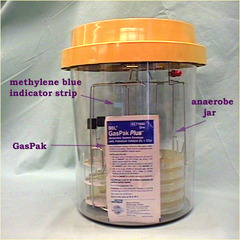
Anaerobic jar
Chemical packs remove O2 + release CO2
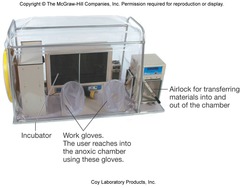
Anaerobic chamber
Enclosed box with all O2 removed; sealed gloves let you handle cultures
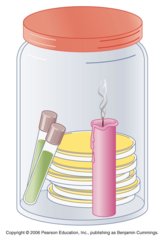
Capnophiles
Need more CO2 + less O2 than air → candle jar: the burning candle consumes O2 and releases CO2
Reactive Oxygen Species (ROS)
From aerobic respiration:
superoxide, peroxides, hydroxyl radical, singlet oxygen, hypochlorite
→ must be detoxified
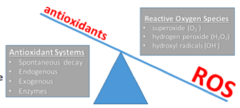
3 detoxifying enzymes
Superoxide dismutase (SOD) - converts dangerous superoxide free radicals into hydrogen peroxide and oxygen
Catalase - degrades hydrogen peroxide into water and oxygen gas
Peroxidase - detoxifies hydrogen peroxide

Obligate anaerobes (ROS enzyme)
Possess no detoxification enzymes, leaving them completely vulnerable to oxygen toxicity.
Aerotolerant anaerobes (ROS enzyme)
Possess Superoxide dismutase (SOD) but lack catalase.
Obligate aerobes (ROS enzyme)
Possess all three detoxification enzymes (peroxidase, SOD, and catalase) to safely survive in oxygen.
Catalase test
Drop of 3% H2O2 → bubbles = catalase positive
(staphylococci +, streptococci −)
Acidity
[H+] measured as pH: below 7 acidic, above 7 basic
Extreme pH damage to macromolecules
High pH → hydrogen bonds in DNA break; extremely basic pH hydrolyzes lipids
Neutralized H+ → proton motive force collapses → impaired ATP production
Proteins = most sensitive: altered ionization and H bonding → misfolding and denaturation
Preservation of acidic foods
Acidic foods resist spoilage - most spoilage microbes prefer near-neutral pH | exception of lactic acid bacteria (thrive near pH 4)
Neutrophiles
Grow near pH 7 (most bacteria), fungi prefer pH 5-6

Acidophiles
Optimum below pH 5.5 → Sulfolobus, Ferroplasma (pH 0-2.9)
→ Adaptations: negatively charged proteins; H+ pumps


Alkaliphiles
Optimum pH 8-10.5 → Natronobacterium, Vibrio cholerae
→ Adaptations: Na+ gradient instead of H+; higher isoelectric point
Psychrophiles
optimum ≈ 15 °C; grow at 0 °C and below; not above ≈ 20 °C
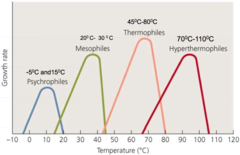
Psychrotrophs
4 °C to 25 °C

Mesophiles
20-45 °C; human pathogens and normal microbiota (37 °C)

Thermophiles
Optimum 50-80 °C
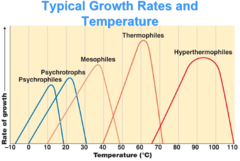
Hyperthermophiles
80-110 °C (some above 121 °C)
Where do Psychrophiles live?
Permanently cold places (deep oceans, polar lakes)

Where do Psychrotrophs live?
Spoil refrigerated food;
Listeria monocytogenes grows at 4-10 °C → risk in pregnancy; avoid soft cheeses, cold cuts

Where do Mesophiles live?
Most human pathogens (E. coli, Salmonella)

Where do Thermophiles live?
Hot springs, compost; Thermus aquaticus, Geobacillus

Where do Hyperthermophiles live?
Deep-sea vents (up to ≈ 340 °C);
Pyrolobus and Pyrodictium grow at 105 °C and survive autoclaving

Osmotic Pressure
High osmotic pressure pulls water out of the cell
→ plasmolysis and death
→ salting preserve food
Halophiles
Require high salt

Halotolerant
Survive in high salt but do not require it

Photosynthetic bacteria
Depend on visible light for energy
Photoautotrophs
Inorganic carbon source, fixes CO2
(cyanobacteria, green sulfur bacteria)

Photoheterotrophs
Organic compounds, cannot fix CO2 (purple nonsulfur bacteria)

Complex media
Yeast, meat, or plant extracts → unknown exact composition (nutrient broth, TSB, brain heart infusion)
Chemically defined media
Every component and amount known (e.g., EZ medium)
Enriched media
Added growth factors, vitamins, and nutrients for fastidious organisms.
Enrichment cultures: favor a microbe present in small numbers
e.g., crude oil as the only carbon source → oil-degrading bacteria
Non-selective media
Support all microbes without inhibition, e.g., Mueller-Hinton agar (Kirby-Bauer antibiotic test)
Selective media
Promote growth of specific target media while suppressing/killing unwanted background microbes
MacConkey agar: bile salts + crystal violet inhibit many Gram-positives → favors Gram-negative enterics

Differential Media
Help distinguish bacteria by the color of the colonies or the change in the medium
MacConkey: lactose fermenters make acid → neutral red turns hot pink
