ECON 2120 HW 4
 Call Kai
 Learn
 Practice Test
 Spaced Repetition
 Match
 Flashcards
 Knowt Play
1/32

Earn XP
Description and Tags
Loanable Funds Market
33 Terms
As the baby boomers retire, what would happen to interest rates and the equilibrium quantity demanded for investment?
Interest rates rise; Quantity demanded for investment falls.

Yan is running a business producing tennis and badminton rackets. He is considering the possibility of opening new retail stores. Using what he learned in economic courses in Clemson, he estimates the expected rate of return from opening a new branch in the following five locations. The estimations are listed in the following table, along with the funds Yan would need to borrow in order to open each location.
Where would Yan open his new retail store(s) if the annual interest rate charged by Bank of America (BOA) on the loan is 6%? (Choose all qualified answers)
Greenville
Charleston
Atlanta
The interest rate of an one-year T-bill is 4.8%. The face value is $100. What is the dollar price of this T-bill?
$95.42
Which of the following is correct when government intends to borrow money from the loanable fund market?
Private investment would be lower.
What is the price of loanable funds?
The interest rate.
Which of the following is TRUE regarding an unanticipated inflation?
Real interest rate drops. Borrowers are helped.
For people listed below, who has the strongest positive time preference?
A three-year-old boy.
Which of the followings will shift the demand for loanable funds?
The change in productivity of machines.
When investment falls, what would happen to the level of capital and future output (GDP) in an economy?
Capital and future GDP fall.
The U.S. population had a bubble of individuals known as the baby boomers. As this group retires, what happens to savings?
Saving declines as baby boomers dissave.
The additional payment a borrower has to make on a loan is referred to as ________.
interest
The total interest that a borrower has to pay on a loan is equal to ________.
principal times the rate of interest
Which of the following statements is TRUE?
The larger the principal invested, the higher will be the interest received at the end of a year.
If an individual borrows $100 at an annual rate of interest of 5 percent, how much interest will he have to pay at the end of 1 year?
$5
If an individual borrows $200 at an annual rate of interest of 10 percent, what is the total amount that she will have to repay after 1 year?
$220
If an individual borrows $100 and pays back $100 after a year to settle his loan, it implies that the rate of interest is ________
0 percent
An individual can borrow a certain sum of money from any of the three banks in her town— Bank 1, Bank 2, and Bank 3. Bank 1 offers her loans at an annual interest rate of 5 percent, Bank 2 offers her loansat an annual interest rate of 3 percent, and Bank 3 offers her a loan at an annual interest rate of 10 percent. A rational individual will ________.
borrow from Bank 2
Assuming all else equal, a rise in the rate of interest ________.
results in a fall in the quantity of loan demanded
The real interest rate is equal to ________.
the nominal interest rate adjusted for inflation
If the nominal interest rate in an economy is 6 percent and the rate of inflation in the economy is 4 percent, the real interest rate in the economy is ________.
2 percent
Consider two economies: A and B. The nominal interest rate is the same in both economies, but the rate of inflation is higher in economy B. Which of the following statements will then be TRUE?
The real interest rate will be higher in economy A.
If the nominal interest rate is greater than the real interest rate in an economy, ________.
the inflation rate must be positive in the economy
If the real interest rate is equal to the nominal interest rate in an economy, ________.
the inflation rate must be zero in the economy
An optimizing economic agent will use the ________ rate when calculating the economic cost of a loan.
real interest
If the annual inflation rate in an economy is positive, the purchasing power of a dollar kept in a bank
will decrease over time
Savers are willing to lend out money because ________
they prefer to spend money in the future rather than today
All else being equal, an increase in government borrowing is likely to cause a(n) ________.
right shift of the demand of loanable funds
The opportunity cost of current consumption is ________.
the real interest rate
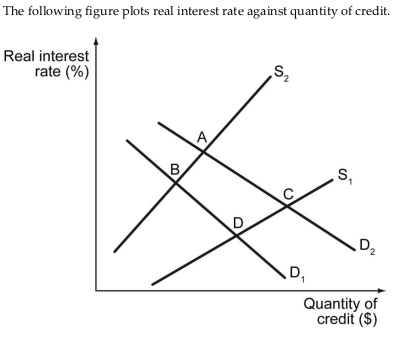
Refer to the figure above. Assume that the loanable funds market initially is in equilibrium at point D.
Why might the equilibrium move to point C?
Increased business confidence

Refer to the figure above. If the supply of credit shifts from S1 to S2 it is most likely that ________.
households have decreased their savings
You want to make a 10% real return on a loan that you are planning to make, and the expected inflation rate during the period of the loan is 4%. You should charge a nominal interest rate of
14%
Eliza wants to borrow $100 from Sandy. Sandy wants to make 4% real return on his money, so they both agree on a 4% interest rate paid next year. Eliza and Sandy did not anticipate any inflation, yet the actual inflation turned out to be -5% next year. In this case,
Eliza will pay an 9% real interest rate.
Sandy is better off.
Eliza will pay a 4% nominal interest rate.
Dean borrows $400 from Tim. Tim wants to make a 10% real return on his money, so they both agree on a 10% interest rate paid next year. Dean and Tim did not anticipate any inflation, yet the actual inflation turned out to be 4% next year. In this case
Dean is better off