CHAP. 8 Nervous System
 Call Kai
 Learn
Learn Practice Test
 Spaced Repetition
 Match
Match Flashcards
 Knowt Play
1/305

There's no tags or description
Looks like no tags are added yet.
Name | Mastery | Learn | Test | Matching | Spaced | Call with Kai | Chat |
|---|
No analytics yet
Send a link to your students to track their progress
306 Terms
The master control and communication system of the body
Nervous system
2 major divisions of nervous system
Central & peripheral nervous system
What does the CNS comprise of?
brain and spinal cord
What does the PNS consist of?
all nerves and ganglia outside the brain and spinal cord
Receives and processes sensory information, initiates responses, stores memories, generates thoughts and emotions.
Brain
Conducts signals to and from the brain, controls reflex activities
Spinal cord
What are the functions of the nervous system?
Receiving sensory input
Integrating information
Controlling muscles and glands
Maintaining homeostasis
Establishing and maintaining mental activity
Communicate with body cells using electrical impulses, causing almost immediate responses.
CNS
Thick bundles of axons (nerves) carrying messages back and forth between the CNS and the rest of the body
PNS
2 functional classification of the PNS
Sensory division & Motor division
Conducts action potentials from sensory receptors to the CNS
Sensory division (afferent)
Conducts action potentials to effector organs, such as muscles and glands.
Motor division (efferent)
Main divisions of nervous system
Somatic nervous system
Autonomic nervous system
Enteric nervous system
Transmits action potentials from the CNS to skeletal muscles. All the nerves throughout the body that carry information from the senses
Somatic nervous system
Transmits action potentials from the CNS to most of the internal organs.
Autonomic nervous system
A special nervous system found only in the digestive tract
Enteric nervous system
What is the involuntary branch of the nervous system?
Autonomic nervous system
Autonomic nervous system consist of only what nerve
Motor nerves
Two divisions of autonomic nervous system
Sympathetic division
Parasympathetic division
“fight-or-flight”; Response to unusual stimulus
Sympathetic
What are the “E” division that we need to remember in sympathetic?
Exercise, excitement, emergency, and embarassment
Maintains daily necessary body functions; “rest-and'-digest” body processes.
Parasympathetic
What are the “D” that are remembered in parasympathetic?
Digestion, defecation, diuresis.
What is defecation?
Regulates the storage and elimination of stool.
A complex network of nerve cells within the walls of the gastrointestinal (GI) tract.
enteric nervous system
The enteric nervous system is composed of millions of neurons arranged in plexuses, which regulate key digestive functions:
swallowing
enzyme release
nutrient absorption
blood flow
waste elimination
Specialized cells that can receive and transmit chemical or electrical signals
Neurons
What are the cells of the nervous system?
Neurons and glial cells
Receive stimuli, conduct action potentials, and transmit signals to other neurons or effector organs
Neurons
What is the function of the neurons?
They receive stimuli, conduct action potentials, and transmit signals to other neurons or effector organs

What cell is this?
Glial cell
cells that provide support functions for the neurons
Glial cell
What are the functions of glial cells?
They enhance neuron function and maintain normal conditions within nervous tissue.
What are the neuron structures?
Dendrites
Cell body
Axon
The main part of the cell; contains a single nucleus and the organelles found in other types of cells
Cell body
Another term for cell body
Soma
Tree-like structures that extend away from the cell body to receive messages from other neurons at specialized junctions (synapses)
Dendrites
What do you all the specialized junctions where dendrites interface and receive signals from other neurons.
Synapses
A tube-like structure that propagates the integrated signal to specialized endings (axon terminals)
Axon
What do you call the specialized endings found at the end of an axon.
Axon terminals
What are the functional classification of neurons?
Sensory neurons
Motor neurons
Interneurons
Carry signals from the outer parts of your body (periphery) into the CNS
Sensory neurons
Carry signals from the central nervous system to the outer parts (muscles, skin, glands) of your body
Motor neurons
Connect various neurons within the brain and spinal cord
Interneurons
What are the structural classification of neurons?
Pseudounipolar neurons
Bipolar neurons
Multipolar neurons
Describe pseudounipolar neurons
only one nerve process extending from the cell body: an axon that extends into dendrites
Describe bipolar neurons
one axon and one dendrite
Describe multipoalr neurons
many dendrites and a single axon from the cell body

Bipolar neuron

Multipolar neuron

Pseudounipolar neuron
The supportive cells of the CNS and PNS; most retain the ability to divide.
Glial cells
Name the glial cells
Astrocytes
Microglia
Ependymal cells
Oligodendrocytes
Satellite cells
Schwann cells
Abundant, star-shaped cells that serve as the major supporting cells in the CNS.
Astrocytes

Name the glial cell
Astrocytes
Spider-like phagocytes; Dispose of debris
Microglia

Name the glial cell
Microglia
Line cavities of the brain and spinal cord ; Circulate cerebrospinal fluid
Ependymal cells

Name the glial cell
Ependymal cells
Produce myelin sheath around nerve fibers in the central nervous system.
Oligodendrocytes

Name the glial cell
Oligodendrocytes
This glial cell protect neuron cell bodies
Satellite cells
This glial cell form myelin sheath in the peripheral nervous system
Schwann cells
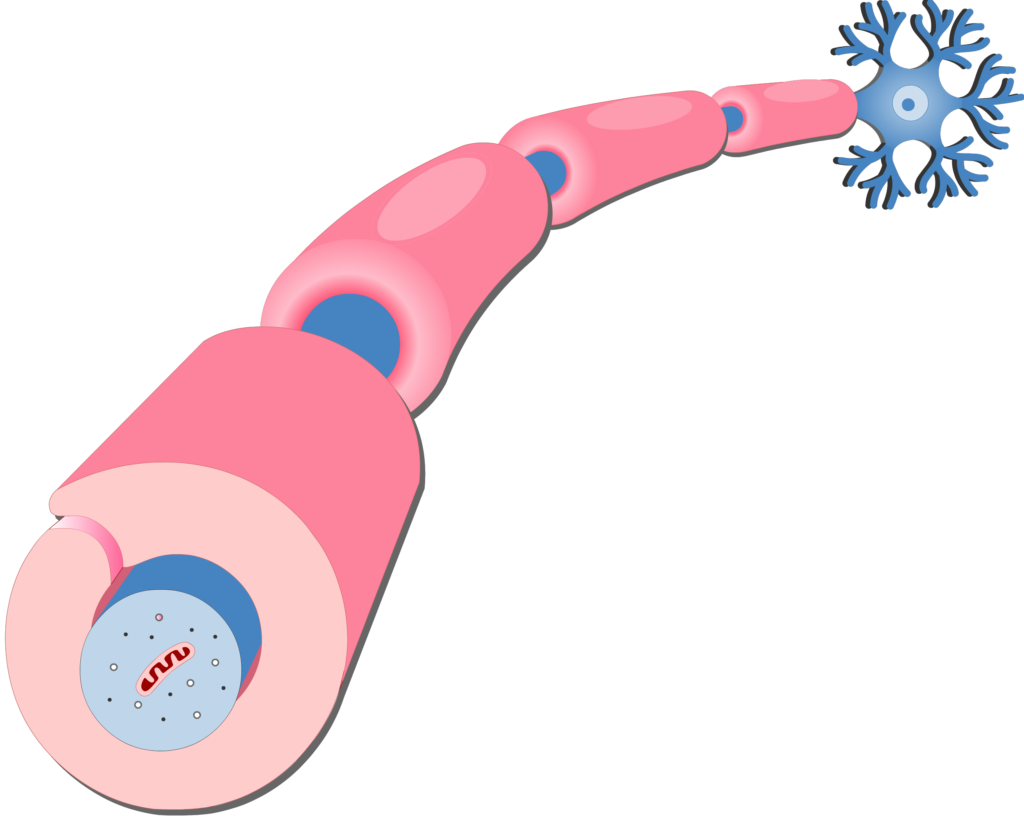
Name the glial cell
Schwann cells
Specialized layers that wrap around the axons of some neurons (myelinated).
Myelin sheath
What forms the myelin sheath in the CNS?
Oligodendrocyte
What forms the myelin sheath in the PNS?
Schwann cells
An excellent insulator that prevents almost all ion movement across the cell membrane.
Myelin sheath
This lacks the myelin sheaths
Unmyelinated neurons
A typical small nerve, consisting of multiple neuron axons, usually contains more unmyelinated axons than myelinated axons
Unmyelinated neurons
What do you call the gaps in the myelin sheath that occur about every millimeter?
Nodes of Ranvier
True or False:
Ion movement can occur at the nodes of Ranvier.
True
A disease of the myelin sheath that causes loss of muscle function.
Multiple sclerosis
What is multiple sclerosis?
A disease of the myelin sheath that causes loss of muscle function.
A chronic autoimmune disease of the central nervous system where the immune system mistakenly attacks the protective myelin sheath covering nerve fibers.
Multiple sclerosis
What are the two primary types of tissues that make up the CNS?
Gray & White matter
Neuron cell bodies and their dendrites, very little myelin
Gray matter
Parallel axons with their whitish myelin sheaths
White matter
Where does the spinal nerves come out?
Spine
Where does the cranial nerves come out?
Brain
How many pairs of cranial nerves are there?
12 pairs
How are cranial nerves numbered?
Roman numerals
These nerves are linked directly to the brain, without having to pass through the spinal cord.
Cranial nerves
2 categories of cranial nerves
Sensory and motor
What are the 12 pairs of cranial nerves?
CN I – Olfactory Nerve
CN II – Optic Nerve
CN III – Oculomotor Nerve
CN IV – Trochlear Nerve
CN V – Trigeminal Nerve
CN VI – Abducens Nerve
CN VII – Facial Nerve
CN VIII – Vestibulocochlear Nerve
CN IX – Glossopharyngeal Nerve
CN X – Vagus Nerve
CN XI – Accessory Nerve
CN XII – Hypoglossal Nerve
What is the 1st cranial nerve?
Olfactory nerve
Sensory nerve for smell.
Olfactory nerve
Outside of the CNS, olfactory nerves are called
Olfactory nerve
inside of the CNS, olfactory nerves are called
Olfactory tract
A patient says "Ah," and their uvula deviates to the right side. They also have a weakened gag reflex. Which cranial nerve is damaged?
Cranial Nerve X (Vagus Nerve)
The functional right side pulls the uvula toward itself, away from the weak left side.
Transmits information from the eye’s retina; Vision
Optic nerve
Controls muscles that move the eyeball.
Oculomotor nerve
What is cranial nerve II?
Optic nerve
What is cranial nerve III?
Oculomotor nerve
What is cranial nerve IV?
Trochlear nerve
What is cranial nerve V?
Trigeminal nerve
What is cranial nerve VI?
Abducens nerve
What is cranial nerve VII?
Facial nerve
What is cranial nerve VIII?
Vestibulocochlear nerve
What is CN IX?
Glossopharyngeal nerve