I 20 - Drugs used in treatment of fungal infections
 Call Kai
 Learn
 Practice Test
 Spaced Repetition
 Match
 Flashcards
 Knowt Play
1/23

There's no tags or description
Looks like no tags are added yet.
24 Terms
How are fungal infections classified?
superficial/cutaneous
Dermatophytoses
Confined to skin, hair, and nails (epidermis)
Caused by dermatophytes: keratin-digesting saprophytic moulds
Contagious
Subcutaneous
e.g. sporotrichosis
Inoculated through broken skin (thorns, splinters)
Slow-growing, localised, chronic
Rarely disseminates
Systemic / Deep-Seated
Endemic + opportunistic
Invade skin, lung, lymphatic and other tissue
Endemic: histoplasmosis, blastomycosis, coccidioidomycosis, sporotrichosis
Opportunistic (candidiasis, aspergillosis) now drive most drug development
What are the fungal drug targets ?
Cell Wall
• Targets: glucan synthase, chitin, mannoproteins; absent from mammalian cells
• Drug class: Echinocandins
Membrane Sterol
• Target: Ergosterol (fungi) vs cholesterol (mammals)
A chemically distinct target sterol
• Drug class: Polyenes
Ergosterol-Synthesis
Enzymes
• Target: Squalene epoxidase CYP51
• Drug class: Azoles, allylamines
Nucleic Acid / Protein Synthesis
• Target: Fungal-specific uptake (permease) and activation (deaminase) enzymes.Antimetabolite
• Drug class: Flucytosine
What are fungal cell wall inhibitors, and what do they target?
As fungi have a cell wall and mammals don’t, this allows selective toxicity
Antibacterial drugs have already been used in a similar approach nd are successful; beta-lactams (e.g. penicillins, cephalosporins, carbapenems and monobactams) inhibit bacterial cell wall synthesis by preventing peptidoglycan cross-linking; similarly, antifungals can too
Echinocandins are the only cell wall-active antifungals licensed in the UK.
Fungal cell wall :
The fungal wall is chemically complex; the biosynthetic enzymes are membrane-bound and hard to assay, and useful inhibitors have almost all been large natural products with poor drug-like properties
β-1,3-D-glucan is the major structural polymer of most fungal cell walls
β-1,3-glucan synthase is a transmembrane enzyme involved in cell wall biosynthesis
The catalytic subunit is known as Fks

How do the structural features of echinocandins contribute to their antifungal activity?
Echinocandins are semisynthetic lipopeptide antifungals that inhibit β-1,3-glucan synthase (Fks), preventing fungal cell wall synthesis.
Their structure has two essential components that work together to produce antifungal activity.
Structural feature | Properties and importance |
|---|---|
1. Cyclic hexapeptide core | Ring containing 6 amino acids, including modified/non-proteinogenic amino acids. Responsible for recognising and binding to the Fks target. |
2. Lipophilic N-acyl side chain | Fat-soluble chain attached to the peptide ring through an amide bond. Anchors the drug in the fungal cell membrane, positioning it near Fks. |
Together, they enable echinocandins to inhibit β-1,3-glucan synthesis, weakening the fungal cell wall and potentially causing fungal cell death.

What is the mechanism of action for echinocandins ?
• Echinocandins inhibit β-1,3-glucan synthesis by noncompetitive binding to β-1,3-glucan synthase.
• The subsequent reduction in the β-1,3-d-glucan content weakens the cell wall
• The fungal cell wall becomes susceptible to osmotic imbalances, leading to rupture of the fungal cell
Why are echinocandins for IV use only?
• Large MW (1100-1300), peptidic and heavily hydroxylated - far outside Lipinski space
• Many H-bond donors and acceptors
• Susceptible to gut peptidases and poorly permeable across enterocytes
• Not a CYP450 substrate, inducer, or inhibitor
• IV infusion only - hospital use
• Poor penetration into cerebrospinal fluid (CSF), vitreous humour and urine
• Avoid in CNS infection and Candida urinary tract infection
What is ergosterol biosynthesis ?
The cell membranes of fungi and mammals contain different
sterols.Mammalian cell membranes contain cholesterol as the sterol
component, whereas fungi contain ergosterolErgosterol plays a critical role in fungal cell membrane fluidity, permeability, and essential cellular processes.
Two targets for antifungals: Squalene epoxidase and CYP51
Two classes of antifungals: Squalene epoxidase inhibitors;
CYP51 inhibitors
What are squalene epoxidase inhibitors, and what do they target?
• Noncompetitive Inhibition: Directly inhibits fungal squalene epoxidase (Site 1 in the ergosterol pathway).
• Ergosterol Depletion: Deprives the fungal cell membrane of essential ergosterol, impairing structural integrity and transport.
• Toxic Squalene Accumulation: Causes massive intracellular buildup of squalene, which is cytotoxic and drives rapid fungal cell death.
• Primary Spectrum: Effective specifically against dermatophytes causing cutaneous and nail infections.

How do the structural features of squalene epoxidase inhibitors contribute to their antifungal activity?
The slide focuses on two drugs: terbinafine (allylamine) and tolnaftate (thiocarbamate).
1. Structure–activity relationships (SAR)
Structural feature | Properties and importance |
|---|---|
Allylamine pharmacophore (terbinafine) | Essential structural group responsible for potent, selective inhibition of fungal squalene epoxidase. |
Lipophilic groups (terbinafine) | Make the drug fat-soluble, allowing it to accumulate in lipid-rich tissues such as the skin and nails. |
Thiocarbamate group (tolnaftate) | A different chemical structure that also inhibits fungal squalene epoxidase. |
Aromatic rings (both drugs) | Contribute to lipophilicity and hydrophobic interactions, supporting antifungal activity. |
Note:
molecules with an allylamine pharmacophore = exceptional selectivity
allylamines - topical and oral; thiocarbamate- topical only

Why is selectivity important?
Squalene epoxidase is involved in both:
Fungi: Produces ergosterol for fungal cell membranes.
Humans: Participates in cholesterol synthesis.
However, terbinafine's allylamine structure allows it to preferentially inhibit the fungal enzyme rather than the human enzyme.
This is called selective toxicity and helps reduce harm to human cells.
How is terbinafine metabolised, and how does this affect its safety and drug interactions?
Multi-Isoform Clearance- It can be metabolised by many CYP450 ( CYP1A2, CYP2D6 and CYP3A4) enzymes in the liver; if one is inhibited, it can still be metabolised, reducing its impact on clearance
If there are broad CYP inhibitors ( cimetidine), terbinafine isn’t broken down, increasing adverse effects
If there are CYP inducers ( rifampicin), terbinafine is broken down faster, levels decrease, and effectiveness decreases
Terbinafine inhibits CYP2D6, slowing down the breakdown of other drugs metabolised so drug concentrations could increase, causing toxicity
How do the structural features of azole antifungals contribute to their activity and pharmacological properties?
Azoles are antifungal drugs that inhibit lanosterol 14α-demethylase (CYP51), an enzyme required for ergosterol synthesis in fungal cell membranes.
Structure–activity relationships (SAR)
Structural feature | Properties and importance |
|---|---|
Five-membered azole ring | Contains 2–4 nitrogen atoms, depending on the azole class. |
Nitrogen atom in the ring | An available nitrogen binds to the haem iron of fungal CYP51, inhibiting the enzyme. |
Aromatic side chain | Helps the drug bind to the enzyme through hydrophobic interactions, increasing affinity. |
N1-linked side chain | Connects the azole ring to the rest of the molecule and helps position it for enzyme binding. |
Key point: The azole nitrogen is essential for enzyme inhibition, while the aromatic side chain helps stabilise drug binding.
What are the different classes of azoles?
Feature | Imidazoles | Triazoles |
|---|---|---|
Nitrogen atoms | 2 | 3 |
Administration | Mainly topical excl.ket | Often oral or IV |
Pharmacological properties | Many are used locally because of systemic toxicity or pharmacokinetic limitations | Many have improved systemic suitability and metabolic stability, oral bioavailability |
Examples | Clotrimazole, miconazole, econazole, ketoconazole | Fluconazole, itraconazole, voriconazole, posaconazole, isavuconazole |

What is the mechanism of action for azoles?
Heme Iron Coordination: The basic nitrogen ( of imidazole, of triazole/tetrazole) forms a coordinate covalent bond with heme Fe3+ of CYP51.
Apoprotein Interactions: The lipophilic aromatic side chain interacts noncovalently with the apoprotein pocket, driving enzyme affinity and isoform selectivity.
Ergosterol Depletion: Blocks conversion of lanosterol to ergosterol, disrupting fungal membrane fluidity and membrane-bound transport.
Toxic Sterol accumulation: Shunts lanosterol via Erg3 to accumulate 14α-methylergosta-8,24(28)- dien-3β,6α-diol, causing cytotoxicity.

How do azole antifungals achieve selectivity for fungal CYP51, and why do drug interactions occur?
Target: Fungal CYP51, which is needed for ergosterol synthesis.
Azole nitrogen: Binds to the haem iron of CYP51, inhibiting the enzyme.
Hydrophobic groups, aromatic rings and linker: Form additional non-covalent interactions that determine selectivity for fungal CYP51 over human CYP450 enzymes.
Selectivity: Itraconazole (769-fold) is more selective than ketoconazole (7-fold) in the slide's comparison.
Drug interactions: Azoles may inhibit human CYP3A4, CYP2C9 and CYP2C19, affecting the metabolism of other drugs.
Key SAR to remember: The azole nitrogen provides enzyme binding, while the rest of the molecule determines selectivity through additional interactions with the enzyme.
Why are azoles more selective for fungal enzymes rather than human enzymes?
Fungal and human CYP450 enzymes have different binding-site structures.
The azole nitrogen binds to haem iron in both enzymes.
However, the hydrophobic groups and aromatic side chains form more favourable non-covalent interactions with fungal CYP51.
This increases affinity for fungal CYP51, producing selective inhibition of ergosterol synthesis.
Why are imidazole antifungals mainly used topically rather than systemically?
Rapid first-pass metabolism: Many are extensively broken down by the liver, reducing oral bioavailability.
Systemic toxicity: Some cause significant adverse effects when administered systemically.
Topical use: Allows high drug concentrations at the infection site with reduced systemic exposure.
Examples: Clotrimazole, miconazole, econazole and ketoconazole.
Structure: All contain an imidazole ring (2 nitrogen atoms) and aromatic groups that support CYP51 inhibition.
Key clinical point: Imidazoles are mainly used for localised fungal infections, whereas triazoles are generally more suitable for systemic treatment due to their pharmacokinetic and safety profiles.

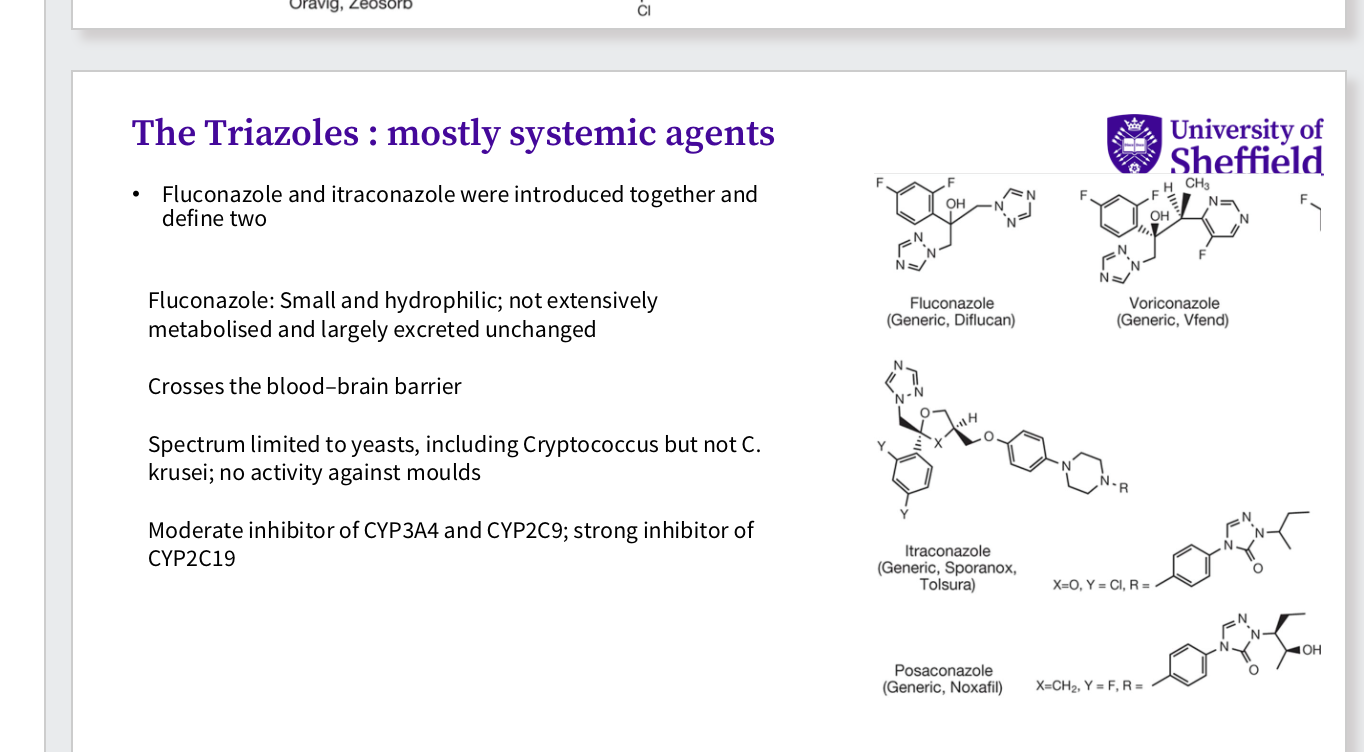
Why are triazole antifungals suitable for systemic use, and how do their structures affect their properties?
Triazole ring: Contains 3 nitrogen atoms; one binds to fungal CYP51 haem iron → inhibits ergosterol synthesis.
Systemic use: Many triazoles have suitable oral bioavailability and metabolic stability.
Fluconazole: Small and hydrophilic → good CSF penetration, useful for certain CNS yeast infections.
Metabolism: Limited hepatic metabolism; mainly excreted unchanged by the kidneys.
Spectrum: Active against many yeasts, including susceptible Candida and Cryptococcus, but not C. krusei or moulds.
Drug interactions: Strong CYP2C19 inhibitor and moderate CYP2C9/CYP3A4 inhibitor → may increase levels of other drugs.
Why was oral ketoconazole withdrawn for fungal infections, and how does its metabolism cause hepatotoxicity?
Absorption: Requires low gastric pH for effective oral absorption.
Metabolism: Extensively metabolised by hepatic CYP3A4.
Drug interactions: Strong CYP3A4 inhibitor → increases concentrations of other drugs.
Hepatotoxicity: A proposed pathway involves:
AADAC converts ketoconazole into N-deacetyl ketoconazole.
FMO1/FMO3 oxidise it.
Further reactions produce a reactive dialdehyde that may damage liver cells.
Clinical outcome: Oral ketoconazole was withdrawn for fungal infections in the UK due to severe liver injury risk, but topical formulations remain available.

What is the structure for a polyene scaffold?
A large macrocyclic lactone (macrolide, with two chemically opposite sides on the same ring:
The hydrophilic side
• A run of hydroxyl groups — the polyol region
• A carboxylic acid
• A sugar, glycosidically linked to the ring
The lipophilic side
• A chromophore of four to seven conjugated double bonds
• This is the polyene that names the class
• It is the face that engages membrane sterols
Polyenes are amphoteric and poorly water-soluble.
They carry both an acidic group (the carboxylic acid) and a basic group (the amine of the sugar), and the two opposed sides make them behave like detergents


What is the Sar for polyenes ?
1) The amino sugar mycosamine is critical for antifungal activity.
Polyene derivatives lacking mycosamine at C19 have no antifungal activity
2) The number of conjugated double bonds correlates directly with antifungal potency in vitro and inversely with toxicity to mammalian cells.
More conjugation: More activity and less toxicity.
What is the mechanism of action for polyenes - membrane sterol drugs ?
1) Binding ergosterol: The polyene face binds the fungal membrane sterol ergosterol with higher affinity than it binds mammalian cholesterol.
2) Aggregate outside the membrane: Rather than inserting as a pore, the drug assembles into large aggregates on the outside of the fungal membrane.
3) Extract the sterol: The aggregate pulls ergosterol out of the bilayer and sequesters it, acting as a sponge that soaks the sterol up.
4)Fungal cell death: The membrane is stripped of the sterol it depends on. The effect is fungicidal, not merely inhibitory

How do the structures of nystatin and amphotericin B affect their antifungal activity, toxicity and clinical use?
Nystatin (tetraene):
Contains 4 conjugated double bonds → lower antifungal potency.
Poor GI absorption → remains in the mouth/GI tract and acts locally.
Too toxic for systemic administration.
Used for oral and gastrointestinal candidiasis.
Amphotericin B (heptaene):
Contains 7 conjugated double bonds → greater antifungal potency.
Can be administered IV for serious systemic fungal infections.
Significant toxicity, especially nephrotoxicity.
Both: Bind ergosterol → disrupt fungal cell membranes → fungal cell death.
Key SAR to remember: The number of conjugated double bonds contributes to antifungal potency, while toxicity and poor oral absorption determine how these drugs are administered clinically.

How does flucytosine selectively inhibit fungal DNA and RNA synthesis?
Structure: Fluorinated cytosine analogue (prodrug).
Uptake: Enters fungal cells via cytosine permease.
Activation: Fungal cytosine deaminase converts flucytosine into 5-FU.
DNA inhibition: 5-FU → 5-FdUMP → inhibits thymidylate synthase → prevents DNA synthesis.
RNA inhibition: 5-FU → 5-FUTP → incorporated into fungal RNA → disrupts protein synthesis.
Selectivity: Human cells lack cytosine deaminase, limiting activation in human cells.
Clinical use: Used with amphotericin B for serious fungal infections, including cryptococcal meningitis.
Key SAR to remember: Flucytosine's cytosine-like structure allows fungal uptake, while its 5-fluorine substitution enables formation of metabolites that disrupt DNA and RNA synthesis.
