Skeletal muscle basics
 Call Kai
 Learn
 Practice Test
 Spaced Repetition
 Match
 Flashcards
 Knowt Play
1/27

There's no tags or description
Looks like no tags are added yet.
28 Terms
Identify the four (4) functions of muscular tissue.
Stabilizing body positions.
Producing body movement.
Storing and moving materials in and out of the body.
Generating heat.
Identify the three (3) types of muscular tissue.
Skeletal, cardiac, and smooth muscle.
Identify the five (5) common properties of muscles.
Excitability
Conductivity
Contractility
Elasticity
Extensibility
Define skeletal muscle.
Skeletal muscle is a collection of muscle cells or fibers.
Define skeletal fibers.
Skeletal fibers are long, cylindrical multinucleated cells.
What is the muscle equivalent of a muscle cell?
Muscle fiber
What is the muscle equivalent of a cell membrane?
Sarcolemma
What is the muscle equivalent of a cytoplasm?
Sarcoplasm
What is the muscle equivalent of a modified endoplasmic reticulum?
Sarcoplasmic reticulum
Identify the three (3) layers of muscular connective tissue (mysia) from most superficial to deep.
Epimysium (around the entire muscle)
Perimysium (around the fascicle)
Endomysium (around the muscle fiber)

Identify the following structures.
Bone
Tendon
Epimysium
Blood vessel
Perimysium
Endomysium
Muscle fiber (Sarcolemma?)
Epimysium
Perimysium
Fascicle
Endomysium
What is myofibril?
Myofibril are the long, rod-shaped organelles inside muscle fibers that drive muscle contraction and relaxation.
Myofibrils are composed of actin and myosin.
Each myofibril is divided into repeating functional units called sarcomeres.
Identify and describe the filaments that comprise myofibrils.
Myofibrils are composed of actin and myosin:
Myosin (thick filament): Thick filamentous motor proteins responsible for movement.
Actin (thin filament): Globular proteins (G-actin) that form long filamentous chains called F-actin.
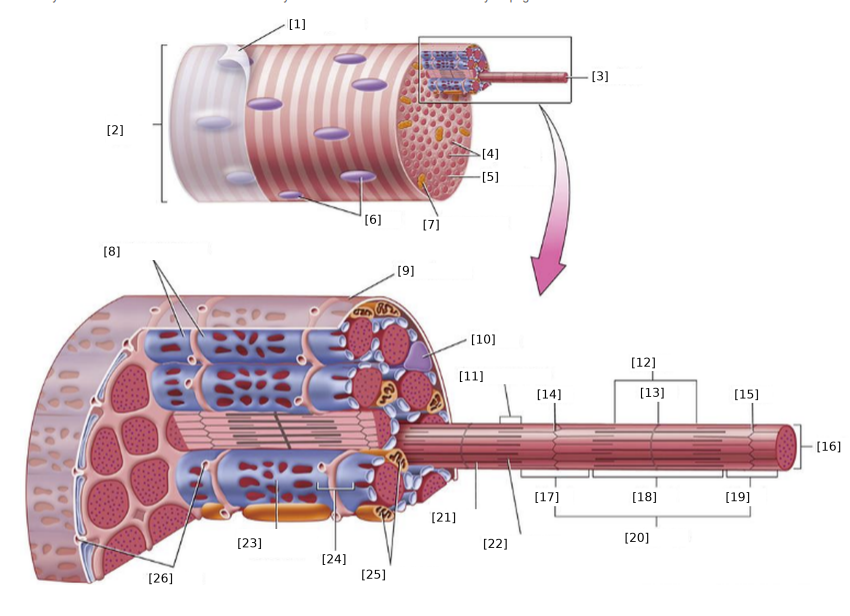
Identify the following structures.
Endomysium
Muscle fiber/cell
Myofibril
Myofibrils
Sarcoplasm
Nuclei
Mitochondria
Terminal cisternae
Sarcolemma
Nucleus
Zone of overlap
H-zone
M-line
Z-disc
Z-disc
Myofibril
I-band
A-band
I-band
Sarcomere
Thick filament (myosin)
Thin filament (actin)
Sarcoplasmic reticulum
Triad
Mitochondria
T-tubules
What is the neuromuscular junction?
The neuromuscular junction is a specialized synapse that connects motor neurons and skeletal muscle fibers, enabling muscle contraction and relaxation.
Contraction: Process that enables the production of force; requires ATP.
Relaxation: Release of tension created by contraction.
Define atrophy.
Atrophy is characterized by a reduction in muscle size and power after a long period of no use.
Define hypertrophy.
Hypertrophy is characterized by an increase in muscle size and contractile activity.
True or false: Muscle cells contain centrioles.
False. Skeletal muscle cells do not contain centrioles, and thus cannot participate in cell division.
They can however, increase or decrease in size.
Identify the four (4) broad categories of muscle fiber arrangements.
Parallel, convergent, pennate, and circular muscles.
Identify the three (3) types of parallel muscles.
Typical parallel muscles
Parallel muscles with tendinous bands
Wrapping muscles
Identify the three (3) types of pennate muscles.
Unipennate muscle
Bipennate muscle
Multipennate muscle
Identify the three (3) types of fiber types.
Slow oxidative: dark, speckled; mitochondria-rich with high oxidative activity.
Fast oxidative: medium gray; intermediate oxidative capacity.
Fast glycolytic: pale; least oxidative.
What is the origin and insertion of a muscle?
Origin: The end of the muscle attached to a fixed, stabilized bone; immovable.
Insertion: The moveable end of the muscle that attaches to the bone being pulled.
What is an agonistic muscle?
Muscle that accomplishes a certain action.
What is an antagonistic muscle?
Muscle that acts in opposition to the agonist.
What are the shortcuts to identify the origin and insertion of a muscle?
For muscles that extend between a broad aponeurosis and a narrow tendon, the aponeurosis is the origin while the tendon is the insertion.
For muscles where there are several tensons on one end and only one on the other end, the region with multiple tendons is the origin, while the region with the single tendon is the insertion.
What is synergistic?
Groups of muscles working together.
What is fixator?
Muscles that holds one bone in place relative to the body while a distal bone is moved by another muscle.