IB ESS: Topic 1.2 Quiz
 Call Kai
 Learn
 Practice Test
 Spaced Repetition
 Match
 Flashcards
 Knowt Play
1/39

Earn XP
40 Terms
What is a system?
An assemblage of parts and the relationships between them, which together, constitute and entity or whole.
How do we study systems in modern ecological investigations?
We study the sytsem as a whole, with patterens and processes described for the whole system.
How can a holistic approach be relevant to systems?
It shows how individual components within the whole system relate to each other.
What are some examples of systems?
Particles
Atoms
Molecules
Cells
Organs
Organ systems
Communities
Ecosystems
Biomes
The Earth
The Solar System
Galaxies
The Universe
What are the two subcategories of flows?
Transfers
Transformations
Define transfers?
They involve a change in the location of energy of matter.
Define transformations?
They involve a change in the chemical nature, a change in chemical state, or a change in energy.
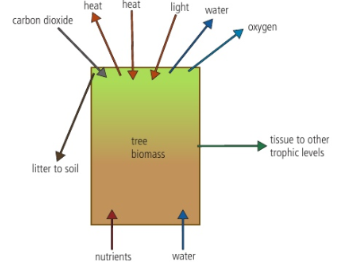
What are the transfers in this tree diagram?
Harvesting forest products, and the fall of leaves and wood to the ground.
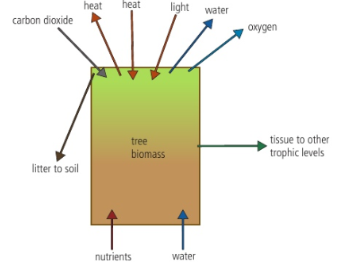
What are the transformations in this tree diagram?
Photosynthesis (CO2 and H2O and light becoming biomass and O2) and respiration (transforming biomass into CO2 and H2O).
Systems can be either…
Opened
Closed

Define an open system?
Exchanges both matter and energy across boundaries of their system. Open systems are organic (living) and so must interact with their environment to take in energy and new matter and to remove wastes. All ecosystems are open systems.

Define a closed system?
Exchanges energy but not matter across boundaries of the system. The Earth can be seen as a closed system with inputs being solar radiation from the sun and output being heat energy.
Who formulated the Gaia hypothesis?
James Lovelock formulated the Gaia hypothesis, named after the Greek supreme goddess of the Earth and compares the Earth to a living organism in which feedback mechanisms maintain equilibrium.
Define the Gaia hypothesis?
It proposes that all parts of the Earth, including the water, rock, soil, atmosphere and the living components (biosphere) are closely integrated to form a complex interacting system.
Esssentially, what does the Gaia hypothesis theory suggest?
It suggests that the Earth is maintaining homeostasis through the interactions of its systems. Earth is a single integrated system.
Define negative feedback loops?
Feedback that counteracts any change away from equilibrium and allows a system to regulate itself. They contribute to stability.

What is an example of a negative feedback loop?
Sweating and vasodilation to cool your body when it gets too hot, or shivering and vasoconstriction to warm your body when it gets too cold
An increased release of CO2 through the burning of fossil fuels leads to enhanced plant growth through increased photosynthesis and lowers levels of CO2.
What is the DaisyWorld Model?
A computer simulation developed by James Lovelock and Andrew Watson that explains negative feedback loops.
What are the assumptions of the DaisyWorld Model?
The only life on DaisyWorld is black and white daisies
Black daisies prefer cooler temperatures and white daisies prefer hotter temperatures
The temperature of the planet is determined by the balance between light absorbed by black daisies and light reflected by white daisies
As a result, the temperature of the planet remains the same within narrow limits
The temperature of the planet is self-regulating
What are the 2 subcategories of Equilibria?
Steady-sate equilibrium
Stable and unstable equilibrium

Define Steady-state equilibrium?
Most open systems in nature are in steady-sate equilibrium. Despite constant inputs and outputs of energy and matter, the overall stability of the system remains.

Define Stable and unstable equilibrium?
If a system returns to the original equilibrium after a disturbance, it is a stable equilibrium. A system that does not return to the same equilibrium but instead forms a new equilibrium is an unstable equilibrium.
Define positive feedback loops?
Occurs when a change in the state of a system leads to additional and increased change. These loops enhance, encourage and amplify change and drive the system to a new equilibrium.
What is an example of a positive feedback loop?
An increase in temperature leads to snow and ice melting which reveals darker surfaces. This leads to a decrease in Earth’s albedo (reflection from the Earth’s surface) and increases absorption which increases temperature.

*Note: population control in animal populations contain both…
positive and negative feedback loops

What can positive feedback loops lead to?
positive feedback loops will tend to amplify changes and drive the system towards a tipping point where a new equilibrium is adopted.
Define a tipping point?
The minimum amount of change within a system that will destabilize it, causing it to reach a new equilibrium or stable state.
What as an example of a positive feedback loop?
Increase in atmospheric levels above 450 ppm would lead to an increase in global mean temperature, causing melting of the ice sheets and permafrost. Reaching this tipping point would cause the melting of the Himalayan mountain glaciers causing water insecurity for many Asian societies.
Define what a model is?
A simplified description designed to show the structure or workings of an object, system, or concept (a simplified version of reality).
What are some examples of a model?
A model could be:
graph
diagram
equation
simulation (or even words)
They can be used to understand how a system works and predict how they respond to change
Whats an example of a complex and simple model?
complex: computer models that predict the effect of climate change
simple: climatic system model

What are strengths of an evaluation of models?
Models allow scientists to simplify complex systems and use them to predict what will happen if there are changes to inputs, outputs, or storages.
Models allow inputs to be changed and outcomes to be examined without having to wait a long time, as we would have to if studying real events.
Models allow results to be shown to other scientists and to the public and are easier to understand than detailed information about the whole system
What are limitations of an evaluation of models?
Environmental factors are very complex with many interrelated components and it may be impossible to take all variables into account.
Different models may show different effects using the same data.
Models themselves may be very complex and when they are oversimplified, they become less accurate.
Many assumptions must be made about complex factors, models such as climate change models may not be accurate. The complexity and oversimplification of climate models has led to some people to criticize these models.
Different models use slightly different data to calculate predictions.
Any model is only as good as the data used. The data used may not be reliable.
Models rely on the expertise of the people making them and this can lead to impartiality.
As models predict further into the future, they become more uncertain.
Different people may interpret models in different ways and so come to different conclusions.
In essence, the need for models to summarize complex systems requires approximation techniquest to be used and these can lead to loss of information and oversimplification.
Define emergent property?
A property that a system has but the individual components of a system do not have.
What is an example of emergent property?
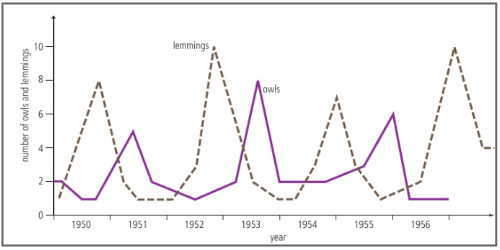
A common example of an emergent property is the predator-prey relationship between lemmings and snowy owls. These predator-prey interactions are controlled by negative feedback mechanisms.
When there are few predatory snow owls, the population of lemmings begins to increase in size. After a period of time, the snowy owl population increases. After another time-lag, the lemming population decreases due predation, then the snowy owl population decreases due to lack of prey.
This is an emergent property because it shows how interactions between two different species lead to fluctuations in population size that are determined by interactions between different components of the overall system.
Define the resilience of a system?
The resilience of a system is the capacity to resist damage and recover from or adapt efficiently to disturbance. It also refers to the system’s ability to avoid tipping points and maintaining stability through a steady-state equilibrium.
What contributes to the resilience of a system?
Main contributors to the resilience of a system is the diversity (large numbers and proportions of species present) and the size of storages within the system.
What kind of diversity do rainforests have?
Rainforests have high diversity, but with enough logging, their resilience has gone down.
What kind of diversity do grasslands have?
Grasslands have low diversity. They have an abundance of nutrients stored below ground in root systems and can recover quickly after fires.
How can humans affect the resilience of systems?
Humans can negatively affect the resilience of a system by reducing these storages and diversity.
Removing trees in the tropical rainforest can have disastrous effects.
Deforestation and reduction in the size of storages leads to decreased productivity through the removal of primary producers (the trees).
Reduction in producers leads to reduced habitat diversity and fewer niches, which threatens more specialized species.
Changed conditions and a less complex ecosystem can lead to species extinction, resulting in shorter food webs and decreased stability.