Intro to muscles, upper limb muscle anatomy
 Call Kai
 Learn
Learn Practice Test
 Spaced Repetition
 Match
Match Flashcards
 Knowt Play
1/93

There's no tags or description
Looks like no tags are added yet.
Name | Mastery | Learn | Test | Matching | Spaced | Call with Kai | Chat |
|---|
No analytics yet
Send a link to your students to track their progress
94 Terms
Muscles attach to bones or other structures via
tendons
attachment point on bone/structure that is more stable, normally most proximal or medial attachment
Origin
attachment point to bone/structure that is more movable, normally most distal
or lateral attachment
Insertion
the primary muscle performing a specific action
Agonist
the muscle(s) performing the opposite action
Antagonist
muscles that aid, adjust, and/or stabilize the action of the agonist
Synergists
muscle fibers arranged in rin
Circular
muscle fibers have broad origin that converge to single insertion poin
Convergent
expanded muscle belly that tapers at ends
Fusiform
fibers run parallel, creating strap-like muscles
Parallel
fibers meet tendon at an angle
Pennate
a muscle that crosses on the anterior side of a joint produces
flexion
a muscle that crosses on the ______ side of a joint produces flexion
anterior
a muscle that crosses on the posterior side of a joint produces
extension
a muscle that crosses on the ______ side of a joint produces extension
posterior side
a muscle that crosses on the lateral side of a joint produces
abduction
a muscle that crosses on the ____ side of a joint produces abduction
a muscle that crosses on the medial side of a joint produces
adduction
a muscle that crosses on the ____ side of a joint produces adduction
connective tissue membrane that bundles structures together in the body
fascia
muscles are grouped together enveloped in
fascial compartments

what is this
trapezius

what is this
levator scapulae

what is this
teres major

what is this
rhomboid minor

what is this
rhomboid major

what is this
latissimus dorsi
trapezius action
elevates, depresses, and retracts scapula
latissimus dorsi action
extends, adducts, and medially rotates arm at shoulder
teres major action
extends, adducts, and medially rotates arm at shoulder
rhomboids major and minor action
retracts scapula and rotates it downward
levator scapulae action
elevates scapula and rotates it downward
pectoralis major action
flexes, adducts, and medially rotates arm at shoulder
pectoralis minor action
depresses scapula, holds scapula against rib cage
serratus anterior function
protracts scapula and rotates it upward
deltoid action
abduction, flexion, extension, medial rotation, and lateral rotation of shoulder
supraspinatus origin
supraspinous fossa
supraspinatus insertion
greater tubercle of humerus
supraspinatus action
abduction of arm at shoulder
infraspinatus origin
infraspinous fossa
infraspinatus insertion
greater tubercle of humerus
infraspinatus action
lateral rotation of arm at shoulder
teres minor origin
lateral border of scapula
teres minor insertion
greater tubercle of humerus
teres minor action
lateral rotation of arm at shoulder
subscapularis origin
subscapular fossa
subscapularis insertion
lesser tubercle of humerus
subscapularis action
medial rotation of arm at shoulder
shoulder abduction is carried out by
trapezius, serratus ansterior, deltoid, and supraspinatus
coracobrachialis origin
coracoid process
coracobrachialis insertion
shaft of humerus
coracobrachialis function
flexion of arm at shoulder
biceps brachii origin
scapula
biceps brachii insertion
radial tuberosity
biceps brachii function
flexion of forearm at elbow, flexion of arm at shoulder, supination of forearm
brachialis origin
shaft of humerus
brachialis insertion
ulnar tuberosity
brachialis function
flexion of forearm at elbow
triceps brachii origin
scapula and humerus
triceps brachii insertion
olecranon process of ulna
triceps brachii function
extension of forearm at elbow, extension of arm at shoulder (long head only)
anterior compartment of forearm layers
superficial- 4 muscles, intermediate- 1 muscle, deep- 3 muscles

flexes wrist
flexor carpi radialis

pronates forearm
pronator teres

tenses skin of palm
palmaris longus

flexes wrist
flexor carpi ulnaris

flexes digits #2-5 at proximal interphalangeal join
Flexor digitorum superficialis

pronates forearm
pronator quadratus

flexes thumb
flexor pollicis longus
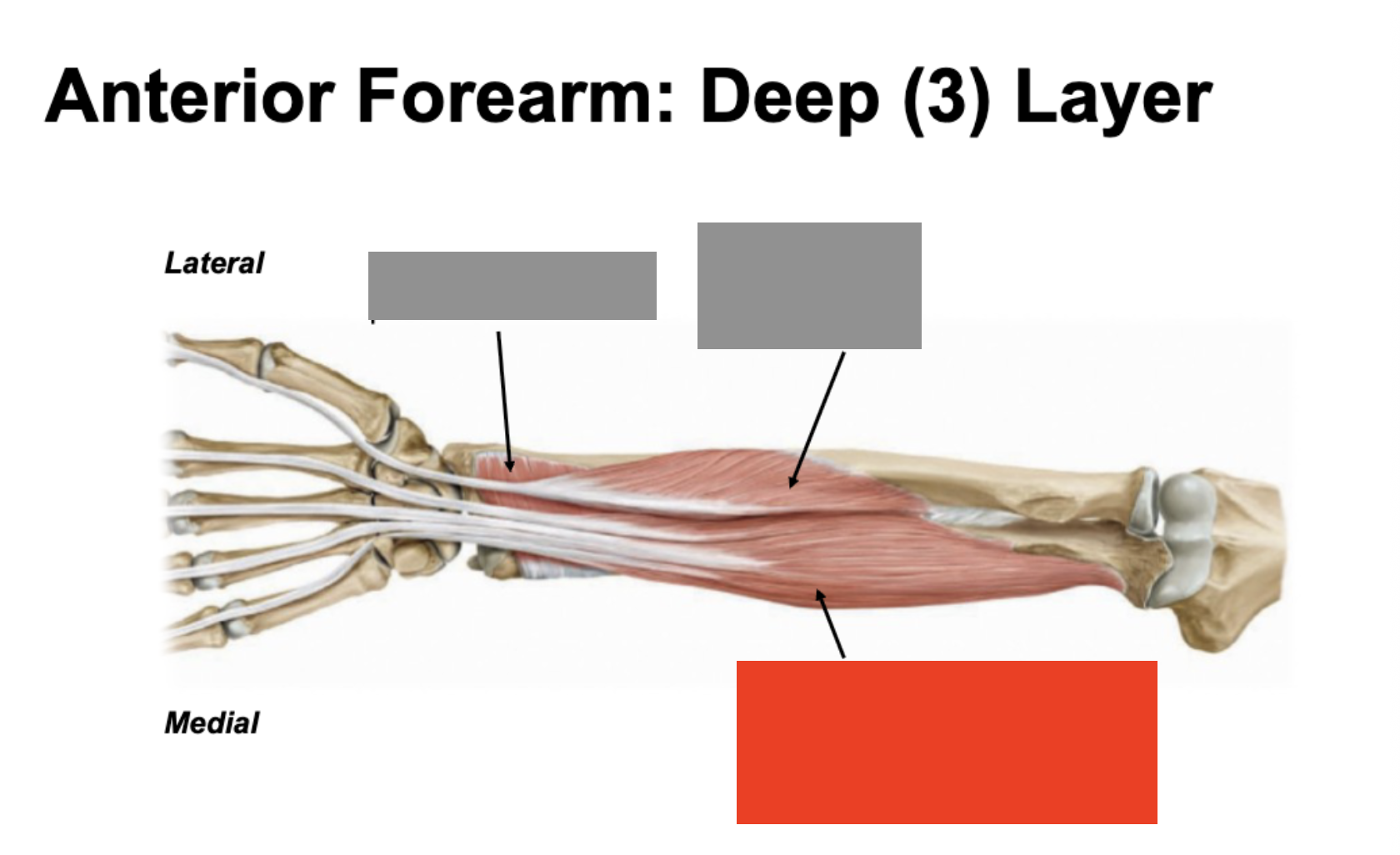
flexes digits 2-5 at distal interphalangeal joint
flexor digitorum profundus
posterior compartment of forearm layers
mobile wad- 3 muscles, superficial layer- 3 muscles. deep layer- 5 muscles

what is this
flexor carpi ulnaris

what is this
mobile wad

extends wrist
extensor carpi radialis brevis
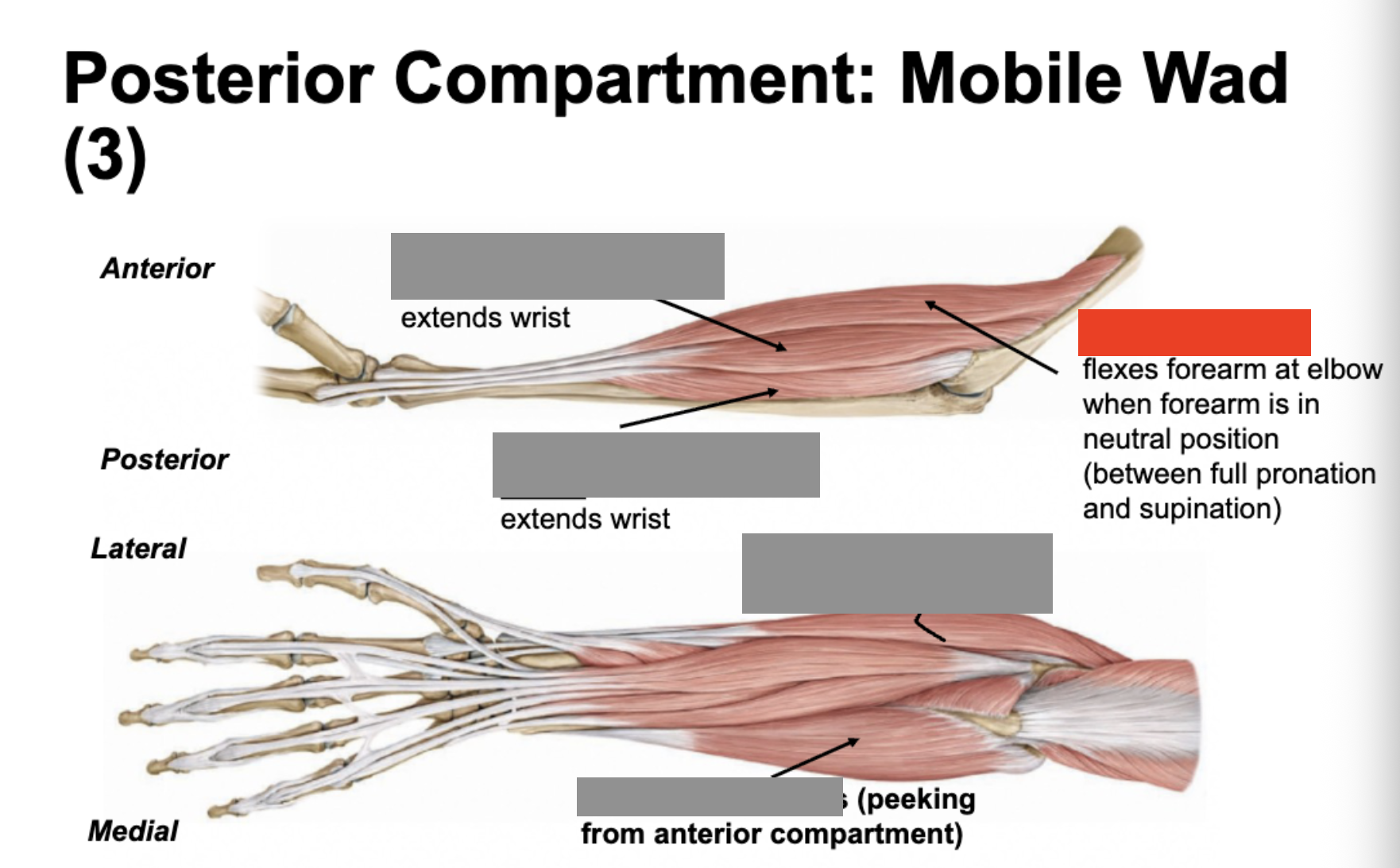
flexes forearm at elbow when forearm is in neutral position
brachioradialis

extends wrist
extensor carpi radialis longus

extends 5th digit
extensor digiti minimi

extends wrist
extensor carpi ulnaris

extends digits 2-5
extensor digitorum

what is this
extensor digiti minimi

what is this
flexor carpi ulnaris

extends thumb
extensor pollicis longus

abducts thumb
abductor pollicis longus
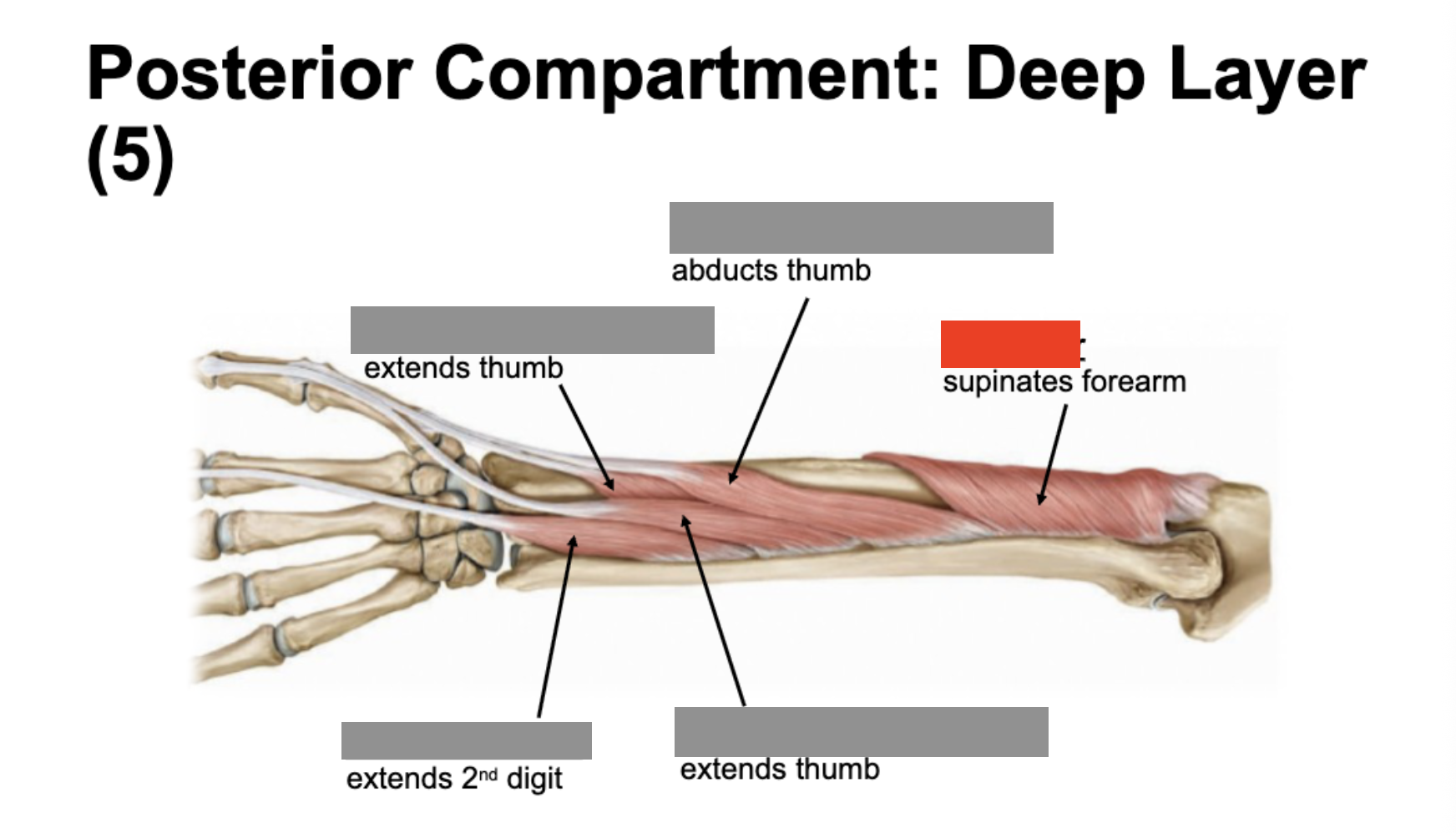
supinates forearm
supinator

extends thumb
extensor pollicis brevis

extends 2nd digit
extensor indicis
Flexor carpi radialis + flexor carpi ulnaris =
wrist flexion
Extensor carpi radialis (longus and brevis) + extensor carpi ulnaris =
wrist extension
Flexor carpi radialis + extensor carpi radialis (longus and brevis) =
wrist abduction
Flexor carpi ulnaris + extensor carpi ulnaris =
wrist adduction

what is this?
flexor digitorum superficalis tendons

palmar interossei (3) adduct digits, dorsal interossei (4) abduct digits “PAD DAB”
Interossei muscles

flexes, abducts, and opposes thumb
thenar muscle group

flexes, abducts, and opposes 5th digit
hypothenar muscle group