physics chapter 1
 Call Kai
 Learn
Learn Practice Test
 Spaced Repetition
 Match
Match Flashcards
 Knowt Play
1/92

There's no tags or description
Looks like no tags are added yet.
Name | Mastery | Learn | Test | Matching | Spaced | Call with Kai | Chat |
|---|
No analytics yet
Send a link to your students to track their progress
93 Terms
What is physics
science that focuses on quantifying observed natural phenomena.
accomplished by using equations that represent the given phenomena and solving the equations to determine quantities related to whats being observed.
Whats the difference between experimental and theoretical physics
Experimental physics involves collecting data based on an experimentation thats designed to get quantifiable information about how something is behaving.
EX: finding the position of an object vs time for a force
Theoretical physics involves developing equations which can be used to make predictions about what is expected to happen.
EX: to determine a function that tells us the predicted position x at all times for t in a given situation
They theoretical makes equations to predict the observations made by experimental
what are the 2 main types of equations
Equations of motion: tells us how things change as a function of time so we can predict how something behaves.
EX: N2 law, kinematic equations
Conservation laws which has to do with things that stay constant throughout motion.
EX: conservation of energy and momentum
Equations of motion- dynamic
these equations are presented as the main equation for a physical theory
Using N2 law to develop an equation based on the external forces acting on an object to solve for position of an object as a function of time x(t) which will describe its motion
Since they are differential equations, they require initial position and speed to solve, and the answer is a function
The ideal spring model- dynamic
spring has no mass and no friction so it will oscillate back and forth forever. typically has a mass attached to the end
Fx=-kx
when its not stretched or compressed x=0 (equilibrium position) at this position Fspring=0
when block is poulled right spring force points left to return to equilibrium. the -ve sign is the equation represents the force opposing the motion or displacement.
the spring constant tells us the stiffness of the ideal spring (N/m)
The more you stretch or compress, the greater the spring force that wants to go back to equilibrium.

What happens when a spring oscillate with object
when you pull spring right it has +A and release it, block accelerates left because max spring force is going left.
as it gets closer to x=0, spring force decreases until spring force =0.
The block does not stop though because it has maximum speed so it flies past equilibrium to compress the spring
the farther the block from equilibrium the greater the acceleration, when a spring is streched fully speed is zero and gets faster as it goes towards x=0
Kinematic equations of motion
equations that represent the position of an object as a function of time without referring to external fields or forces. it describes how something moves without asking what caused the motion. it just says given this, what is the position.
acceleration must be constant and is for motion in 1D

Kinematic equation notation subscripts
Vox= the initial quantity in the x direction (time=0)
Vx- the final quantity in the x dimension
conservation laws
Conservation of energy E
The basic idea is that energy cannot be created or destroyed but can be transferred or converted. so the initial energy in a system= the final energy
conservation of momentum p→
there is no external impulse on the system so the momentum before collision = momentum after collision
how to solve for 2 unknowns at the same time
To solve for 2 unknowns at the same time with 2 equations we can:
substitiution
elimination
graph both equations and find POI
Point mass
Everything can be approximated as a single point in space that contains the entire mass of the object. This simplifies calculations. particle physics involves treating elementary particles as point masses and focusing on how they interact with fundamental interactions such as gravity so it is very common.
studying motion of point masses using equations of motion
Dimension
the number of coordinates required to specify a point in space. (1D, 2D, 3D)
we will work in 3D (x, y, z)
coordinates
the values that defines the exact point in space to specify positions of objects (x,y,z)
Physical quantities
it must be something that can be measured having a numerical value and a unit.
They are often functions of some other variables meaning The value of that physical quantity can change depending on another variable.
they are represented with scalars and vectors
EX: when you are waling your position x changes as time moves on so position depends on time

scalars
quantities that have magnitude but no direction.
can be tve, -ve or zero.
vectors
many physical quantities are vectors because they have direction. to express a physical quantity as a vector we must do it in 3D notation and say the direction of motion.
The components are positions as a function of time so as time passes and the object moves the 3 components will tell you exactly where they are at a specific point in time

velocity
velocity is a vector that describes how fast we are going (m/s) and magnitude of it is speed
motion in 1D
when an object is only moving in one component so there is no motion in x and z for example. The x and z dont need to be zero they just must be constant.
the x and z components for velocity and acceleration will be zero since there is no motion in those directions.
the object does not need to be moving parallel to axis it must be moving in a straight line in 3D space such that all points for all time are on the same line.

average velocity
a measurement of the rate of change of position of an object which travelled a displacement over time. takes into account start and end point without referencing high and low velocity points
instantaneous velocity
the derivative of a position function. measures the velocity at a specific point in time.its the limit of the average velocity (at a single point)
why does average velocity in xnot equal average speed in x
average velocity uses the displacement and average speed uses the total distance so if the distance goes back and forth it will be different from displacement giving you different values
average acceleration
rate of change of the velcoty function with respect to time. tells us on average hoe much we are accelerating
instantaneous acceleration
time derivative of the velocity function telling you the acceleration at every point in time
Graphs of differential functions
at each differentiation the order decreases by one. speed is magnitude of velocity and cannot be negative

positive and negative signs for position and velocity
position: the sign will indicate position relative to the origin
velocity(+): indicates moving in the =+x direction
Velocity(-): sign indicates moving in -x direction
EX: if x=-5 moving towards origin vx is positive but if x=5 moving towards origin vx is negative
positive and negative signs for acceleration
acceleration is positive: moving in +x and speeding up
acceleration is positive: moving -x direction and slowing down
acceleration is negative: moving in +x direction and slowing down
acceleration is negative: moving in -x direction and speeding up
force vector
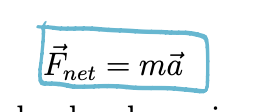
a force is a push or a pull which can cause a change in motion including stopping or changing direction the object is moving. if the net force acting on an object in not zero then the net force will cause a change in motion
Newtons 2 law with respect to ideal spring
the spring force is not a constant force it depends on position of mass relative to the equilibrium. so the equilibrium of the spring is when hookes law =0 so there is zero force on the mass on the end of spring.
-ve sign shows the spring is a restorative force- axts to move the system back to equilibrium.
since Fs is only force the net force is just that force
A solution to this case must be LS =RS
tIt tells us that the spring force causes the acceleration predicted by Newton's 2nd law and the farther the mass, the greater the acceleration back towards equilibrium

angular frequency
tells us how quickly the spring is oscillating back and forth.
if k increases the spring is stiffer (directly proportional to w)
if m increases the mass is heavier and it will oscillate slower (inversly propersional to w
how is sin equation related to spring overall summary

simple harmonic motion
Simple harmonic motion happens when an object's acceleration is proportional to its displacement from equilibrium and always points back toward equilibrium
Eamples of simple harmonic motion
LC circuit
molecular vibrations
vibrating string
rigid body oscillations
object bobbling in water
plasma physics
quantum mechanics
kinematic equation of motion integrals
Integrals reverse the derivative equation working backwards. integration can only happen because acceleration is constant.
we have 4 kinematic equations with 4 variables that do not equal zero and each appear in only ¾ equations because when we derive equations you must always eliminate a different variable

motion in 1D using kinematics
to solve for motion in 1D,
is acceleration constant
draw the situation, decide where object starts, direction and choose the positive axis
identify what you are trying to find look for the variable you do not have
pay attention to tve and -ve signs
solve
1D motion near earths surface
when acceleration is constant we can use the kinematic equations for near earth problems we replace acy with -g. -ve beacuse gravity is pointing downwards and we usually classify y in the upward positive direction.
the origin is usually earths surface at y=0

N3 law
force between 2 objects exist in equal magnitude and opposite directions
force of a on b= -force of b on a
the forces dont cancel out because the a finger exerts force on wall and the wall exerts force on finger.
3 types of problems for N2 law
changing acceleration: ideal spring
constant acceleration (non zero): kinematic equations near earth problems
constant acceleration (zero): equilibrium situations
possibility A: equilibrium- acceleration is zero and the velocity is a nonzero constant (object os still moving)
possibility B: : static equilibrium- acceleration is zero and velocity is zero. the object is not moving.
types of forces
Normal force: the force a surface exerts on an object which is perpendicular to surface
friction force: the force a surface exerts on an object parallel to surface
tension force: a pulling force on an object (massless string)
weight: the force due to gravity
acceleration constraints
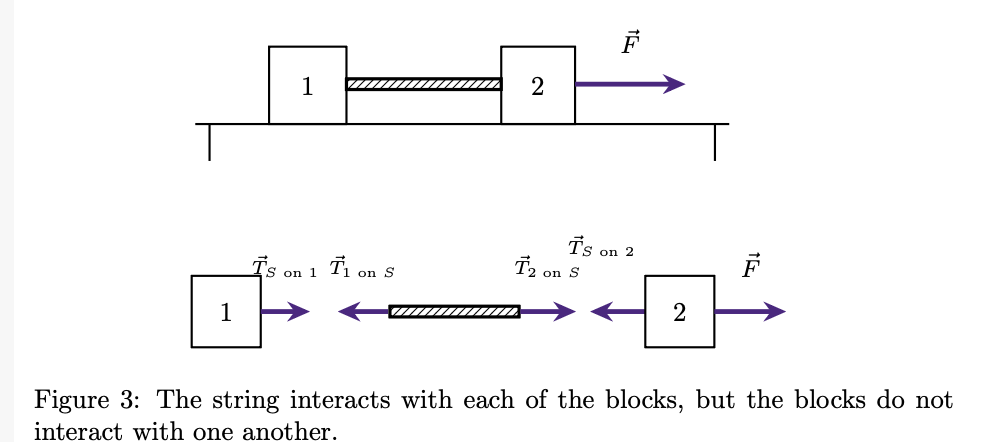
if 2 objects are connected, they are moving together and have the same acceleration so the acceleration for each object can be written using the same symbol.
massless string approximation
strings are massless because yes it is an object but they connect to blocks. the 2 blocks do not directly interact with one another so the only thing relating them is the string.
if the string is treated like a mass the net force would be too complicated so we set Msax=0
so we can rearrange the equation for net force and have the tension of 2 on string= tension of 1 on string.
SO, the force experience by each block has the same magnitude and can act as if they directly interact.
Static equilibrium
when an object is in static equilibrium the net forces acting on an object are equal to zero and the object is stationary.
forces can be present in the components but when added they must sum to zero. vector hat on tension symbolizes that they each have multiple components
friction
friction acts when we try to move one object across another
static friction
kinetic friction
static friction
the amount of force that needs to be exerted on an object for it to start to move. the maximum static friction is the max amount of static friction force we see before motion occurs.
if the object has not yet started to move, then the magnitude of static friction is equal to the magnitude of the applied force, so forces cancel and we have zero acceleration since there is no movement. true until fmax
An object is at rest while Fs<Fsmax

kinetic friction
the amount of friction while in motion.
it is a constant force. it is not equal to the max static friction, once an object starts to move, the force drops slightly until is becomes constant

Applied force
this is a push or a pull
non constant forces
constant forces are not functions of time. When you have a non constant force acceleration is not constant and the force depends on time.
we are not able to use kinematic equations because… so we now have an acceleration function and must use integrals to get position and velocity

direction of motion for pulley problems with friction possible outcomes
move right
move left
stationary, static friction left
stationary, static friction right
stationary, tensions are equal and opposite (no movement)
3 block pulley problem motion conditions
if T2>T1, friction will point left (m3>m1)
If T2> T1+Fsmax, the block will move because it overcomes T1 and the static friction, and we will have kinetic friction on the diagram
if T2<T1 +Fsmax, the block will not move because it does not overcome T1 and static friction and we will have static friction on diagram
2. if T1>T2, friction will point right (m1>m3)
if T1>T2 +Fsmax, block will move because it overcomes static friction and we will have kinetic friction
if T1<T2 + Fsmax the block will not move because it doesnt overcome static friction
If T1=T2, the tension is equal and static friction =0

systems of linear equations
2 equations and 2 unknowns
3 equations and 3 unknowns
2 equations and 2 unknowns
if there are more equations that unknowns, there can be a unique solution.
if there are more unknowns than equations, there is infinitely many solutions or no solutions.
the denominatiors cannot be zero or else there is no unique solution

steps to solve a system with 2 equations and 2 unknowns
draw a free body diagram for each object with coordinate axis
newtons 2nd law for each object
check the condition for a unique solution (denominators do not equal zero)
solve for required unknown by using equation 5 and 6
Block and pulley with ramp motion conditions
if T>m1gsintheta + Fsmax, the force of tension is greater than static friction causing the block to move up ramp (tension will point down ramp)
If m1gsintheta>T + Fsmax, the force of gravity is greater than tension and static friction and block will move down ramp (tension will point up ramp)

how does a ramp pulley problem with physics connect to no ramp friction problem
when you get the equation for the ramp pulley problem with friction and want to change the conditions to without friction and flat, you can sub those components=0.
when this happens we can get the original equation that was solved for before showing the connection
projectile motion
involves the 2D motion near the earths surface where the acceleration due to gravity is a constant so kinematic equations can be used.
We assume no air resistance so we have a constant ay.
we assume z is a constant and x and y acceleration components are constants acx=0 and acy=-g
kinematic equations for x component in projectile motion
there is no acceleration in x for projectile motion because we ignore air resistance so we can sub a=0 into the equations.
when we do this and simplify our equations equations 1 and 3 and 2 and 4 are equal resulting in 2 kinematic equations in x for projectile motion

kinematic equations for projectile motion in y
the equations are the same except we sub a = -g. we will use 2 of the equations that directly give us the position and velocity functions

position velocity and acceleration vectors for projectile motion

classic projectile motion
same starting and ending height, launched from the ground and lands on the ground.
time: tH the time it takes to reach max height (Vy=0), half of time it takes to reach max range (peak) tR=2tH
launch angle in terms of initial velocity components
maximum height, Hmax which is how high above ground the projectile gets at peak of motion
range R, total distance travelled in x

classic projectile: time to reach maximum height
when Vy=0, we are at max height since this is the point when the object turns around and starts heading back to the ground.
we can use our velocity equation for Vy and sub it =0 and rearrange for tH

classic projectile: launch angle
at t=0 we have initial velocity vector, so we use our trigonometry vector components to determine launch angle.
then we use tan law where Voy/Vox=tan and rearrange and get our launch angle

classic projectile: max height
we can use our position kinematic equation for y and sub in our equation for tH into t and simplify to get an expression for max height.
the ½ factor is there because the velocity in y is changing with respect to time due to gravitational acceleration unlike x where there is no acceleration.

classic projectile: range
the horizontal distance travelled by x so the change in x is equal to the range.
rearrange one of the x equantions and replace delta x with R. range is double the max height because projectile takes equal heigh going up as it does going down.
so we sub tH into x equation and simplify

linear quadratic systems of equations
the quadratic equations in this system are a conic section that has 3 different possibilities: parabola, ellipse and a hyperbola depending on the known coefficents and which unknowns are present.
this is when a 2D plane intersects a 3D cone at different angles.

how to determine solutions for a linear quadratic system
we use the discriminant.
if D>0- 2 solutions (line intersects twice)
if D=0, one solution (line intersects once gas a repeated root)
If D<0, no solutions (no intersection
projectile motion: variable initial heights
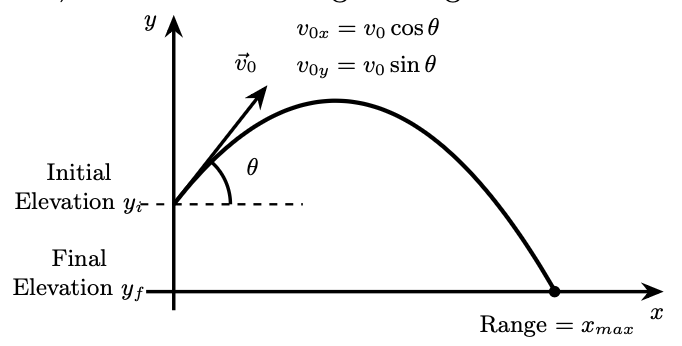
projectile is launched from a higher initial height and lands lower.
the difference from classical motion is that Yo does not =0 and the change in Y is not 0 because we launch from a different height than we land so displacement is difference between start and end height.
whats given in variable intial height problems
launch speedVo
launch angle
launch height Yo=h
y=0 is the landing point on the ground

how to solve for rangle for variable initial height
isolate for t in initial range equation and sub into quadratic equation
simplify
only take positive root because negative range indicates negative time. so there are 2 solutions from the discriminant but we only use one

total flight time: variable initial height
isolate t from x equation again but for tT and substitute into range equation (R)
variable final height
projectile starts from ground and reaches a different higher final height. the change in y=h.
common givens for variable final height
launch speed Vo
launch angle
distance to wall d
for our equations we replace x with d in our x equation and Xo=0
for y equations h is positive and yo=0
unknowns are h and t, isolate t to figure out and sub into h equation after

total flight time
this can be determined by simply isolating the x dimension equation of tT
how to solve for trajectory of projectile
we rearrange our x equation for t and sub it into our y equation.
it must be in the form of a quadratic equation, so we need to foil out the brackets and expand. This is for our classic projectile motion

four fundamental interactions
There are 4 fundamental interactions/forces:
Gravity
Electromagnetism
Weak interaction
Strong interaction
They are called fundamental because currently we cannot explain them in terms of anything more basic
Gravity- newton vs einstein
Newtonian Gravity
Works extremely well for everyday situations on Earth and most solar-system situations.
Fg=mg) comes from Newtonian gravity.
Still commonly used in areas such as engineering and construction.
General Relativity
Einstein developed General Relativity because Newtonian gravity could not explain certain observations, such as aspects of Mercury's orbit.
Its equations of motion are called:
Einstein's Field Equations
maxwells equation
Electricity and magnetism were originally thought to be separate phenomena.
James Clerk Maxwell unified them into electromagnetism.
The fundamental equations are:
Maxwell's Equations
weak interaction
Weak nuclear force: Important at the subatomic level.
Associated with phenomena such as: radioactive decay
Its mathematical framework is based on Yang–Mills theory.
strong interaction
Strong nuclear force
Responsible for:
Helping hold atomic nuclei together
Holding together the elementary particles that form protons and neutrons
Like the weak interaction, its mathematical framework is based on Yang–Mills theory.
quantum mechanics
Classical mechanics works well for macroscopic objects, but does not properly describe many microscopic phenomena.
At approximately atomic/nanoscale sizes: Quantum mechanics becomes necessary
The lecture roughly separates:
Size far larger than \(10^{-9}\) m → classical mechanics
Size near or below \(10^{-9}\) m → quantum mechanics
Two major mathematical descriptions are:
Schrödinger
Heisenberg
standard model of physics
The Standard Model is our current description of much of the fundamental physics of the universe. It includes 3 of the 4 fundamental interactions:
Electromagnetism + Weak + Strong
It does NOT include gravity.
These interactions have been described using quantum field theories.
Examples:
Electromagnetism → Quantum Electrodynamics (QED)
Strong interaction → Quantum Chromodynamics (QCD)
Electromagnetic + weak → unified into Electroweak Theory
Particle accelerators such as the Large Hadron Collider (LHC) allow scientists to collide particles and study nature at very small scales
grand unified theory
Grand Unified Theory (GUT)
Goal: combine: Strong + Weak + Electromagnetism into one self-consistent theory.
This has not yet been fully achieved.
Theory of Everything
Even bigger goal: Gravity + Strong + Weak + Electromagnetism
All four fundamental interactions described by one unified framework. A major difficulty is incorporating/quantizing gravity
why fundamental physics matters
Equations of motion are not only academic.
Understanding fundamental physics eventually leads to technologies that may be developed long after the original physics was discovered.
Examples covered in this lecture:
Medical imaging/treatment
GPS
Electricity generation
Solar cells
Nuclear power
Lasers
Semiconductors
Telecommunications
MRI
MRI uses both:
Electromagnetism + Quantum Physics
Basic process:
Magnets create a static magnetic field.
The field aligns hydrogen nuclei in the body.
Pulses excite the nuclei.
As the nuclei relax, electromagnetic waves are detected.
Signals are processed to construct images.
Multiple 2D scans can be combined into 3D images.
Maxwell's equations are involved in describing the electromagnetic fields.
X-RAY imaging
X-rays are a type of:
electromagnetic radiation
They pass through the body, but different tissues absorb different amounts. Dense materials such as bone absorb more, so they appear white in typical X-ray images.
A CT scanner:
Rotates an X-ray device around the patient
Takes many 2D scans
A computer combines them to produce 3D images
PET scans
PET scans use a radioactive substance injected into the bloodstream.
The substance decays and ultimately produces: gamma rays
The gamma rays are detected by scanners.
Millions of detected events are combined to create a 3D image.
Unlike basic structural imaging, PET scans can provide information about metabolic/cellular activity, making them useful for applications such as detecting cancer
radiation therapy
Radiation therapy uses high doses of electromagnetic radiation, such as:
\[ \boxed{\gamma\text{ rays}} \]
Radiation is focused on a tumour to damage and kill cancer cells.
According to the lecture, cancer cells are more prone to this damage, while healthy cells are generally better able to recover.
GPS and relativity
GPS satellites contain extremely precise: atomic clocks
Both Special Relativity and General Relativity affect the rate of satellite clocks relative to clocks on Earth.
GPS systems must correct for these relativistic effects.
Without the corrections: GPS positions would drift by kilometres per day
This is an important everyday application of relativity
power generation- electromagnetism
One of Maxwell's equations tells us:
Changing magnetic field → electric field
This principle can be used to produce electric current.
For example, rotating a wire loop in a magnetic field continually changes the magnetic field through the loop.
That creates an electric field, causing charges to move:
moving charges=electric current
This is fundamental to generators, transformers, and electrical power grids.
Generators
A generator converts: Mechanical energy → Electrical energy
Mechanical energy rotates a magnet or coil.
Sources of mechanical energy can include:
Moving water → hydroelectric
Wind → wind turbines
A person physically turning a crank
The motion itself can be described using classical mechanics, while the generation of electricity involves electromagnetism.
solar cells
Solar cells convert:
Sunlight → Electrical energy
They work through the: Photovoltaic effect
which is described by quantum mechanics.
Unlike traditional generators, solar cells do not require mechanical energy as the input.
Nuclear power
Nuclear physics studies atomic nuclei and involves the: Strong + Weak interactions
Nuclear Fission
splitting atoms releases large amounts of energy. That energy can ultimately provide mechanical energy to generators.
Nuclear Fusion combining nuclei
Fusion is the process used by the Sun to generate energy.
According to the lecture, fusion is not yet commercially viable but is an important area of research and is expected to produce less long-lived radioactive waste than fission.
lasers
Lasers involve quantum physics and the emission of photons.
They can produce electromagnetic radiation from different regions of the electromagnetic spectrum depending on the application.
Uses include:
LASIK eye surgery
Precision manufacturing/cutting
Fiber-optic communication
DVDs/Blu-ray
Scientific research
The lecture also highlights Canadian physicist Donna Strickland, who shared the 2018 Nobel Prize in Physics for work involving Chirped Pulse Amplification (CPA), which enables high-intensity laser applications
semi conductors
Semiconductors combine ideas from: Quantum mechanics + Electromagnetism + Solid-state physics
They are foundational components of modern electronics.
Examples of devices relying heavily on semiconductors:
Smartphones
Laptops
Tablets
telecommunications
Maxwell's equations describe electromagnetic waves, including how they:
Are generated
Propagate
Interact with materials
Radio waves are electromagnetic waves that can carry information.
Basic process: Transmitter → radio wave → receiver
Used for:
Mobile phones
Satellite communication
Radio
Television antennas