Musculoskeletal System Definitions
 Call Kai
 Learn
 Practice Test
 Spaced Repetition
 Match
 Flashcards
 Knowt Play
1/73

There's no tags or description
Looks like no tags are added yet.
74 Terms

Flexion
Bending a limb, ex. Elbow and knee

Extension
Straightening a flexed limb, ex. Elbow and knee

Circumduction
Moving a body part in a circular motion, ex. Shoulder and hip

Abduction
Moving away from the middle, ex. Shoulder and hip

Adduction
Moving toward the middle, ex. Shoulder and hip

Protraction
Moving forward, ex. Jaw

Retraction
Moving backward, ex. Jaw

Rotation
Moving around a central axis, ex. C1 Vertebrae

Dorsiflexion
Bending backward, ex. Wrist and ankle

Pronation
Turning palm down, ex. Wrist
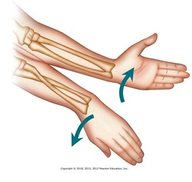
Supination
Turning palm up, ex. Wrist

Eversion
Turning sole out, ex. Ankle

Inversion
Turning sole inward, ex. Ankle
Agonist
The muscle that is the primary mover of a given movement.
Amputation
Surgical or traumatic removal of a limb, part, or other appendage.
Antagonist
Muscle that counteracts the action of another muscle.
Arthralgia
Joint pain.
Ataxia
Lack of muscular coordination.
Atonic
Lack of normal muscle tone.
Atrophy
Loss of muscular tissue that may be caused by lack of use or lack of nerve stimulation of the muscle.
Brachyalgia
Pain in the arm
Bradykinesia
Slowness of motion or movement
Bursa
Pad-like sac between muscles, tendons, and bones that is lined with synovial fluid and contains a fluid
Calcaneal
Pertaining to the heel bone
Carpal
Pertaining to the wrist bones
Cast
Medical equipment that is hard and used to immobilize a fractured bone, dislocated joint, or sprain
Chondral
Pertaining to cartilage
Clavicular
Pertaining to the clavicle or collar bone
Coccygeal
Pertaining to the coccyx or tailbone
Contracture
Shortening of the muscle that is then resistant to stretching
Dactylogram
A fingerprint
Dislocation
Separation of the bone from the joint
Dystonia
Impaired muscle tone
Fixation
Process of holding or securing in a fixed position
Flaccid
Lacking muscle tone
Hallux
The great toe
Humeral
Pertaining to the humerus
Iliac
Pertaining to the ilium.
Iliosacral
Pertaining to the ilium and the sacrum.
Intercostal
Pertaining to the space between two ribs.
Ischial
Pertaining to the ischium.
Lumbar
Pertaining to the lower back.
Mandibular
Pertaining to the lower jaw.
Maxillary
Pertaining to the upper jawbone.
Meniscus
Crescent-shaped cartilage that is located in certain joints, such as the knee.
Myalgia
Pain in the muscle.
Orthopedics
Area of medicine focusing on the musculoskeletal system, its structure, function, and pathology.
Osteogenesis
Formation of bone
Pedal
Pertaining to the foot
Radial
Pertaining to the radius
Spinal
Pertaining to the spine.
Symphysis
A firm joint, made of cartilage.
Synergist
The muscle that acts alongside another muscle to produce movement.
Tibial
Pertaining to the tibia
Ulnar
Pertaining to the ulna
Xiphoid Process
Cartilage shaped like a sword located at the base of the sternum
Long Bones Location and Example
Located in the arms and legs, ex. Femur
Flat Bones Location and Example
Located in the shoulder, skull, ribs, and parts of the pelvis, ex. Sternum and skull
Short Bones Location and Example
Located in the fingers and toes, ex. Carpal bones
Irregular Bones Location and Example
Located in the spine and ear, ex. Vertebrae
Sesamoid Bones Location and Example
Shaped like a sesame seed, ex. Patella
Cartilage
Fibrous connective tissue found at the ends of bones, in joints, and the tube structures of the body,e x, larynx, air passages, ears
Tendons
Fibrous cords that connect muscles to bones
Ligaments
Fibrous tissues in bands or sheets that connect two or more bones, cartilages, or other structures, helping to support fascia and muscles
Joints
Where two or more bones connect
Skeletal Muscles
Attach to bones around joints and contract to produce movement
Parts of Skeletal Muscle
Origin, Insertion, and Body
Muscle Origin
Where the muscle starts and is attached to a fixed bone
Muscle Insertion
Where the muscle attaches to the bone that it moves
Muscle Body
Between the origin and insertion, where contraction occurs
Fibrous Joints
Joints that do not provide any movement, ex. Joints in the skull
Cartilaginous Joint
Provides slight movement, ex. Between vertebrae
Synovial Joint
Allows free movement in a variety of directions, ex. Hips, knees, shoulders, elbows, wrists, ankles
Synovial Fluid
Lubricating fluid found in synovial joints that allow for free movement in multiple directions