Management of Abnormal Gait Patterns & Balance Deficits in Neurological Disorders
 Call Kai
 Learn
 Practice Test
 Spaced Repetition
 Match
 Flashcards
 Knowt Play
1/87

There's no tags or description
Looks like no tags are added yet.
88 Terms
What is one of the early and most characteristic symptoms of neurologic disorders
What is critical to independence?

Gait and Balance Difficulty in Neurologic Disorders stats

How a pathology impacts gait depends on?

Impairments affect gait & balance - msk vs nm
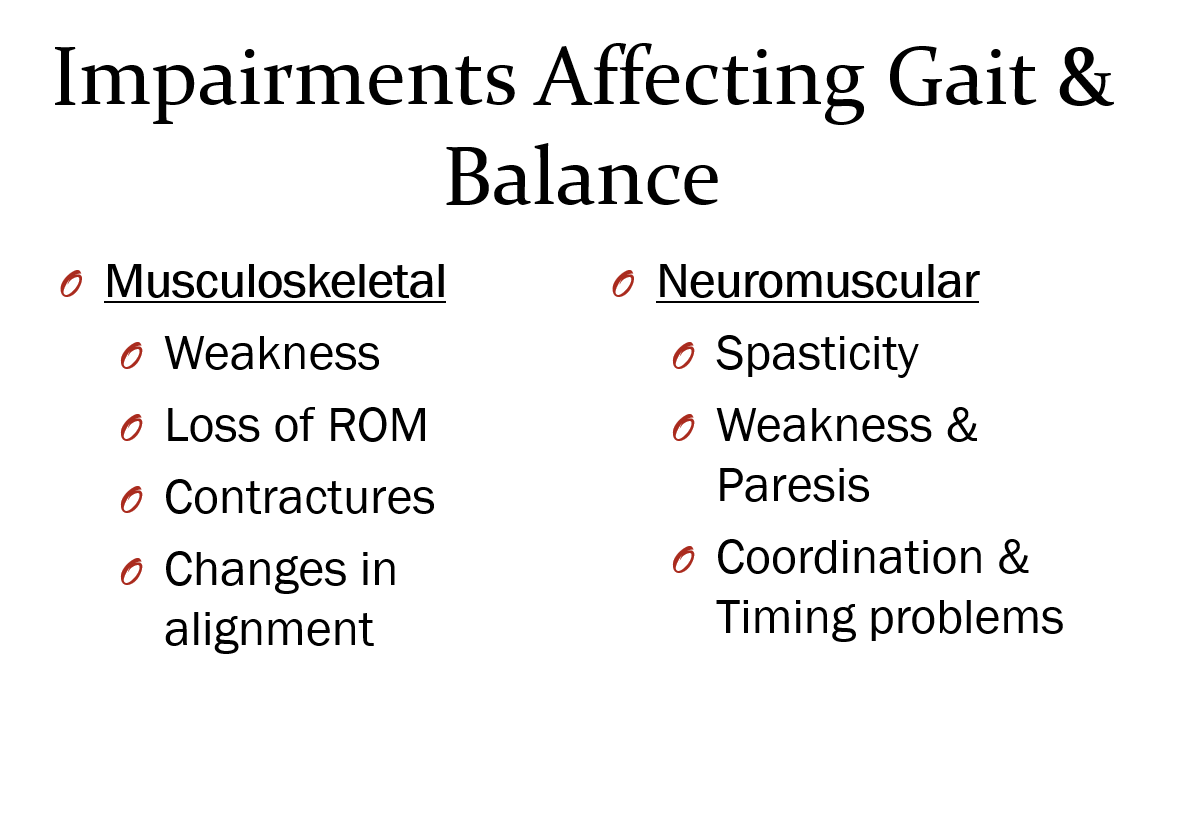
MSK changes may occur due to neuro pathologies - like?
Soft-tissue contractures, decreased ROM, changes in alignment, weakness

MSK changes may occur due to neuro pathologies
How does it affect movement? workload?

MSK changes may occur due to neuro pathologies
creates what difficulties throughout the gait cycle?
How much DF needed for heel strike?

Common degrees of PF contracture?

Hip flexion contracture affects?

Knee flexion contracture affects?
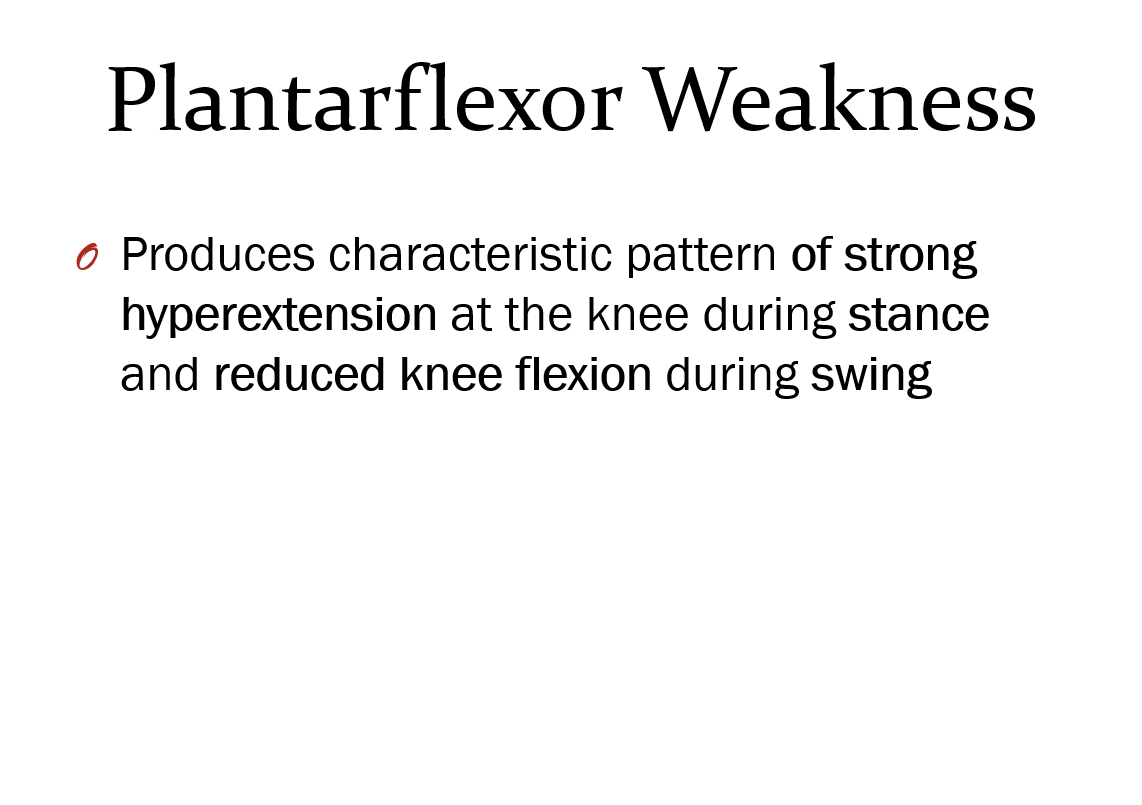
PF weakness causes?

Quad weakness
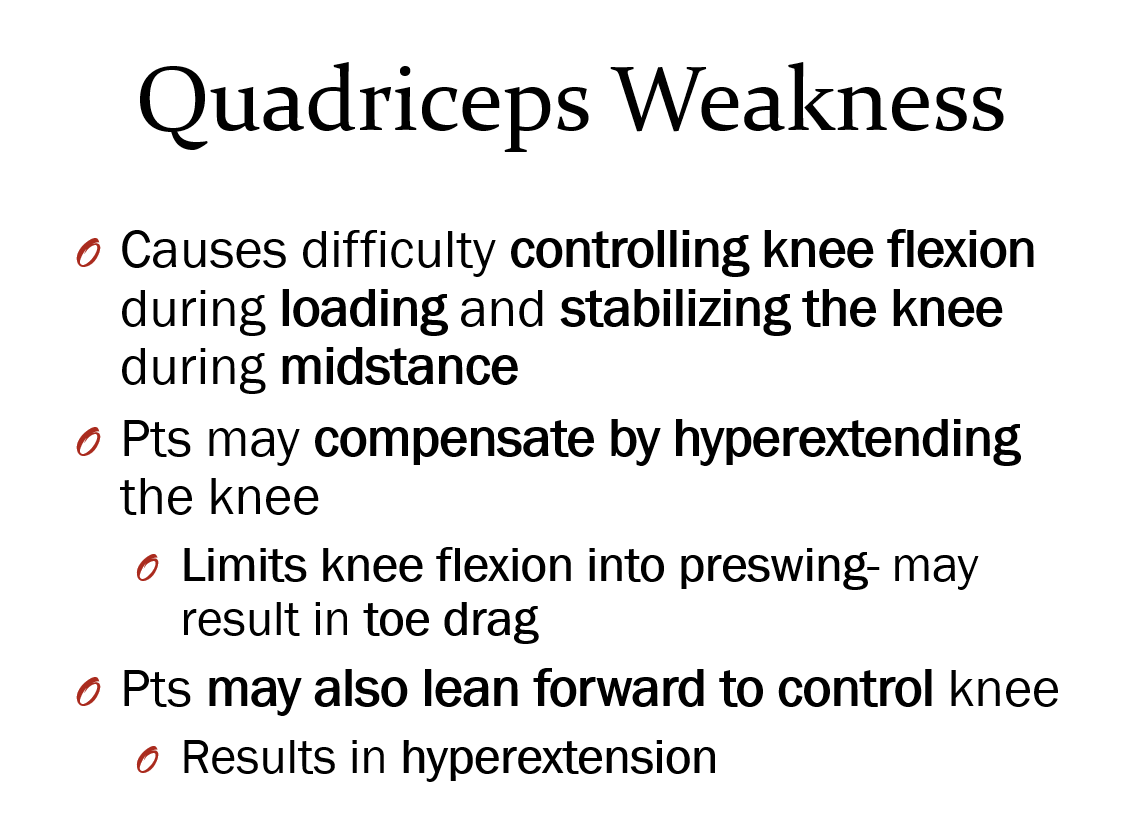
Causes difficulty…


Quad weakness
compensations:

Quad weakness
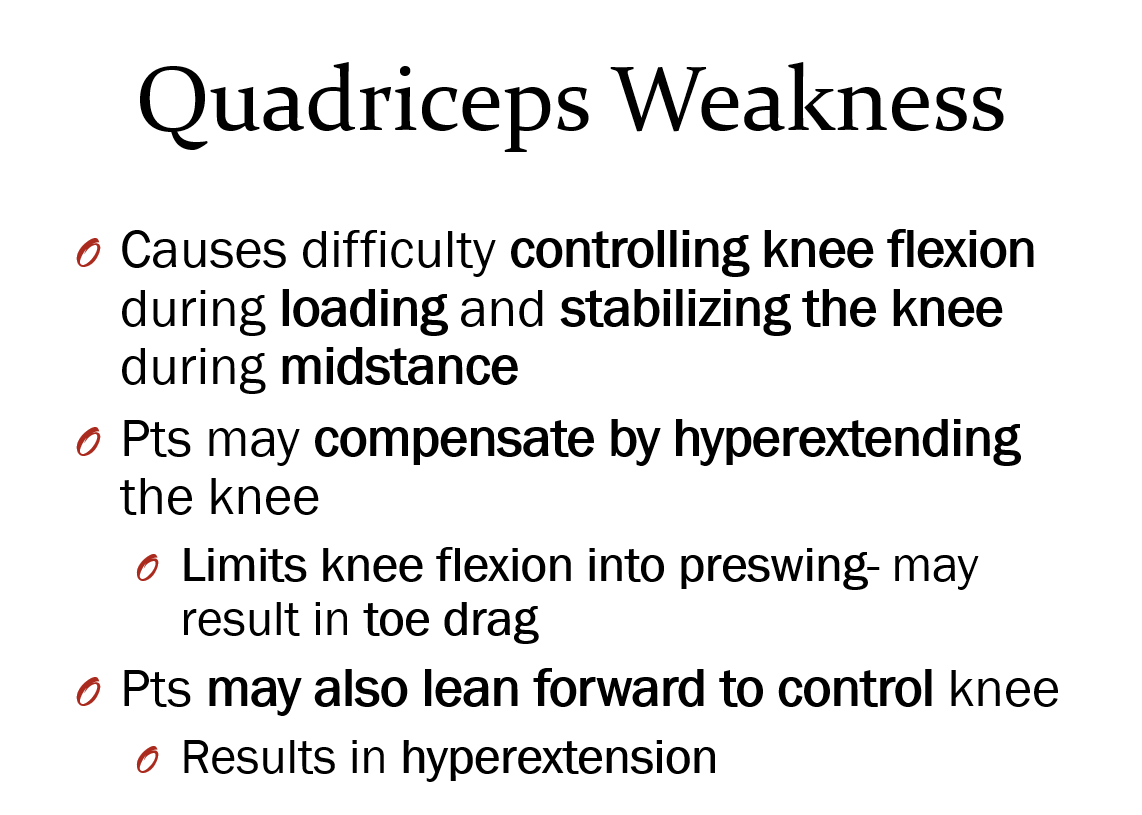
Compensation: hyperextending knee - results in?
Quad weakness
Compensation: leaning forward (anterior trunk lean) - to control? results in?
Hip flexor weakness
Need what grade MMT for normal gait?
Primarily effects what phase?


Hip flexor weakness
what might also be lost? resulting in? might see what as a result?

Hip flexor weakness
Compensations

Hip extensor weakness
Hip extension is critical for

Hip extensor weakness
Weakness may cause? which threatens?

Hip extensor weakness
Compensation?
this compensation requires?

Hip Abductor weakness
Results in ___ gait: drop of pelvis on __ side during WB
Compensates with __ weight shift: over which side? while leaning to which side?
moves GRF in same or opp direction?
Also may affect?

Effects of Weakness/Paresis on Gait
What parts of the motor neurons are impacted?

Effects of Weakness/Paresis on Gait
Insufficient ___ recruitment of motor neurons in specific leg muscles during parts of gait

Effects of Weakness/Paresis on Gait
Non-neural changes in muscle fibers from?

Effects of Weakness/Paresis on Gait
Affects force to move body ___ and ___ of moving segments
Weakness/Paresis Affects Gait Speed
Loss of peak power at what muscles/joints can reduce joint speed?

What has the greatest impact on gait speed?

Also found in geriatric population w/ msk disuse atrophy of __ but no neuro pathology
Effect of Spasticity on Gait
Results in ____
Alters ____

Effect of Spasticity on Gait
Results in inappropriate activation of muscles at the point in the gait cycle when they are?
eccentric or concentric?

Effect of Spasticity on Gait
Alters mechanical properties of muscles, producing what?
Which negatively impacts?

Spasticity most commonly seen in which muscles?

PF Spasticity
Common in which disorders?
PF Spasticity
Triceps surae (TS) most __ active during __ phase
PF Spasticity
Spasticity causes TS to fire too soon or too late? resulting in?
compensate with?

PF Spasticity
Early TS shortening limits ___ needed for __
Results in increased workload on __ to __ during __ what phase?
May see?

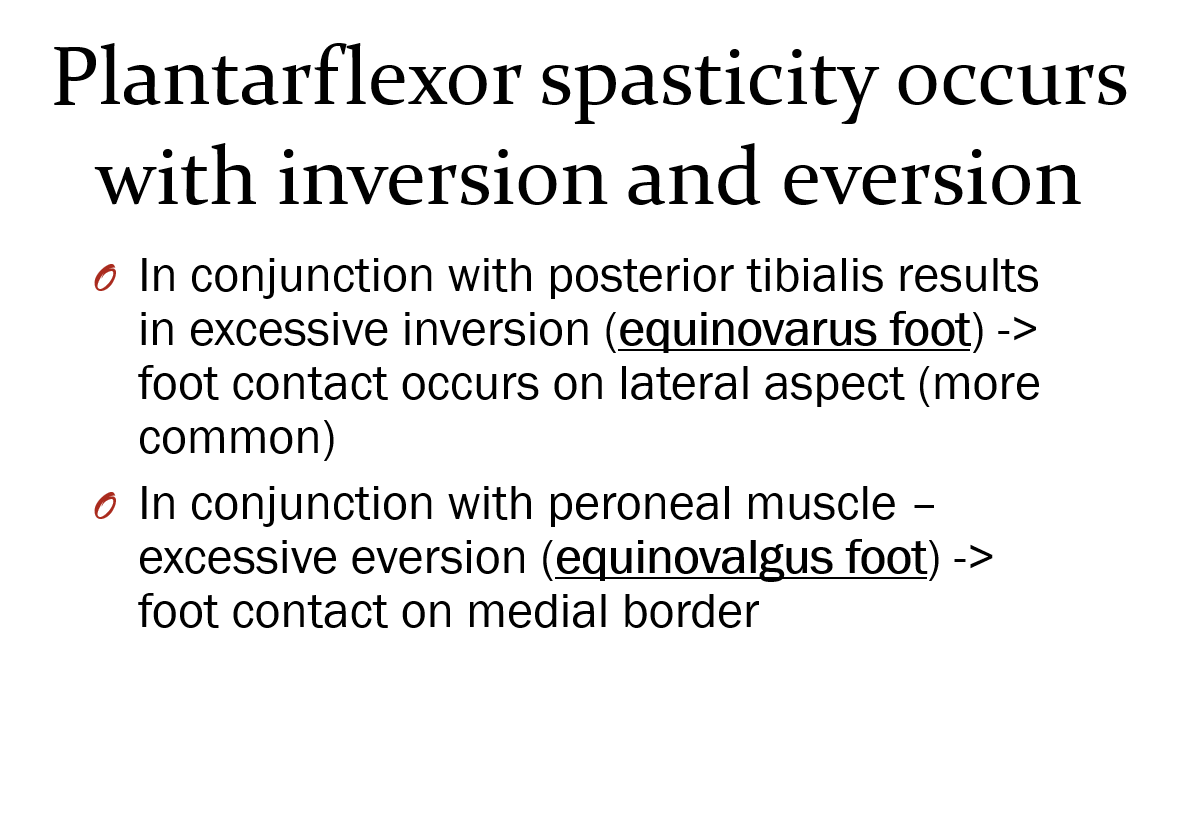
PF spasticity occurs with Inversion & Eversion
With post tib
excessive inversion or eversion?
Equionovarus or valgus foot?
Foot contacts occurs on medial or lateral aspect?

PF spasticity occurs with Inversion & Eversion
With fibulares/peroneal muscles
excessive inversion or eversion?
Equionovarus or valgus foot?
Foot contacts occurs on medial or lateral aspect?
Spasticity in Quadriceps
Results in __ during __
this is in response to ___ that normally occurs to ___

Spasticity in Quadriceps
No impact on gait velocity but…
long term spasticity results in?

Hamstring Spasticity
Manifests as what gait pattern? seen in?

Hamstring Spasticity
Affects what in terminal swing?

Hamstring Spasticity
Excessive knee flexion persists throughout stance phase and increase work of __ to prevent __
What else does it result in?

Adductor Spasticity
Produces ___ during __ because femur is drawn __

Adductor Spasticity
Results in what gait?

Adductor Spasticity
Results in what during early stance phase?

Adductor Spasticity
May impede?

Synergistic movement patters = loss of ____
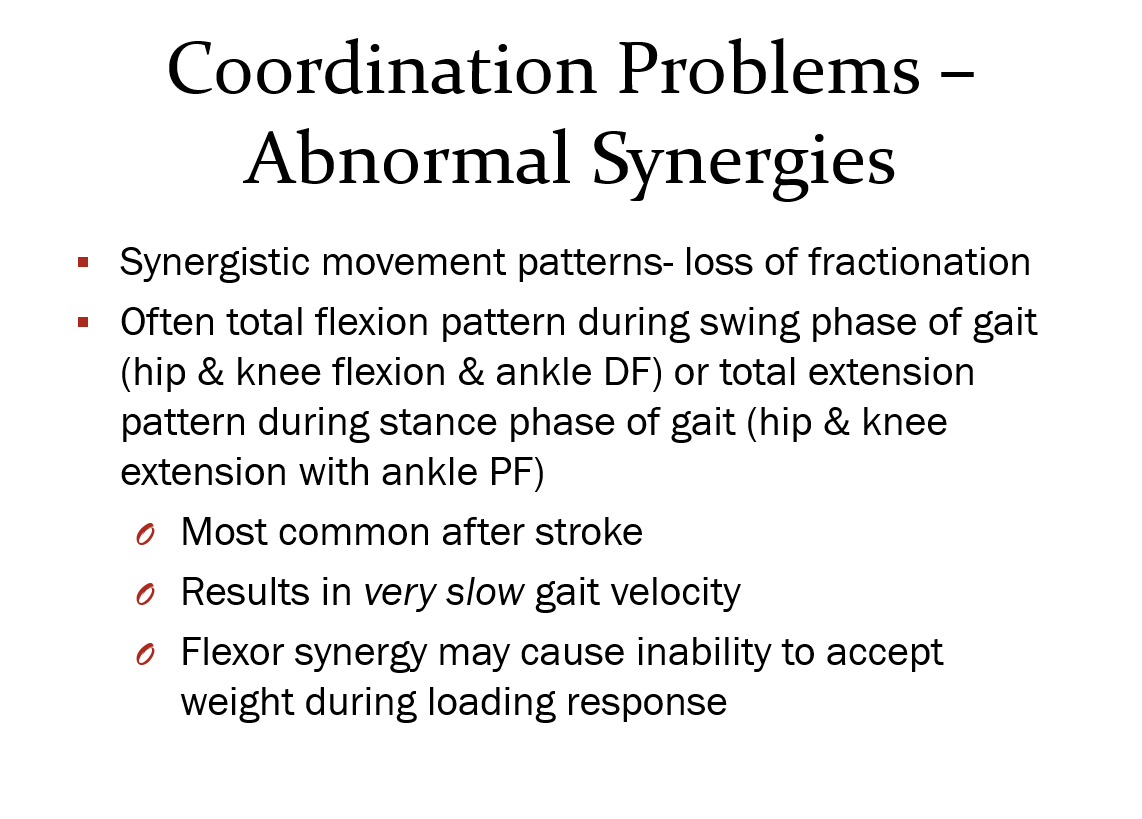
Coordination Problems – Abnormal Synergies
Total flexion pattern during what phase?
or
Total extension pattern during what phase?

Coordination Problems – Abnormal Synergies
Total flexion or extension patterns
most common after?
Results in?

Coordination Problems – Abnormal Synergies
Which synergy may cause inability to accept weight during loading response

Poor inter-segmental coordination
Dyssynergia

Coordination Problems – Coactivation of Agonists & Antagonists
Normal gait involves a high degree of __ muscle recruitment
Co-contraction - loss of selective recruitment of physiologically __ muscles
Common problem in?

Somatosensory deficits result in? due to loss of?

Visual deficits
impact ___ control of equilibrium
Results in ___ -> greater risk for ___ and difficulty with ___

Vestibular deficits
Affects ___ or __ during gait
Results in 3 things?

Perceptual deficits
Body image/scheme disorders can result in?
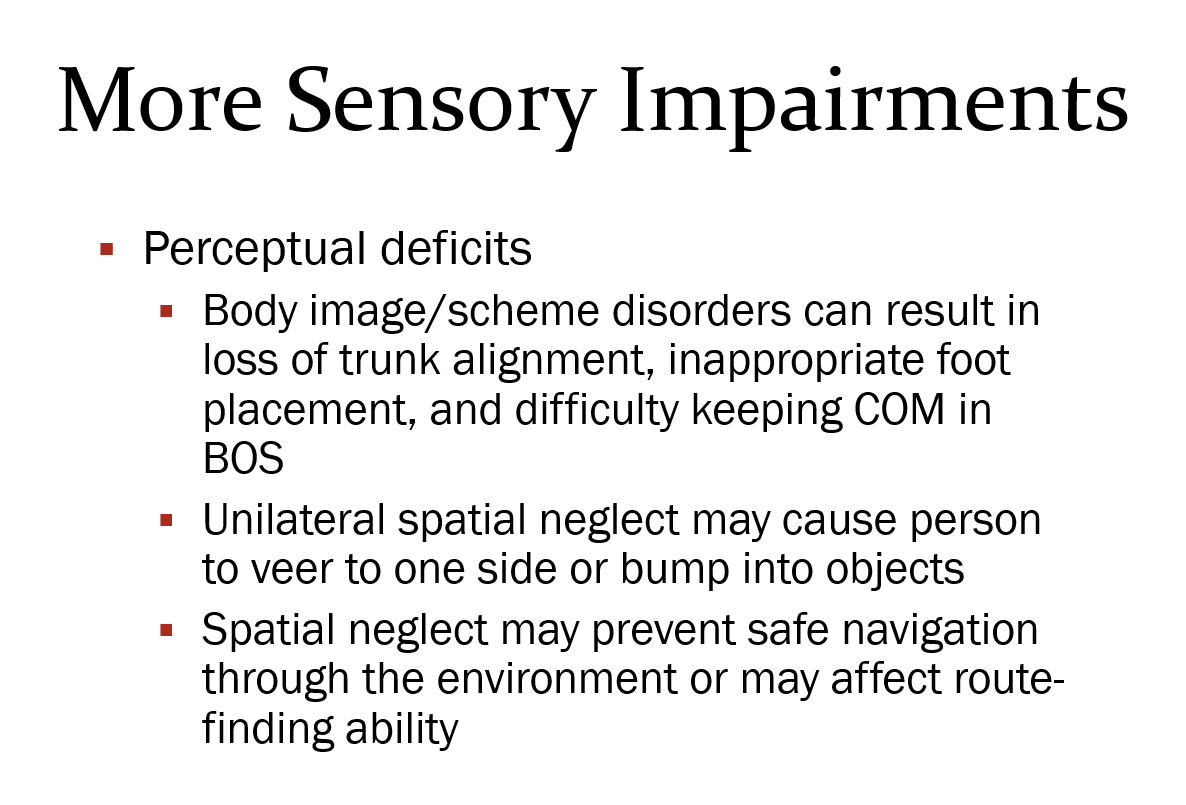
Perceptual deficits
Unilateral spatial neglect may cause?
Perceptual deficits
Spatial neglect may prevent?

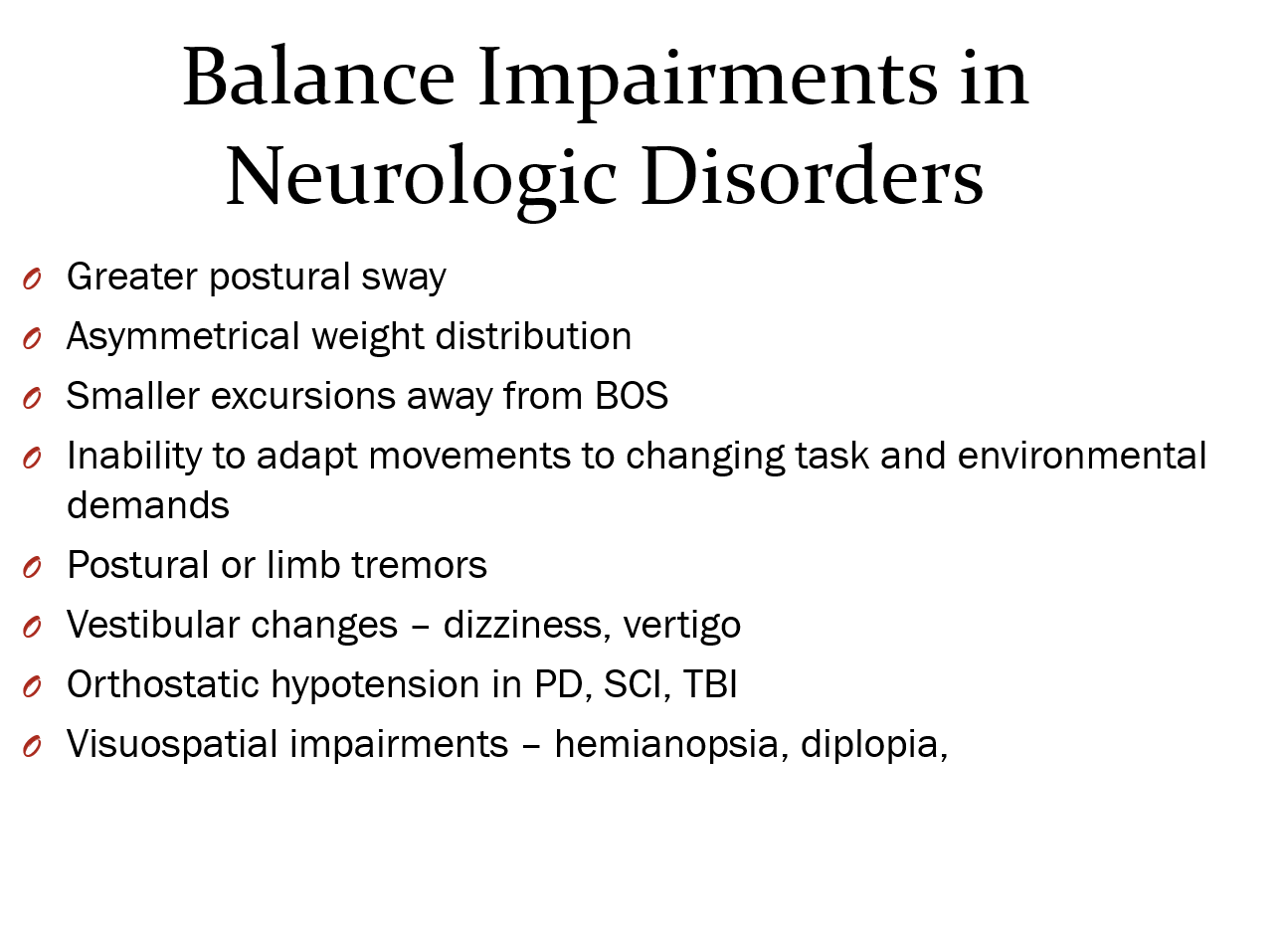
Balance Impairments in Neurologic Disorders
Cognitive Impairments Also Effect Gait & Balance

Pain often results in alteration in movement
Gait velocity
Shortened stance phase on which side?
Stiff limb during?
Reduction in?

Compensations for pain includes?

When do you document antalgic gait
Stair climbing
Climbing stairs requires generation of reciprocal motions at what joints?
Along with increased force production at what joints?
Stability demands are the greatest during?

Stair Climbing
Decreased concentric control affects ___
Decreased eccentric control affects ___
People with CNS pathology tend to?

Speed in order to cross street safely in normal time allotted by stop light?
Curbs are how tall?

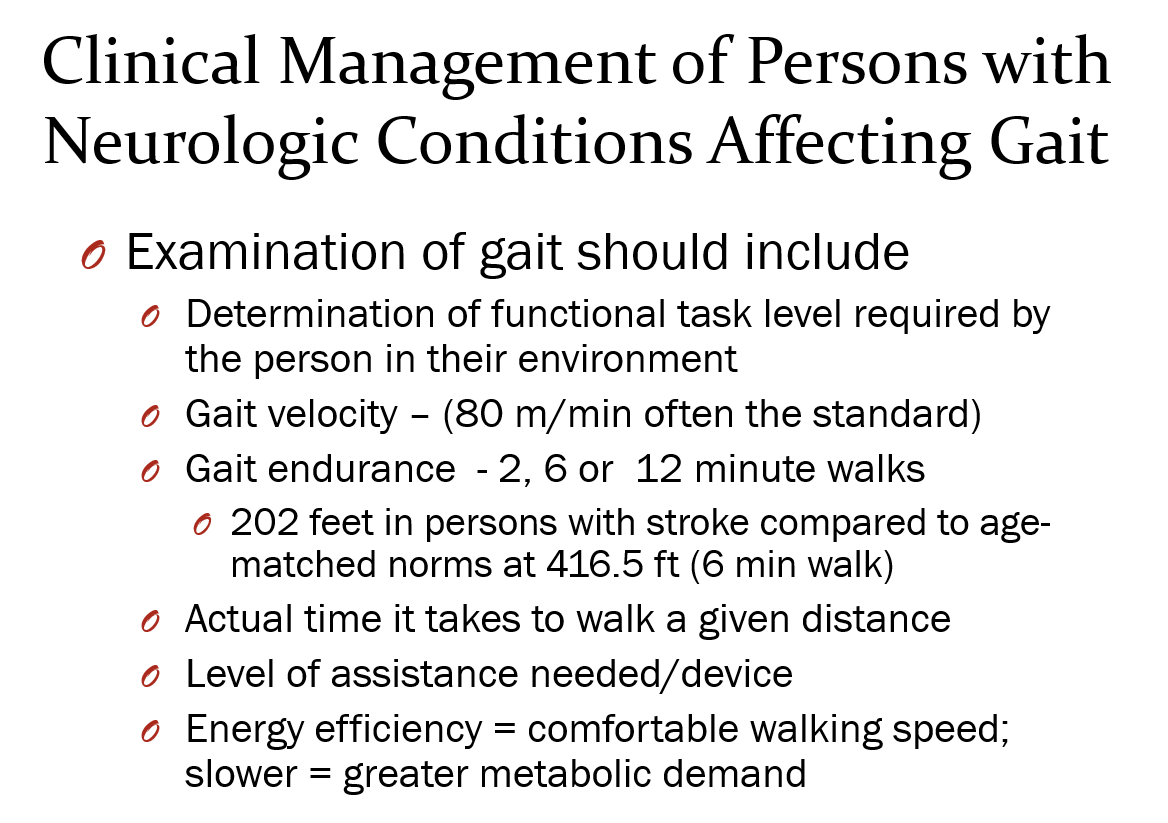
Examination of gait should include
Standard gait velocity?
Energy efficiency =
slower means?

A slower walking speed means?
Functional Mobility Tests

Long term goals for gait should be writing in functional terms with cleared state levels of?

Short term goals can be written about?
Interventions for Balance and Gait Deficits
what intensities?
utilize what principles?
Emphasis on promoting?

Locomotor CPG
For what pathologies?
What type of approach?
Includes what variables?
Does it address impairments?
Emphasizes?

Traditional Gait Training
For?
Focuses on?

Impairment Level
May work to increase?
Must have interventions aimed at?

Gait Training Strategies
Aimed at impairment level

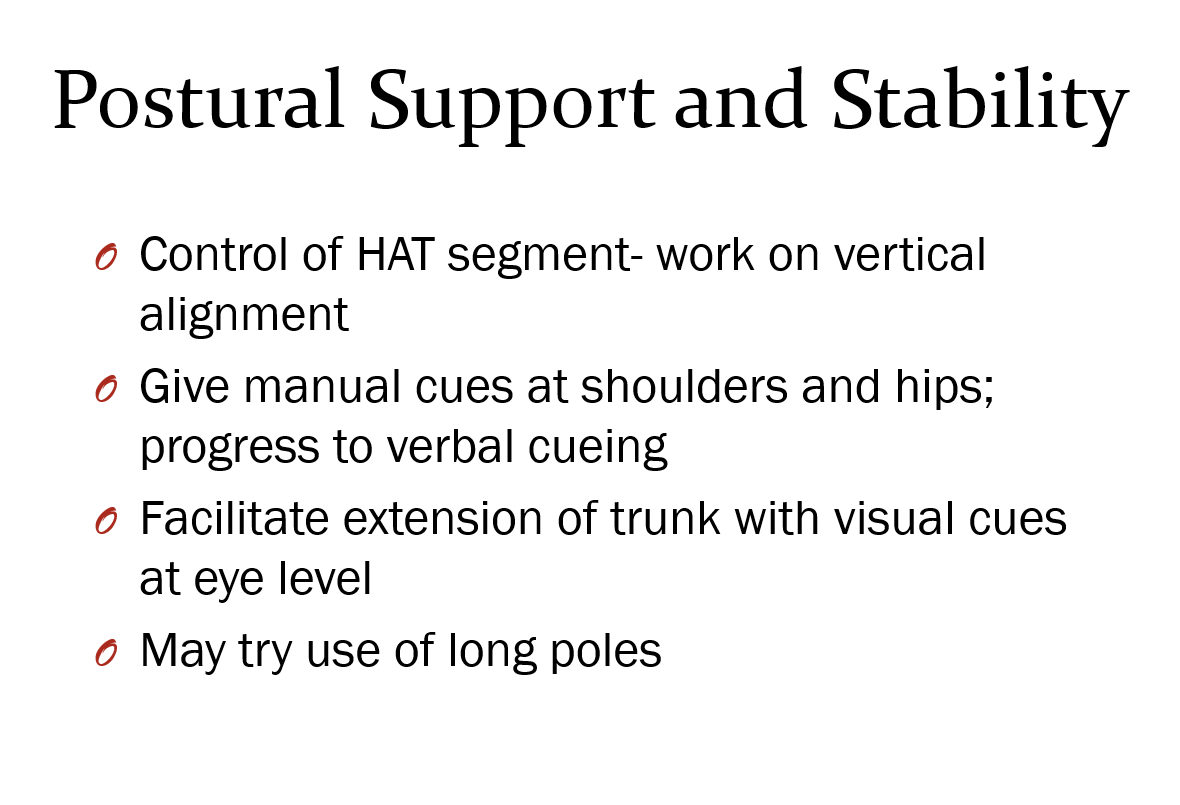
Postural Support and Stability
Control of HAT segment- work on __ alignment
Give manual cues at __ and __ - progress to verbal cuing
Facilitate extension of trunk with?
May try use of?
Extensor Support Moment
Weakness of hip & knee extensors = difficulty with?

Extensor Support Moment
Closed or open chain?
May brace knee to facilitate WB, but lose?
May try?
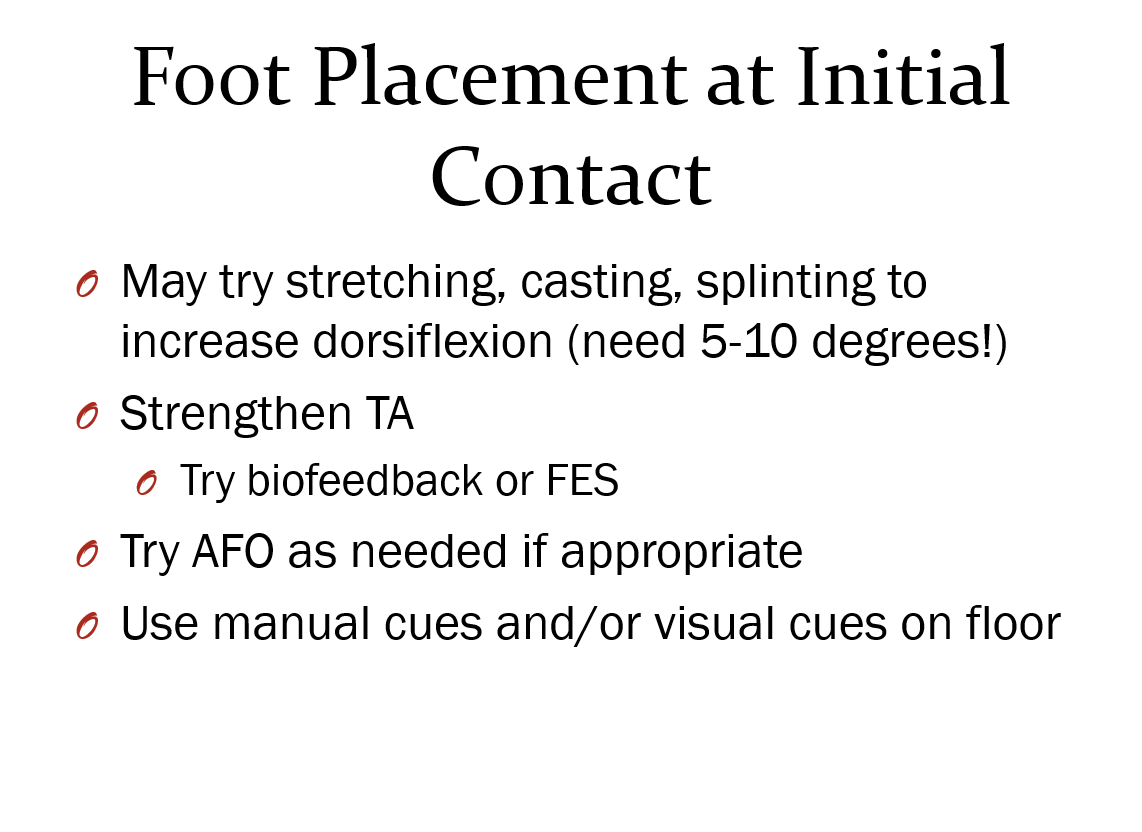
Foot Placement at Initial Contact
May try?
Need how much DF?
Strengthen what muscle?
try?
Use what cues?
Balance in Single and Double Limb Support
Includes?
What can be a great tool here?

Progression
Energy generation from push off (__) and pull off (__)
Practice what?
Advancement of swing limb:
Faster gait =

Whole vs. Part Training
What is best to achieve max function?
Harness Systems and Treadmills
What should be your first choice for gait training?
