A&P exam 1
 Call Kai
 Learn
Learn Practice Test
 Spaced Repetition
 Match
Match Flashcards
 Knowt Play
1/39

There's no tags or description
Looks like no tags are added yet.
Name | Mastery | Learn | Test | Matching | Spaced | Call with Kai | Chat |
|---|
No analytics yet
Send a link to your students to track their progress
40 Terms
Cytosol
intracellular fluid; mostly water with dissolved solutes, inclusions (storage molecules), and proteins; site of many
important chemical reactions
Cytoskeleton
network of protein
filaments; creates and maintains shape;
holds organelles in place; provides
transportation for substances within cell
Integral proteins
span entire membrane; “transmembrane” proteins
Peripheral proteins
found only on one side of membrane or other
How to remember the characteristics of living organisms
Cats Might Grow Extra Red Mice Randomly
How to remember the levels of structural organization
Chemicals Can Train Our Organic Organisms

What organ system is this
Endocrine system

What organ system is this
Cardiovascular system

What organ system is this
Lymphatic system

What organ system is this
Urinary
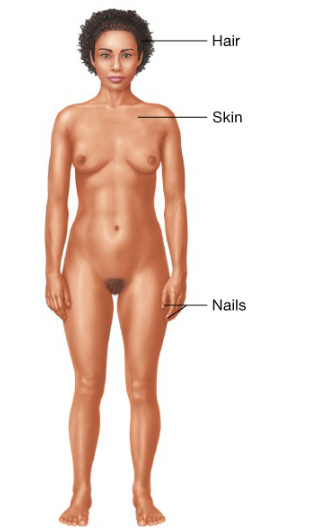
What organ system is this
Integumentary system
Negative loop
Makes the variable go in a different direction
Suspension
Large, uneven distributed particles
Colloids
Small, even distributed particles and will not seethe out
Solutions
Will not settle out and includes Solute and Solvent
Cholesterol
lipid; stabilizes plasma membrane’s fluid structure during temperature changes
glycoproteins
carbohydrate bound to either lipid
or protein respectively
Agonists
mimic ligand’s actions; stimulate receptor
Antagonists
inhibit ligand’s actions by blocking receptor
Diffusion
movement of solute molecules from high to low concentration; move
down (with) concentration gradient until equilibrium
Simple diffusion
mostly nonpolar solutes (oxygen, carbon dioxide, lipids, and hydrocarbons); pass through phospholipid bilayer without membrane protein
Tonicity
way to compare osmotic pressure gradients between two solutions: cytosol and ECF
Phagocytosis
cells ingest large particles like bacteria or dead or damaged cells or parts of cell
Pinocytosis
cells engulf fluid droplets from E C F
Peroxisomes
They contain enzymes that carry out oxidation reactions, often producing hydrogen peroxide
Ribosomes
tiny granular nonmembrane-bound organelles; site of
protein synthesis
Lysosomes
organelles responsible for digestion of worn out cells or cellular components
Cytoskeleton
dynamic structure; changes function based on needs of cell:
Action Filaments
Supports the plasma membrane
Involved in cell motion and cell division
Intermediate Filaments
Form the framework of the cell
Support the shape and size of the nucleus
Provide cell strength
Microtubes
Maintain the position of organelles
Form the core of cilia and flagella
Move vesicles and organelles throughout the cell
3 main structures in the nucleus
nuclear envelope
DNA protein in nucleoplasm
One or more nucleoli
Sebaceous glands release their secretory products by collecting the product intracellularly until the entire cell ruptures and dies. What mode of secretion is this?
Holocrine secretion
Which component of the extracellular matrix is primarily responsible for resisting tensile forces and stretching in tissues like tendons?
Collagen fibers
Marfan syndrome is a genetic connective tissue disorder caused by mutations in the gene encoding fibrillin-1. Which extracellular matrix fiber is directly impacted?
Elastic
spindle-shaped, non-striated cells under involuntary control
Smooth muscle
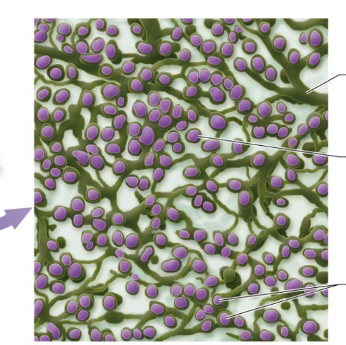
What is this
Reticular Tissue
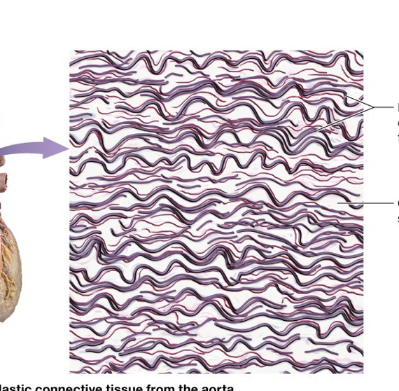
What is this
Dense Regular elastic tissue

What is this
Hyaline cartilage