GBS 708 - Week 2
 Call Kai
 Learn
 Practice Test
 Spaced Repetition
 Match
 Flashcards
 Knowt Play
1/25

There's no tags or description
Looks like no tags are added yet.
26 Terms
ORC
position on DNA at which replication start points are found by physical methods (where do nascent strands of DNA start?)
DNA sequence that when added to non-replicating DNA, it causes it to replicate.
DNA sequence whose mutation abolishes replication
6 subunit protein complex (ORC1-ORC6), binds to A box of ARS1 and replication origins in an ATP-dependent manner; ATPase activity
is required to load (CDC6, Cdt1, MCM2-7)

Autonomously Replicating Sequences (ARS) + image!
in yeast, if adding DNA fragment to non-replicating DNA causes it to replicate, then there is an ORC on fragment

ARS1
origin in plasmid, point mutations (with URA3 gene as selection marker) identifies critical A elements in ARS1
WT-ARS1: transform ura3-yeast with URA3 plasmid (with different mutations across ARS) and plate on uracil

SV40
polyomavirus, if you delete origin, virus does not replicate
double-stranded DNA circular virus that replicates like plasmid in mammalian cells
7 replication elongation factors/machinery (proks vs euks + function)
are conserved!

8 steps of DNA replication
T-antigen/Helicase binds origin on DNA and unwinds DNA. Replication-Protein-A (RPA) binds single-stranded DNA
RPA coats single-stranded DNA and recruits DNA pol α primase
DNA pol α primase synthesizes RNA primer (2-6 bases) that copies DNA
DNA pol α extends RNA primer as DNA only in 5’-3’ direction; it lacks proof-reading activity and so DNA is error-filled
RF-C loads PCNA at DNA end, which displaces DNA pol α and recruits/attaches DNA pol Δ/ε to DNA which synthesizes rest of new leading strand/Okazaki fragment
DNA pol α and DNA pol α primase initiates new Okazaki fragments on lagging strand. Pol switching occurs on lagging strands; pol δ/ε (have proof-reading activity) do most of DNA synthesis
RNAseH, 5→3 exonuc Fen1, and Dna2 endonuc remove RNA primers/RNA and most of DNA pol α synthesized-DNA (bc error-filled) at 5’ end of each Okazaki fragment
DNA ligase I uses energy of ATP hydrolysis to seal nicks in DNA
RF-C
5-subunit complex; all subunits related in sequence and have ATP binding motifs
hydrolyze ATP to load PCNA clamp
functional homolog of clamp-loader γ complex
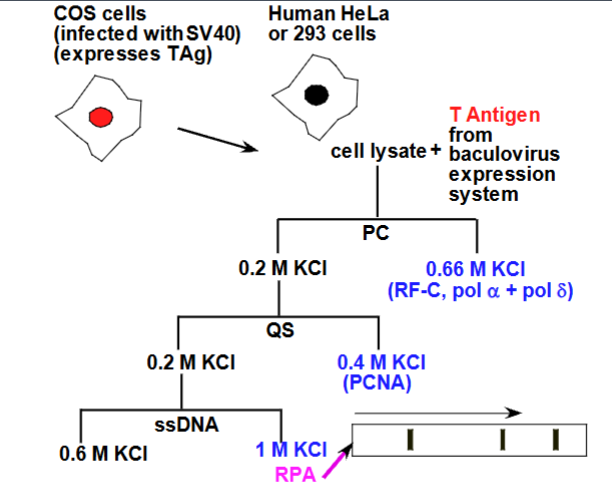
3 steps of SV40 DNA replication in vitro experiment
COS cells (infected with SV40 and expresses TAg) + cell lysate + plasmid w/ ori + dNTP + rNTP + α32P dATP @ 37C for 60 mins
DNA replication will incorporate radioactive α32P dATP into 5 kb DNA → analyze products by electrophoresis and autoradiography
fractionation of cell lysate to homogeneity to identify replication factors provided by cell
proof-reading activity
3→5 exonuc activity in DNA pol δ and ε, NOT IN DNA pol α!!!
primase in 2 separate subunits of DNA pol α lays down primer

PCNA clamp vs β clamp (compare vs contrast)
PCNA in euks, β clamp in bacteria
functionally same and structurally similar, forms protein ring around DNA
clamp pol to DNA, processivity factors for DNA pols

Processivity
can pol stay attached to its product DNA and extend it for long stretches?

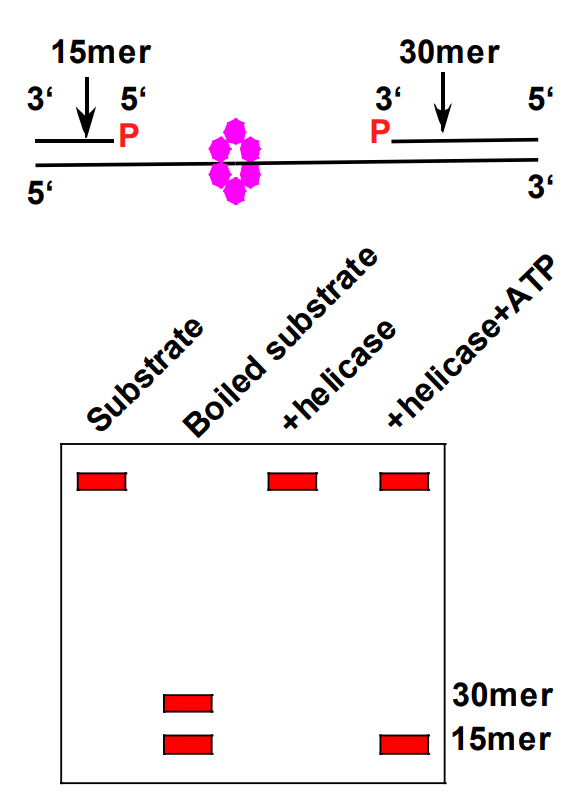
DNA Helicase
hydrolyzes ATP to move/binds ss DNA and peel annealed DNA and unwind double-stranded DNA
moves 5→3 or 3→5 (so both directions) on ssDNA; conserved, dimer or hexamer
binds ATP → tight conformation; hydrolyzes ATP → relaxed conformation
Walker A motif (GxGxGKT) and Walker B motif (ΦΦΦDEad) for ATP-binding/hydrolysis; these are also present on all proteins that hydrolyze ATP (helicases, clamp-loaders, protein kinases, DNA ligases, ATPases)
MCM2-7 (Mini-Chromosome Maintenance) + image
core of euk replicative DNA helicase; if yeast has temp-sensitive (ts) mutation in replication factor, then at nonpermissive temp, plasmid will not replicate and will get lost from culture
yeast containing Leu2 on plasmid → grow under non-selective conditions (permissive/nonpermissive temps) → plate yeast on Leucine-plates to estimate rate of plasmid loss
inactive, consists of hexamer of MCM #2-7, loaded on ds DNA in G1 using cdk2 kinase @G1-S→ creates CMG complex (active, consists of MCM2-7, cdc45 and GINS), an active helicase poised for DNA unwinding
nuclear export (in yeast) or displacement from chromatin (in mammalian cells).

3 initiator proteins
Mcm2-7 helicase core cannot load on DNA by itself and requires help of initiator proteins (ORC, Cdc6, Cdt1)

CDC6 and Cdt1
essential factor that cooperates with Cdt1 (degradation in mammalian cell) for loading of MCM2-7
proteolyzed in yeasts or exported out of nucleus in mammalian cells at G1- S transition
overexpression of Cdc6 in yeast causes multiple rounds of DNA replication without intervening mitosis, critical regulator of DNA replication
DNA replication initiation required on double-stranded DNA substrate is dependent on Cdc6, elongation not effected!
overexpression of Cdt1 and Cdc6 produces cells with > 4n DNA

cyclin-CDK complex + know image
dimeric enzyme that is active/inactive as cell moves through cell-cycle
consists of cdk (catalytic subunit) and cyclin (regulatory subunit)
cdks phosphorylate substrates on Serine (S) or Threonine (T)
different cyclin-cdk complexes drive different parts of cell cycle
initiation of replication at G1-S transition
prevention of re-replication before mitosis AND mitosis before replication

Initiation of replication at G1-S transition
CDK converts inactive MCM2-7 to active CMG helicase
CDC45, GINS, CDC7/DBF4, CyclinE/A-Cdk2
cdc45
activates MCMs along with GINS (CMG complex) to initiate DNA replication
unwinds DNA, loading of DNA primase/polymerase complex
GINS (Go-Ichi-Ni-San complex)
essential in initiation of DNA replication, activates MCM2-7 helicase
4 subunits (SLD5, PSF1, PSF2 and PSF3) that forms ring on EM.
CDC7/DBF4 + know image!
DBF4-dependent-kinase (DDK) and Dbf4 required for initiation of DNA replication
kinase phosphorylates MCMs to relieve auto-inhibition

CyclinE/A-Cdk2 kinase + know image!
protein kinase essential for initiation of DNA replication by phosphorylation/activation of Sld2 + Sld3 substrates to recruit Dpb11 adaptor, CDC45 and GINS-polε to form active CMG
assembles CMG w/ DDK (de-represses MCM), essential for activating MCM2-7 helicase to form active CMG

unwinding to DNA synthesis: recruitment of which 2 polymerase-primases?
Mcm10 and AND-1 (and pol ε) recruit DNA pol α to CMG helicase and onto ssDNA
MCM10: essential in initiation of DNA replication in yeast, required in Xenopus after loading of Mcm2-7 and before loading of CDC45, splits Mcm2-7 double hexamers into 2 hexamers
AND1/CTF4: in yeast, mutations lead to defects in chromosome-transmission-fidelity. required for stability of p180 (DNA pol α, catalytic subunit) and to load pol α on chromatin at ORC along with polymerase ε

2 ways cell prevent re-replication in the same cycle?
cdks phosphorylate replication initiator to prevent loading of new MCM2-7 on replicated DNA
geminin stabilized in S phase to also prevent loading of new MCM2-7
Geminin
in Xenopus, protein degraded by Anaphase-Promoting-Complex
inhibits initiation of DNA replication by blocking loading of MCM proteins onto replication origins
inhibits Cdt1 in S phase to prevent re-replication, knockdown causes more RNAi

5 steps in checkpoint pathways
cyclin-cdk prevented from becoming highly active before DNA replication complete so cells cannot enter mitosis while DNA replication ongoing
ATR/ATM kinases activated when DNA replication ongoing (re-replication)
geminin loss causes re-replication that activates Chk1 and Chk2, Chk1/Chk2 kinases phosphorylated
Cdc25C phosphatase phosphorylated
14-3-3σ binds to phospho-Cdc25C and sequesters/inhibits it in cyto
Cdk1 (Y15-P) inactive

4 anti-S phase (de-regulate DNA replication) anti-cancer drugs
topoisomerase inhibitors (etoposide, doxorubicin)
alkylating agents
cross-linking agents (cisplatin)
radiation
activate intra-S phase checkpoint and block cell-cycle! induction of re-replication kills cancer cells