1.1
 Call Kai
 Learn
Learn Practice Test
 Spaced Repetition
 Match
Match Flashcards
 Knowt Play
1/55

There's no tags or description
Looks like no tags are added yet.
Name | Mastery | Learn | Test | Matching | Spaced | Call with Kai | Chat |
|---|
No analytics yet
Send a link to your students to track their progress
56 Terms
What is a macromolecule?
Large molecules that are found in living organisms.
Consist of smaller units that are joined together
What is DNA
Deoxyribonucleic acid
Large macromolecule (polymer) found in living organisms
Double helix structure
The chemical that controls everything that happens in cells.
Is acidic and contains phosphorus
Found in nucleus - nucleic acid
Stores and transmits genetic information
How long ago was DNA believed to have formed?
3 billion years ago, when the first forms of live arose
What is the structure of DNA?
double helix (twisted ladder) held together by complementary base pairs
Basic units of DNA are nucleotides

Where is DNA found in cells?
chromosomes in the nucleus (nucleic)
What are chromosomes?
The structural unit of information in cells
What does DNA do?
Stores and transmits genetic information, managing the requirements and activities of the cell
What does DNA being universal mean?
DNA functions the same in all living things
DNA from one species can be inserted into the genome of another species and the message is still transmitted.
What types of cells have evolved over time?
Prokaryotic and Eukaryotic cells
Prokaryotic cells are thought to have existed first, as they are relatively unspecialised and do not contain membrane-bound organelles
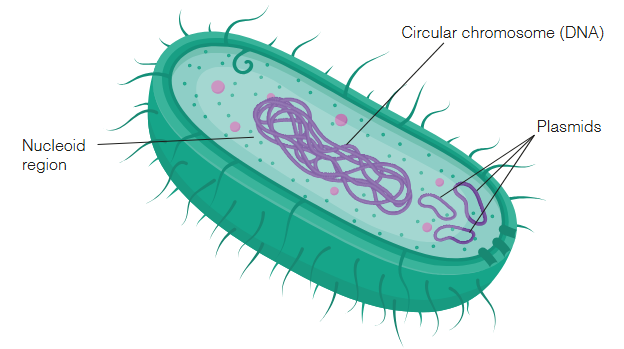
What is found in prokaryotic cells?
singular, circular, double-stranded chromosomal DNA in the cytosol, referred to as the nucleoid region.
RNA and proteins (macromolecule) in the nucleoid region and cytoplasm
Plasmids - small amounts of circular, double-stranded DNA that are separate from the cell’s chromosomal DNA
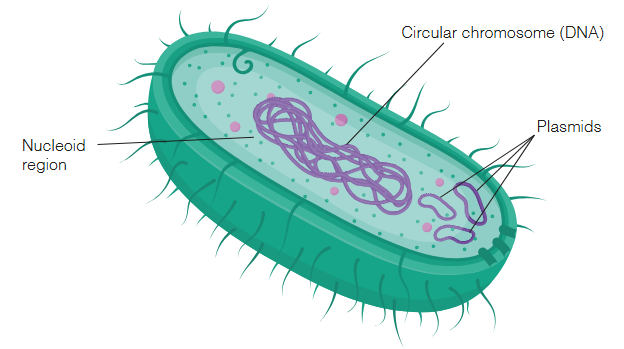
What are plasmids?
accessory chromosomes
amounts of circular, double stranded DNA separate from chromosomes
replicate independently of the main chromosome
What is conjugation?
A process in which 2 organisms exchange genetic material
Some conjugative plasmids can be exchanged with other bacteria - conjugation
Plasmids can transfer antibiotic resistance to other bacteria
What are eukaryotic cells?
Cells that make up large, complex, multicellular organisms (animals, plants, fungi)
Highly organised and more specialised than prokaryotic cells
Contain membrane-bound organelles that have specific functions in the cells (nucleus, mitochondria, chloroplasts, Golgi bodies, ER)
DNA found in the nucleus
How many chromosomes do human somatic (body) cells have?
46 chromosomes (23 pairs)
22 pairs of autosomal (non-sex) chromosomes and one pair of sex chromosomes (XX female or XY male)
A set of human chromosomes is known as a karyotype

What is a karyotype?
During cell division when DNA condenses and becomes visible, a photo can be taken
Each chromosome can be cut out and arranged in order of size to form a picture called a karyotype
Each pair consists of one maternal and one paternal chromosome
The pair without a number are sex chromosomes
F = XX
M = XY
Other 44 non-sex chromosomes are called autosomes

What is the structure of chromosomes?
Arranged into condensed linear strands consisting of double stranded DNA molecules wrapped around histone proteins
Have a centromere in centre (not always actually in centre)
Contain sister chromatids

How is chromosomal DNA packaged?
Packaged inside microscopic nuclei with help of histones
Histones are positively charged proteins that adhere to negatively charged DNA to form nucleosomes
Nucleosomes fold to form chromatin fibre which forms loops
The fibres are compressed and folded to produce wide fibre that is tightly coiled into the chromatid of a chromosome
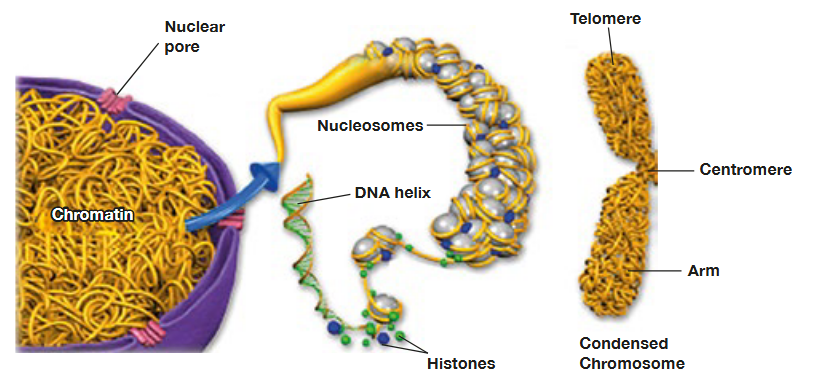
What are telomeres?
Short lengths of DNA at the end of chromosomes
Protect the tips of chromosomes from breakdown and stop them from binding to each other
Prevents loss of genes
Do not code for genes
Repetitive sequences of DNA
When DNA is replicated, telomeres shorten - when too short, chromosomes cannot replicate
When are chromosomes visible?
Only visible under a light microscope during cell division when DNA is condensed (prophase, metaphase, anaphase)
What are chromatin?
Decondensed form of chromosomes
Present in the nucleus of cells throughout the cell cycle (excluding cell division)
Why is chromatin important?
It is important that the genetic code is accessible during the growth and development of a cell so that DNA, protein, and RNA synthesis can occur.
If DNA is condensed, the genetic code is hard to access and synthesis cannot occur.
What is a gene?
A section of DNA which carries codes for a particular protein
Contains instructions for one characteristic of an organism
Why are condensed chromosomes important?
It is important for chromatin to condense into chromosomes prior to cell division to protect the genetic code and ensure identical copies are transferred to both daughter cells
What would happen if chromatin was present during cell division?
As each human somatic cell contains 2-3 metres of DNA when in decondensed linear form, if chromatin was present during cell division, it is likely the decondensed DNA would get tangled and result in DNA breakages.
What is a genome?
The complete set of an organism's genetic instructions - DNA - containing information needed to build and maintain the organism
Genetic info is carried by DNA
What membrane-bound organelles also contain DNA?
Mitochondria (mtDNA)
Chloroplasts (cpDNA)
mtDNA and cpDNA are double-stranded, circular, and not bound to histone proteins (similar to prokaryotic cells)

Compare DNA molecules in prokaryotic cells, mitochondria, and chloroplasts in eukaryotic cells
(Shape of chromosomes, oops)

What are vital functions which DNA performs?
For DNA to be able to store and transmit genetic information, it must be capable of variation to be able to code for the endless variety seen in life on Earth
The structure enables it to perform two vital functions necessary for life:
1. Make identical copies so that genetic information can pass from cell to cell and be inherited to the next generation
2. Provide a code that can be used by cells to manufacture protein molecules
What functions necessary for life does DNA perform?
1. Make identical copies so that genetic information can pass from cell to cell and be inherited to the next generation
2. Provide a code that can be used by cells to manufacture protein molecules
What is a nucleotide?
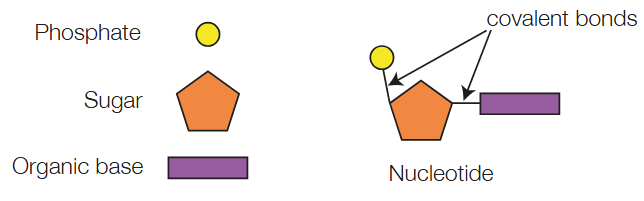
Repeating units in DNA, complex molecules made of three smaller molecules linked by covalent bonds:
- A pentose (5-carbon) sugar called deoxyribose
- Phosphate group
- A nitrogen base (ACTG)

What is the structure of a nucleotide?
Phosphate of one nucleotide is attached to the sugar of the next. This creates a sugar-phosphate backbone, resulting in one end of the strand ending in a phosphate and the other in a sugar.
Comprised of a 5-carbon sugar, a phosphate group, and a nitrogenous base
The end with phosphate is called the 5' end, the beginning of the DNA strand. The opposite is a sugar molecule, the 3' end. - two strands of DNA are antiparallel
So DNA is written from 5' to 3' direction
The phosphate is negatively charged, so DNA is negatively charged.
How do the bases stick together and why is this an advantage?
They each form weak hydrogen bonds with their complementary base located in the same position on the other strand.
This is an advantage because they are easy to break and re-form in DNA replication, which involves breaking the double helix to form organic bases for base pairing
What is the evidence for complementary bonding?
Each species has identical amounts of adenine and thymine and identical amount of guanine and cytosine
E.g. if there is 20% of thymine then there is 20% of adenine therefore there is 30% of guanine and cytosine.
How is DNA read?
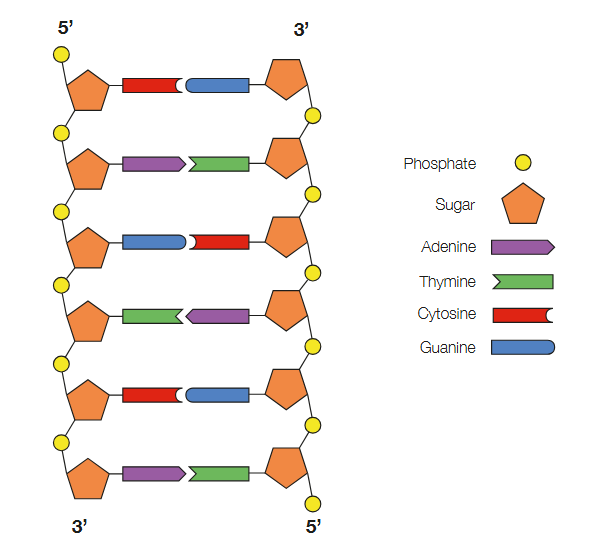
When DNA is assembled, it consists of two complementary strands linked by the complementary base pairs ATCG
As two strands are ‘complementary’, they are read in opposite directions
The DNA strand on the left is read from top to bottom
The DNA strand on the right is read from bottom to top
The rule: read from 5’ to 3’
What are genes?
Chromosomes are made up of functional units of information called genes
Each gene is a unique sequence of bases on one strand of DNA (the coding strand)
How do species differ?
- Number of chromosomes found in cells (therefore number of genes)
- the base sequences of genes found in DNA
- the length of the DNA molecules and hence number of bases
E.g. Different species have different characteristics and therefore numbers of genes and chromosomes. E.g. simple bacterial cells require hundreds of genes because they require hundreds of proteins
What is DNA replication?
Occurs in ALL cells
Occurs BEFORE cell division so each daughter cell contains identical DNA to the parent cell
Mechanism for copying DNA.
Takes place in nucleoid region of prokaryotic cells and nucleus of eukaryotic cells.
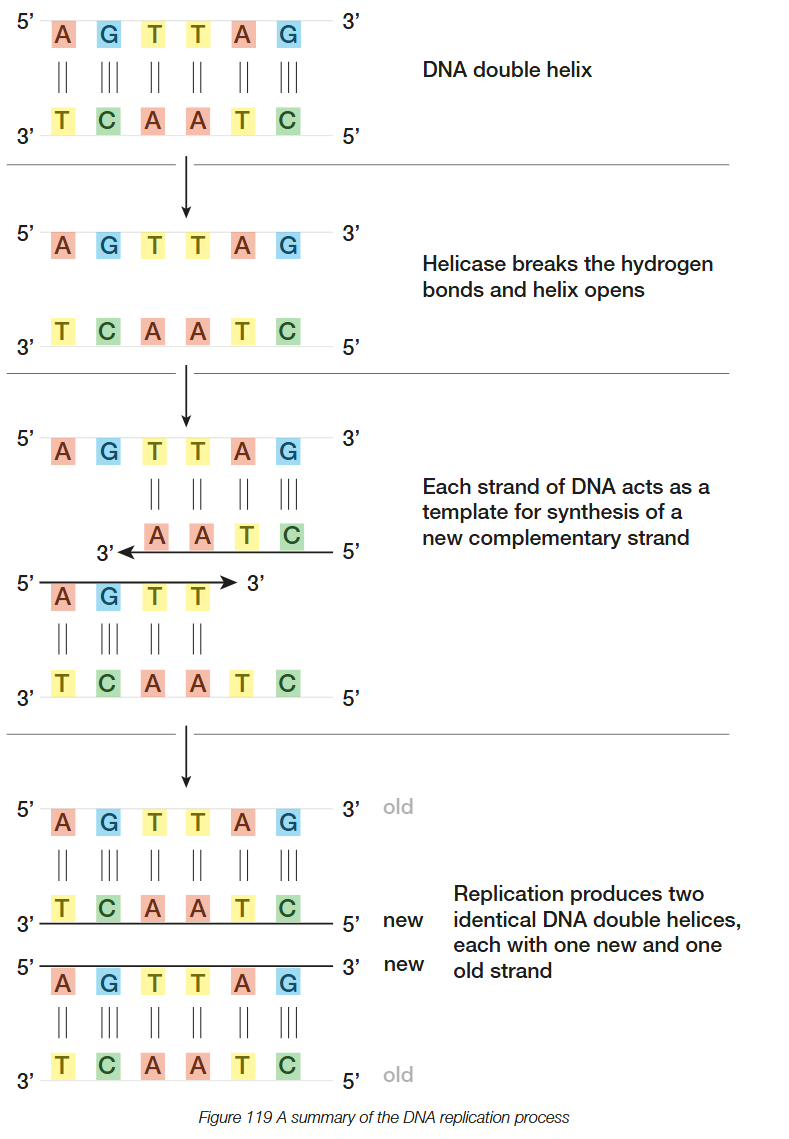
Semi-conservative - each double strand consists of one old strand (from the original) and a newly synthesised strand.
The two DNA strands are complementary so they are added in opposite directions
DNA nucleotides are added in the 5' to 3' direction by DNA polymerase to the exposed bases of old strands
What is the process of DNA replication?
1. The enzyme helicase (zip) breaks the hydrogen bonds between the complementary bases joining the two strands, unwinding and exposing their bases
2. Each strand serves as a template for making a new complementary strand
3. Enzymes, called DNA polymerase, add free DNA nucleotides to the exposed corresponding bases on the separate strands
4. The new DNA is synthesised in the 5' to 3' direction, therefore DNA polymerases add DNA nucleotides to the 3' end of the DNA strands
5. Each new double-stranded DNA molecule rewinds into a double helix and are joined at the centromere
What does a DNA molecule need to replicate?
Before cell division DNA is replicated
Occurs during interphase of cell division so two daughter cells will contain the correct amount of genetic material
New cells are required for growth and repair
Depends on cell type
Prokaryotic: Binary fission
Eukaryotic: Mitosis
What is binary fission?
DNA loop anchors to the membrane
DNA is copied and the copy also anchors to the membrane
The cell elongates and DNA circles are pulled apart
The cell pinches in and divides
Produces daughter cells that are genetically identical to the parent cell
What is mitosis?
Duplicated DNA molecules are arranged into two separate nuclei
During cell division, mitosis is specifically the separation of the duplicated genetic material carried in the nucleus
Four stages :prophase, metaphase, anaphase, telophase
Division of cell in two occurs in telophase
What happens in interphase?
DNA is present as uncondensed chromatin
DNA is contained within the nucleus
Centrosomes and other organelles have been duplicated
Cell is enlarged in preparation for division
What are the four phases and what happens in mitosis?
Prophase: DNA supercoils and chromosomes condense (become visible under light microscope)
Metaphase: Microtubule spindle fibres from both centrosomes connect to the centromere of each chromosomes
Anaphase: Continued contraction of the spindle fibres causes genetically identical sister chromatids to separate
Telophase: Nuclear membranes reform around each chromosome set
Cytokinesis occur, splitting the cell into two
What are the three forms DNA can be seen in?
Following DNA replication, the DNA is doubled and all chromosomes in the cell consist of TWO IDENTICAL sister chromatids
- Decondensed chromatin
- Condensed chromatin
- Two identical sister chromatids
Note: count amount of chromosomes by centromeres ('middle' circles)
Why is DNA replication limited?
Every time DNA in chromosomes is replicated, the telomeres shorten (this is why aging occurs)
After a certain number of DNA replications, the telomeres are too short for further replication to occur
What is a monomer?
building block for DNA
What is a polymer?
A molecule, made from joining together many small molecules called monomers
Poly = many , mer = unit
A DNA macromolecule is made up of many small nucleotides
What two base pairs are pyrimidines?
Thymine and cytosine ALL HAVE Y (shorter)
What two base pairs are purines?
Adenine and guanine (longer)
How many weak hydrogen bonds do AT have?
2 (T for two)
How many weak hydrogen bonds to CG have?
3 (Cee for three)
What are the main enzymes involved in DNA replication?
Helicase (unzipper):
Unwinds the DNA double helix molecule
Separates the 2 strands by breaking the hydrogen bonds
DNA Polymerase (builder):
Attaches new nucleotides to form new strands using the pre-existing strands as a template
Primase (initialiser):
Makes the primer so DNA polymerase knows where to start
DNA Ligase (gluer):
DNA-joining enzyme
If two pieces of DNA have matching ends
Ligase can link them to form a single, unbroken molecule of DNA
Explain DNA replication step by step
1. Helicase breaks the hydrogen bonds between the base pairs to 'unwind' the double helix
Helicase continues to unzip until it reaches a stopping point forming a replication fork
2. The leading strand is the easiest to replicate
A short piece of RNA known as a primer binds to the 3' end of the template of the leading strand
DNA polymerase binds to the primer on the 3' end of the leading strand and begins to add complementary base pairs creating a new strand as it progresses
3. DNA polymerase works in the 3' to 5' direction of the original template strand
Synthesising a new complementary strand that is seen to be 5' to 3'
4. Because DNA polymerase works in the 3' to 5' direction of the original template strand, the lagging strand is more complicated to synthesise
The lagging strand begins replication by binding with multiple primers
Each primer is only several bases apart
5. DNA polymerase then adds complimentary base pairs called Okazaki fragments in the spaces between the primers
6. Once the leading and lagging strands are formed the RNA primers are removed and complimentary free nucleotide bases have filled the gaps on the template strand, DNA ligase joins the Okazaki fragments together
7. Finally, DNA replication is complete and two identical, double stranded DNA molecules are formed
Each molecule contains one of the original strands and one newly synthesised strand (semi-conservative replication)
When does DNA replication occur?
Prior to cell division in both prokaryotic (binary fission) and eukaryotic (mitosis) cells so that each daughter cell produced contains identical DNA to the parent cell
Question 6: If bases 1, 2 and 3 respectively represent Adenine, Guanine and Thymine which other 2 bases would also represent thymine? (Page 12)
K) 9 and 10
9 because it is in the same place as 3(T)
10 because it is opposite of 1(Adenine) which pairs with Thymine
Question 7: Which number represents the model of DNA replication that occurs in human cells? (page 12)
K) 2
2 is the correct answer because DNA replication is a semi-conservative process, meaning a new strand is synthesised (dotted lines) and one line is the original strand (non-dotted lines), therefore there is one dotted line and one non-dotted line