Prokaryotic cells and viruses
 Call Kai
 Learn
 Practice Test
 Spaced Repetition
 Match
 Flashcards
 Knowt Play
1/5

There's no tags or description
Looks like no tags are added yet.
6 Terms
Prokaryotic cell structure
Prokaryotes are single-celled organisms.
Bacteria (like E. coli) are examples of prokaryotes.
You need to know the structure of a prokaryotic cell and what all the different organelles inside are for — see Figure 1. Prokaryotic cells are much smaller and simpler than eukaryotic cells — and they don't have any membrane-bound organelles (like a nucleus) in their cytoplasm.
Image
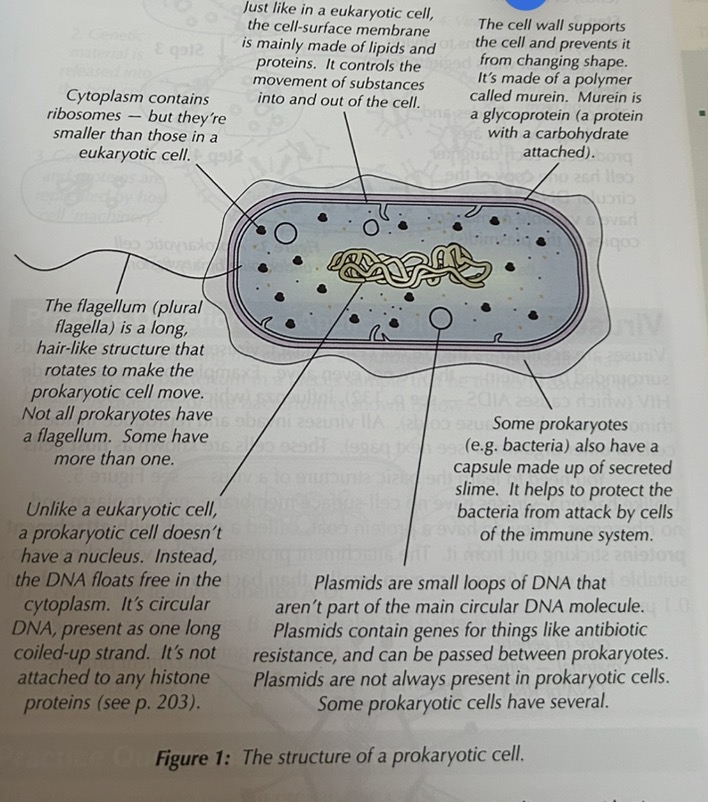
They’re very small
Prokaryotic cells are extremely small — less than 2 um in diameter (that's two millionths of a metre or 0.002 mm). Eukaryotic cells can be up to 50 times bigger (although that's still only around 0.1 mm).
Prokaryotic cell replication
Prokaryotic cells replicate by a process called binary fission. In binary fission the cell replicates its genetic material before physically splitting into two daughter cells

viruses
Viruses
Viruses are acellular — they're not cells. In fact, viruses are just nucleic acids surrounded by protein -they're not even alive. Examples of viruses include HIV (which causes AIDS — see p. 132), influenza (which causes the flu) and rhinoviruses (which cause colds). All viruses invade and reproduce inside the cells of other organisms (see next page). These cells are known as host cells.
Unlike bacteria, viruses have no cell-surface membrane, no cytoplasm and no ribosomes. They do have a protein coat, called a capsid, with attachment proteins sticking out from it. The attachment proteins let the virus cling onto a suitable host cell. Viruses are even smaller than bacteria — e.g. HIV is about 0.1 um across.

Viral cell replication
Because they're not alive, viruses don't undergo cell division. Instead, they inject their DNA or RNA into the host cell — this hijacked cell then uses its own 'machinery' (e.g. enzymes, ribosomes) to do the virus's dirty work and replicate the viral particles. The overall process is shown in Figure 6.
In order to inject their DNA or RNA, viruses first have to attach to the host cell surface. To do this they use their attachment proteins to bind to complementary receptor proteins on the cell-surface membrane of the host cells. Different viruses have different attachment proteins and therefore require different receptor proteins on host cells. As a result, some viruses can only infect one type of cell (e.g. some viruses can only infect one species of bacteria), while others can infect lots of different cells (e.g. influenza).
