Austria: Military History and Notable Events
 Call Kai
 Learn
Learn Practice Test
 Spaced Repetition
 Match
Match Flashcards
 Knowt Play
1/19

There's no tags or description
Looks like no tags are added yet.
Name | Mastery | Learn | Test | Matching | Spaced | Call with Kai | Chat |
|---|
No analytics yet
Send a link to your students to track their progress
20 Terms

1315 - Battle of Morgarten (All Facts)
Battle in which Duke Leopold and his forces were defeated by the Three Forest Cantons of the Swiss and their forces, thus consolidating the Three Forest Cantons into the old Swiss Confederacy
Battle in which a smaller army of Swiss foot-soldiers at Luke Zug had routed the Habsburg army which came to the valleys of Schwyz and Unterwalden to
subdue the peasant farmers there
bring central Switzerland within the domain of the Habsburg Empire
Battle prior to which the Habsburgs had long enjoyed manorial rights in the valleys of Schwyz and Unterwalden, but hadn’t ever pressed their claim to political power there
Battle which caused the Three Forest Cantons, which were become increasingly independent prior to the namesake, to come together and fortify the entrances to their valley
Battle which was triggered when a dispute over grazing rights involved the men of Schwyz in attacking an abbey and taking some of its monks hostage
Battle in which Duke Leopold of Austria devised a plan involving naval forces on Lake Lucerne to block off Unterwalden and attack Schwyz
However, he did not reckon with the slaughter that followed, mostly of his own men and its noble leaders in the namesake district

1386 - Battle of Sempach (All Facts)
Battle in which Leopold III of Austria and his forces were defeated by the (Old) Swiss Confederation
Battle in which Leopold III of Austria was killed in battle
Battle which broke out due to Leopold III of Austria’s growing power in the Duchy of Swabia
Battle after which a treaty was signed, (supposedly) the Treaty of Zurich by Albert, which recognized recent Swiss conquests and allowing the Swiss to keep all the land they won
Battle after which a few years later the Habsburg dukes of Austria agreed to another 20-year truce with the Swiss Confederation
1474 - Perpetual Peace (All Facts)
Peace treaty signed between Archduke Sigismund of Habsburg Austria and the Old Swiss Confederacy (the Eight Cantons), in which the parties agreed to effectively end over a century of open hostilities between themselves, forcing Austria to renounce its claims on several Swiss-occupied territories and establishing a critical anti-Burgundian alliance
1482 - Treaty of Arras (All Facts)
Treaty in which Burgundy and Picardy were absorbed into France
Treaty in which Artois became the dowry of the two-year-old Margaret of Burgundy, daughter of Mary and Maximillian, who had been promised in marriage to Charles VIII

1515 - First Congress of Vienna (All Facts)
Meeting attended by the Holy Roman Emperor Maximilian and the Jagiellonian brothers, King Vladislaus II of Hungary and Bohemia, and King Sigismund of Poland and Grand Duke of Lithuania where they all forged an alliance with one another
Meeting in which Holy Roman Emperor Maximilian married off his children Ferdinand and Mary to King Vladislaus II of Hungary and Bohemia’s children Louis and Anne
Meeting in which the Kingdom of Hungary, given its absence of a direct heir to King Louis II, was inherited to Archduke Ferdinand of Austria and the House of Habsburg
This partially protected them from the Ottoman Empire
Meeting after which the hereditary territories of the Habsburgs were united amongst Austria, Bohemia, and Hungary

1529 - 1533 - First Habsburg-Ottoman War (All Facts)
War in which Suleiman and his Ottoman forces defeated Ferdinand and the Habsburgs (Holy Roman Empire and Spain)
War which saw
The Siege of Vienna
The Siege of Kőszeg

1529 - Siege of Vienna (All Facts)
Battle in which the Holy Roman Empire and Spain and their combined forces (nearly) defeated Suleiman and his Ottoman forces in the Habsburg-Ottoman War
Battle before which the Imperial Holy Roman Diet assembled in Innsbruck and voted 120K Rhenish guilders for defense against the Ottoman forces
In addition, the Diet of Speyer had promised an army of 16K men and 4K cavalry, despite opposition of Philip of Hesse and other German Protestant Princes
Battle in which the Ottoman troops were first met by a garrison of seasoned veterans, and, wave after wave Suleiman and his forces were beaten back and made no significant breach into the city walls
Battle in which Suleiman and his Ottoman forces lost a month battling through heavy storms, building bridges across rivers, and leading his troops through treacherous terrain of streams and marshes
Battle in which bad weather and disease had been the crucial factors in preventing the Ottomans from gaining control of Austria, not Christian arms or strategies
Battle in which Suleiman and his forces lost horses and men from hunger and disease
Battle after which the Ottoman forces, which were encamped beneath the namesake Austrian city walls for three weeks, were ordered by Suleiman to retreat, and headed back towards Belgrade

1540 - 1547 - Third Habsburg-Ottoman War (All Facts)
War in which Suleiman and his Ottoman forces defeated Ferdinand and the Habsburgs (Holy Roman Empire and Spain)

1541 - Siege of Buda (All Facts)
Battle in which Suleiman and his Ottoman forces defeated Holy Roman Emperor and Hungarian King Ferdinand in the namesake Hungarian city during the Third Habsburg-Ottoman War
Battle after which Hungary became a (Turkish) province of the Ottoman Empire

1551 - 1562 - Fourth Habsburg-Ottoman War (All Facts)
War in which Suleiman and his Ottoman forces defeated the Habsburgs (Holy Roman Empire and Spain)

1565 - 1568 - Fifth Habsburg-Ottoman War (All Facts)
War in which Suleiman and his Ottoman forces defeated Holy Roman Emperor Maximilian II and his Habsburg forces

1571 - Battle of Lepanto (All Facts)
Battle in which Don John of Austria and the Holy League defeated Ali Pasha and the Ottoman Turks
Battle in which two great galleys, one flying the pennant of the Cross and the other the Crescent were being rowed directly at each other, gathering speed all the time as the galley-masters whipped their slaves to even greater efforts
Battle in which the Cross met the Crescent in which many believed will be the last great encounter between the two galley fleets
Battle in which the La Real and Sultana flagships struck each other so hard that they locked together
Battle triggered by Sultan Selim II’s invasion of Cyprus
This brought the combined fleets of Spain, Venice, and the Papacy face-to-face with the larger Turkish fleet
Famagusta had fallen, and reports of unbelievable atrocities had incensed the Christians to a crusading fervor as they sailed from Messina
Battle in which Don John of Austria
rode in La Real, the Spanish flagship
drew his sword and braced himself for the inevitable head-on crash
began to charge forward in the La Real after the Ottomans had moved out to attack in their crescent formation
led his men onto the Sultana’s foredeck and confronted Ali Pasha in person
Battle in which Ali Pasha (the Turkish commander)
ordered his men on the Sultana, the Turkish flagship, to prepare to board
and his fleet was anchored in the gulf when the Christian fleet hove into sight
and the Ottoman Turks hesitated before moving out to attack in a crescent formation
was killed by a Spanish arquebus, his head struck off and presented to Don John of Austria
Battle in which the Ottoman Turks lost 230 galleys
Battle in which the Holy League of Christians lost just 16 galleys
Battle whose victory by the Christian Holy League brought great rejoicing throughout the West

1591 / 1593 - 1606 - Long Turkish War / Thirteen Years’ War / Fifteen Years’ War / Sixth Habsburg-Ottoman War (All Facts)
War in which Murad III, Mehmed III, and Ahmed and their Ottoman forces fought against Holy Roman Emperor Rudolf II and the Habsburgs (Holy Roman Empire and Spain) and their allies; which ended in a stalemate
War during which Ottoman forces captured the fortress of Raab in Hungary

1595 - Siege of Esztergom (All Facts)
Battle in which Habsburg forces defeated Ottoman forces during the Long Turkish War Thirteen Years’ War / Fifteen Years’ War / Sixth Habsburg-Ottoman War
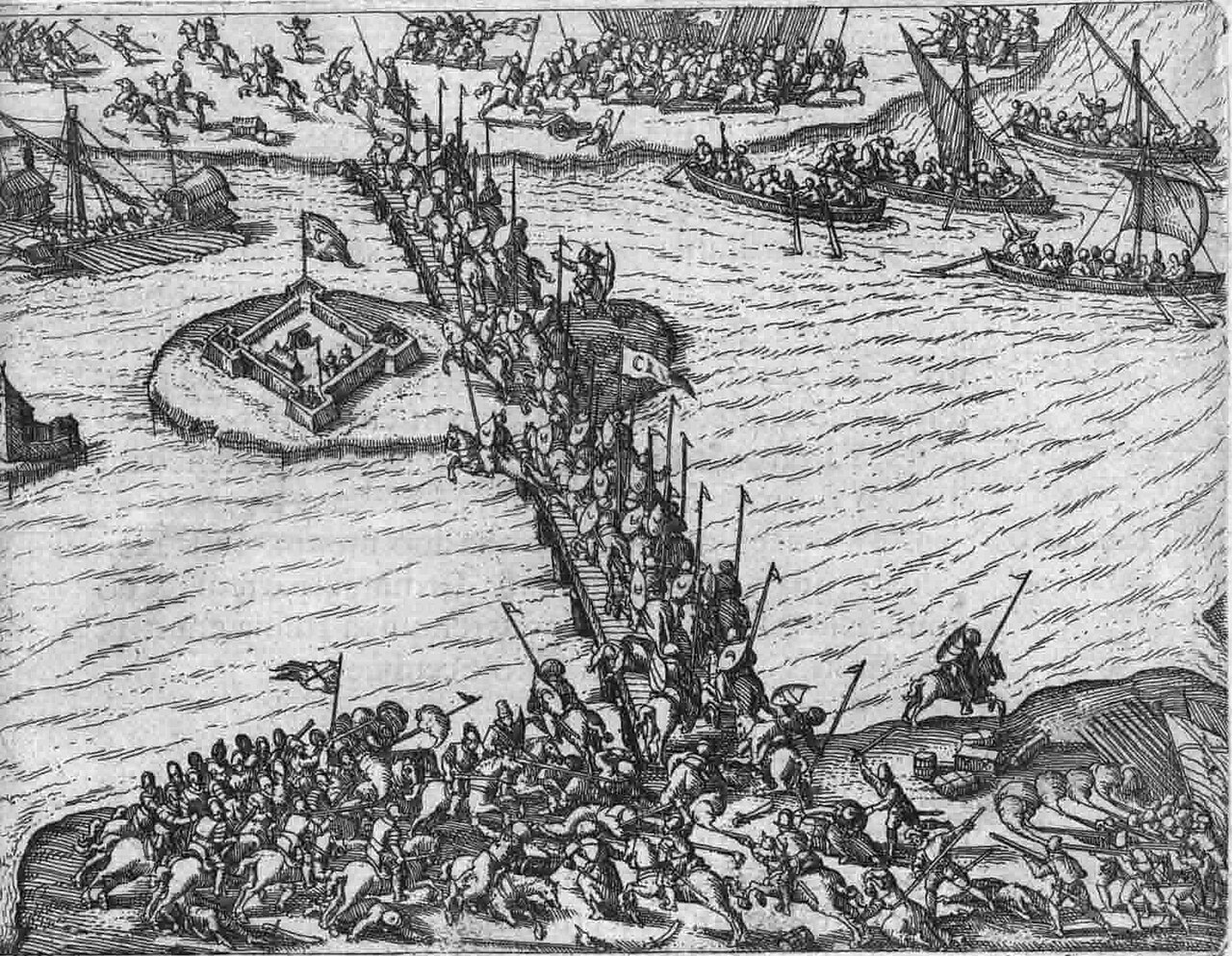
1595 - Battle of Giurgiu (All Facts)
Battle in which Sigismund Bathory and his Habsburg forces defeated Ottoman forces during the Long Turkish War / Thirteen Years’ War / Fifteen Years’ War / Sixth Habsburg-Ottoman War

1596 - Battle of Mezőkeresztes (All Facts)
Battle in which Mehmed III and his Ottoman forces defeated Sigismund Bathory and his Habsburg forces and allies during the Long Turkish War / Thirteen Years’ War / Fifteen Years’ War / Sixth Habsburg-Ottoman War
Battle in which Mehmed III
was personally responsible for turning the tide of battle, despite a mass desertion by the Ottoman Turkish infantry
in one fell swoop, saved a huge swathe of territory for the Ottoman Empire, saving its possessions in Macedonia, Bulgaria, and Hungary despite a string of previous Hungarian military victories
tried to follow the “siphahis” when they walked off the battlefield, but his generals held a council of war to persuade him to stay with the rest of his army
Battle which
began badly for the Ottoman forces, when early reverses caused the “sipahis,” the fief-holding backbone of the Ottoman forces, to simply walk off the battlefield
Battle in which the overconfident Christian Habsburg forces broke rank to plunder the Ottoman Turkish camp, only for the Ottoman cavalry to kill them and take enormous booty including a hundred cannons
Battle in which 30K Hungarians and Germans died

1606 - Peace of Zsitvatorok (All Facts)
Peace Treaty signed between Holy Roman Emperor Matthias and Sultan Ahmed of the Ottoman Empire, ending the Long Turkish War / Thirteen Years’ War / Fifteen Years’ War / Sixth Habsburg-Ottoman War
Peace Treaty signed between equals (unlike previous treaties which were “graciously accorded by the Sultan” to his “vanquished” rival) in the namesake obscure town on the Hungarian frontier, which promised a new era of stability between the two longstanding foes
Peace Treaty in which Austria was no longer able to pay an annual tribute (to the Ottoman Empire) and a final payment was agreed upon, after which the ambassadors (and rulers) of the two great powers promised to exchange ceremonial gifts every three years
Peace Treaty in which
the Ottoman Empire renounced its claims to Hungary with the exception of two newly-created provinces and the frontier fortresses of Erlau, Gran, and Kanischa
Stephen Bocskai and Transylvania gained considerably autonomy under Ottoman rule
Peace Treaty which would remain in effect (definitively) for the next 20 years

1618 - 1648 - Thirty Years’ War (All Facts)
Conflict
between Catholics and Protestants in Germany following the failure to reconcile them via the Peace of Augsburg
Conflict in which
4.5M-8M people were killed from
the battlefield
plague and disease
the constant maneuvering helped to spread disease
famine
the constant maneuvering laid waste to vast tracts of farmland
Crops were destroyed
German towns lost as many as 50% of their populations from
being razed to the ground by siege and fire
plague borne by countless armies
the European continent was nearly destroyed
Conflict which began
with the Defenestration of Prague and Bohemian Revolt
when Bohemia elected itself a new Protestant as king, Frederick V, previously the elector of Palatine, to replace the Habsburg King Ferdinand II, whom the Bohemian estates had previously “accepted” as king
Conflict during which
The Protestant Union was dissolved
Conflict during which
Johann Tserclaes (Count of Tilly) and his Catholic forces sacked the Heidelberg University Library
Bavaria (as well as Spain and Austria) invaded France with their armies and advance units of the Bavarian cavalry arrived in the Parisian suburbs
These armies invaded France but were driven back
Conflict which saw
The Bohemian Revolt
The Defenestration of Prague
The Battle of White Mountain
The Vatellina War (between Spain and Switzerland)
The Battle of Lutter
The Battle of Dessau Bridge
The Sack of Magdeburg
The Battle of Breitenfeld
The Battle of Lutzen
The Battle of Nordlingen
The Battle of Wittstock
The Battle of Rheinfelden
The Battle of Freiburg
Conflict which involved
The Eighty Years’ War / Dutch Revolt (between Spain and the Netherlands / Dutch Republic)
Conflict which ended with
The Peace of Prague
The Peace of Westphalia
This took three years of negotiation in two cities, Munster and Osnabruck, to bring about the official signing
Just four years prior to the start of the war,
Catholics and Protestants alike in Germany were already preparing for the conflict, which threatened to engulf the whole continent as
battle-lines were already being drawn up by then
fortunes were already being spent equipping private armies throughout Germany
Germany prepared itself to be the battlefield when the war would break out
In the Protestant north of Germany,
whole cities were ringed with star-shaped walls, bastions, and moats
In Catholic Bavaria and in the Rhineland,
great new fortresses pierced the skylines
intense diplomatic activity was taking place, particularly on the part of
Prince Christian of Anhalt-Bernburg
King James of England
Conflict which ended when three successive salvos crashed out from 70 cannons on the walls of Munster to announce that peace came from a war-ravaged Europe after three decades of bitter conflict in which every power became involved both on land and sea
Conflict after which
100K+ mercenaries had to be paid and returned home lest they turn themselves into robber-bands adding even more torment to a war-weary Europe
the high cost of the war caused massive tax demands on both nobles and peasants, both parties of whom threatened revolt

1626 - 1627 - Upper Austrian Peasant War (All Facts)
War which began when 17 Austrian peasants were led out of Frankenfeld Castle and hanged for their heresy, as Archduke Ferdinand II did not like their rudeness to his newly installed Italian Catholic priests in former Protestant churches in Linz
War which began when Protestant revolted as a result of their deaths
War in which rebel peasants put Linz under siege and pleaded for foreign aid
War during which
Calvinist ministers were expelled
nobles faced a choice between conversion and expulsions
plans were afoot to proscribe Protestantism completely
1635 - Peace of Prague (All Facts)
Peace Treaty signed between Holy Roman Emperor Ferdinand II and Elector John George of Saxony in which
ended the pre-French “religious-based” phase of the Thirty Years’ War as the war was not really about religion thereafter
the dukes of Saxony and Brandenburg retained their ecclesiastical lands which they held eight years prior
the armies of Saxony and Brandenburg had to switch allegiance and come under the command of the Holy Roman Empire
Calvinists were excluded, and the Holy Roman Empire would continue to wage war on them thereafter
Peace Treaty signed between Holy Roman Emperor Ferdinand II and the Lutheran states of Bavaria, Mainz, Cologne, and Trier
This allowed the emperor to claim that all the major German Protestant Princes were united behind him
The treaty was political and religious in nature
Peace Treaty which
brought rejoicing to Germany
brought fear to France, the Netherlands, and other European powers