Ch 6
 Call Kai
 Learn
 Practice Test
 Spaced Repetition
 Match
 Flashcards
 Knowt Play
1/62

There's no tags or description
Looks like no tags are added yet.
63 Terms
When is DNA replicated?
during cell division
how many cells are generated everyday in the human body?
1 billion
mutations/errors in DNA replication can lead to
genetic disorders and diseases.
conservative mode of DNA replication
a method where the original DNA strands remain intact and a completely new double helix is synthesized.

semiconservative mode of DNA replication
a method where each new double helix consists of one original strand and one newly synthesized strand.
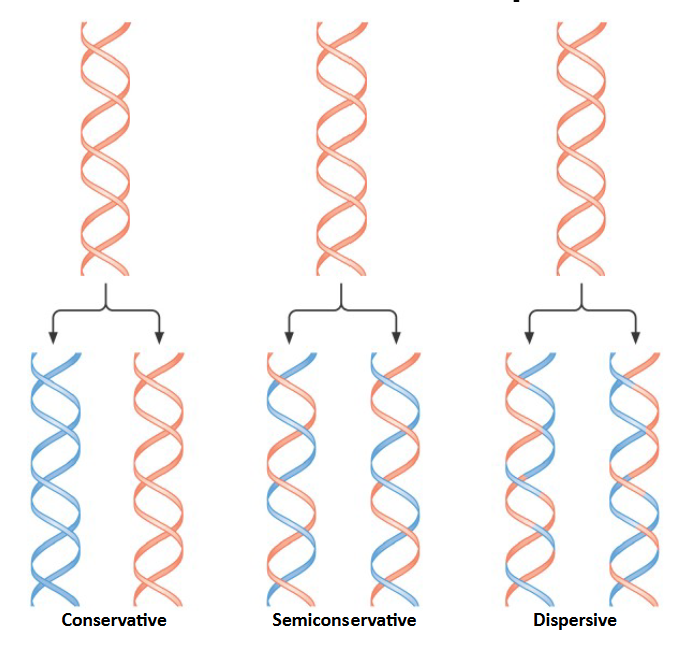
dispersive mode of DNA replication
Each strand contains interspersed sections of parental and new DNA

Meselson-Stahl experiment
An experiment conducted by Matthew Meselson and Franklin Stahl in 1958 that demonstrated the semiconservative nature of DNA replication by using isotopes of nitrogen (radiolabeled DNA nitrogenous bases) to label newly synthesized DNA strands and observe the distribution of parental and newly synthesized strands across generations by comparing the mass of DNA strands over 2 generations.
How did they compare the masses of DNA strands?
high-speed centrifugation in graded solution
semiconservative replication over time
The proportion of original strands and newly synthesized strands is maintained, resulting in DNA molecules that contain one old and one new strand for each helix.

each DNA strand can serve as a template for the synthesis of a new _____ strand
complementary
DNA replication
begins with DNA strands being pulled apart with the aid of initiator proteins
initiator proteins
allow the separation of the double-stranded DNA (dsDNA)
replication origins in bacteria vs human genome
bacteria: 1 replication origin
human genome: 10,000 replication origins
are replication origins more likely to be A-T rich or G-C rich?
Replication origins are more likely to be A-T rich due to the presence of two hydrogen bonds between A and T, making them easier to separate compared to G-C pairs which have three hydrogen bonds.
a twisting force that occurs during DNA replication, caused by the unwinding of the double helix. some stress can be relieved by DNA supercoiling
torsional strain
topoisomerase
An enzyme that alleviates torsional strain in DNA during replication by inducing temporary single-strand breaks and allowing the DNA strands to unwind.
How does topoisomerase relieve torsional stress ahead of helicase?
Topoisomerase temporarily breaks one DNA strand. DNA rotates freely around the phosphodiester bond in the opposite, unbroken strand, releasing the twisting stress ahead of helicase. The same topoisomerase then reseals the break.
y-shaped junction where DNA is replicated
replication fork
a group of proteins that are recruited to the site and replicate the DNA after separation of double helix
replication machine
DNA synthesis is ___ to ___
5’ → 3”
nucleotides are added only to the ___ end of a DNA strand
3’
catalyzes new strand synthesis
DNA polymerase
DNA polymerase processivity
clamo proteins anchor the DNA Pol III enzyme to remain clos to the DNA ensure processivity
DNA Pol II can synthesize 1,000 nucleotides/second
processivity
refers to the ability of DNA polymerase to add nucleotides continuously without detaching from the DNA template.
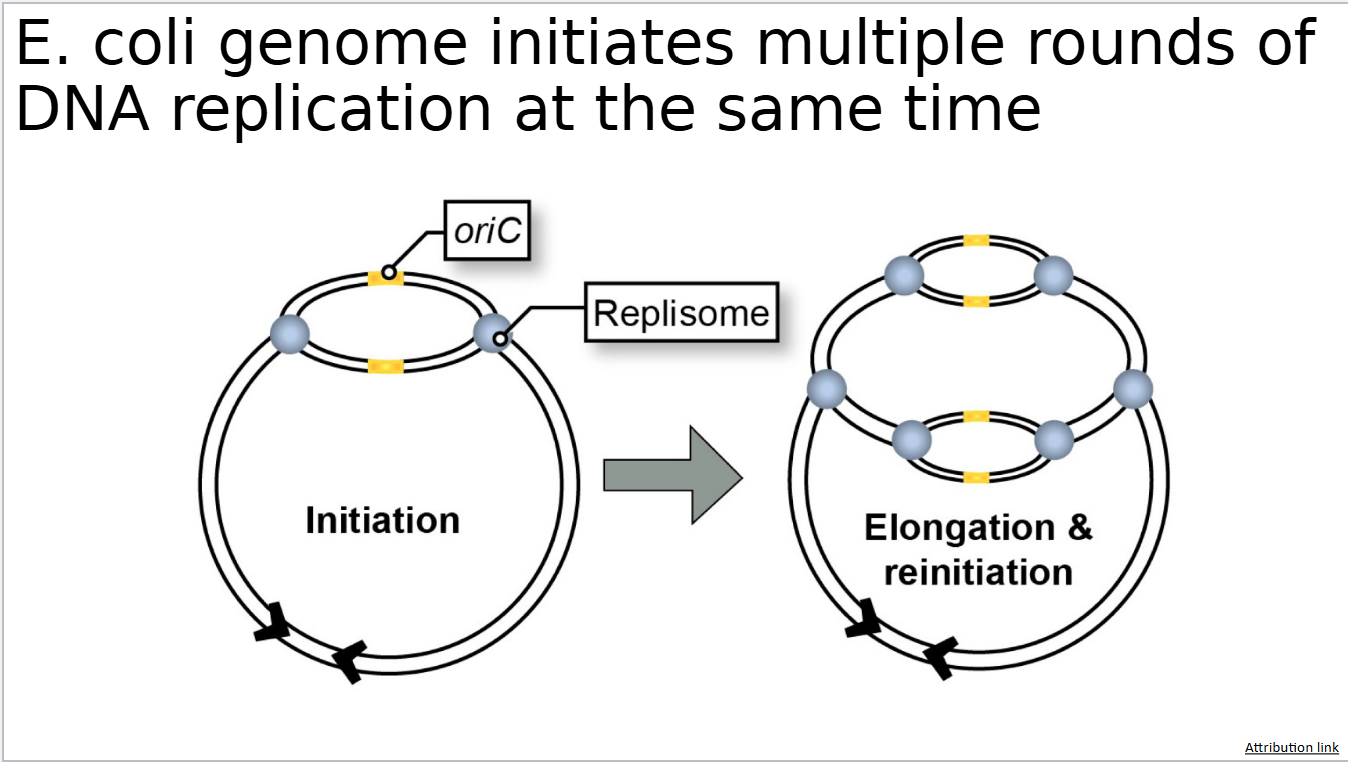
how can the doubling time of E. coli be appx. 15-20 min.? Given that and E. coli genome can be replicated in 50 min..
E. coli starts new rounds of DNA replication before the previous round finishes. This creates multiple replication forks copying DNA simultaneously.
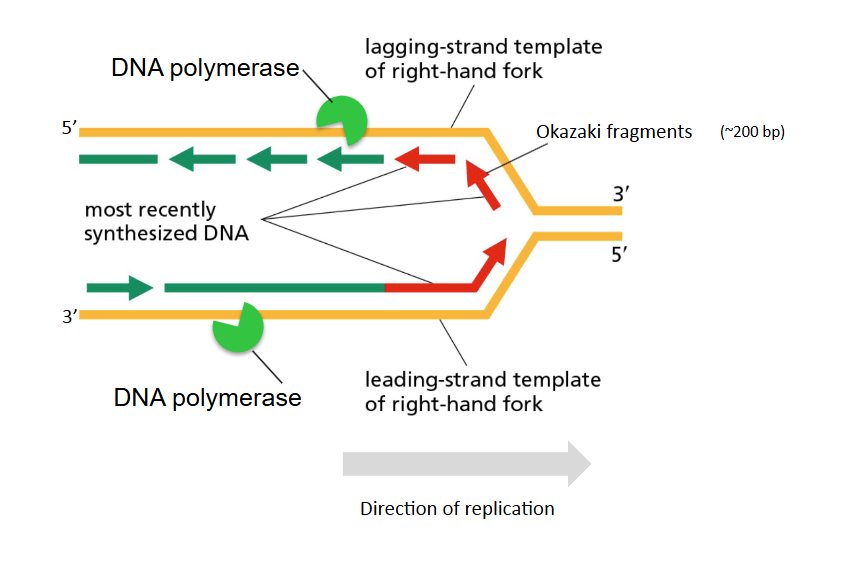
If DNA is synthesized only in the 5’ to 3’ direction, how are both strands replicated at the fork?
Both strands are replicated simultaneously using leading and lagging strands; the leading strand is synthesized continuously, while the lagging strand is synthesized discontinuously in Okazaki fragments.
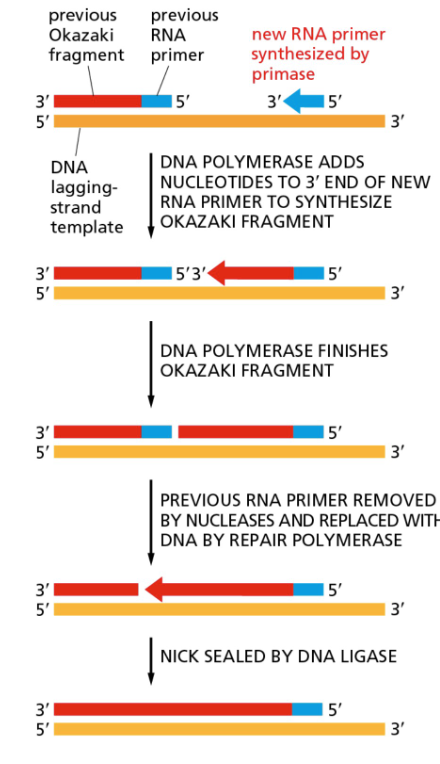
will synthesize NA primer to begin replication
primase
will extend the okazaki fragment until it runs into the next RNA primer
DNA polymerase
RNA primer will then be degraded by a ____ and a DN polymerase called __________; replaces the RNA with DNA
ribonuclease; repair polymerase (DNA Poly 1)
joins okazaki fragments (5’ Phosphorous to 3’ OH)
DNA ligase
Important replication proteins
initiator proteins, helicase, single-stranded DNA-binding proteins, topoisomerase, primase, DNA Polymerase III, sliding clamp, nuclease, DNA polymerase 1, and DNA ligase.
catalyzed by 3’→5’ exonuclease activity.
polymerase error: error rate is 1 in 107 bp
exonuclease error: error rate is 1 in 102 bp
DNA polymerase proofreading
How does DNA synthesis in the 5’ to 3’ direction facilitate proofreading?
During 5′→3′ synthesis, each incoming nucleotide supplies the energy needed to attach itself to the growing strand.
If proofreading removes an incorrect nucleotide from the 3′ end, it leaves a free 3′-OH. The next correct nucleotide supplies fresh energy, so synthesis can continue.
In hypothetical 3′→5′ synthesis, removing the incorrect nucleotide would also remove the growing strand’s activating triphosphate (energy source), preventing continued synthesis.
Therefore, 5′→3′ synthesis allows mistakes to be removed without losing the ability to keep building DNA.
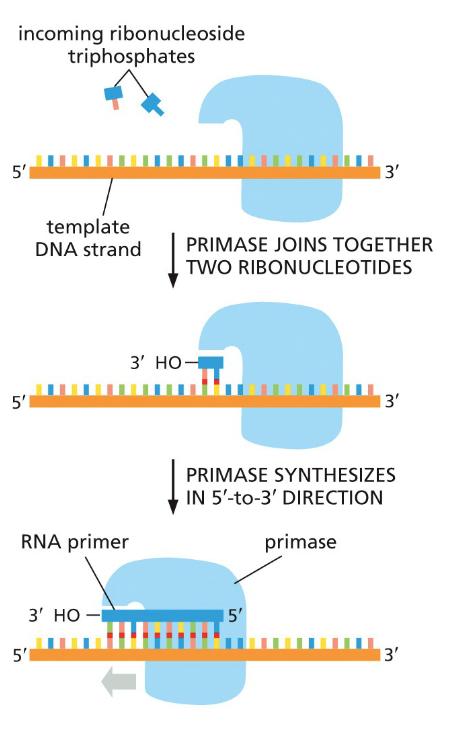
DNA Priming (leading strand)
provides starting point DNA polymerase needs to build a new strand since it can’t start from scratch; it needs an existing 3’ OH to add nucleotides
primase can start from scratch. it joins RNA nucleotides to make a short RNA primer complement to the DNA template
primer grows 5’→ 3’, and DNA poly adds nucleotides to its 3’ end
DNA Priming (lagging strand)
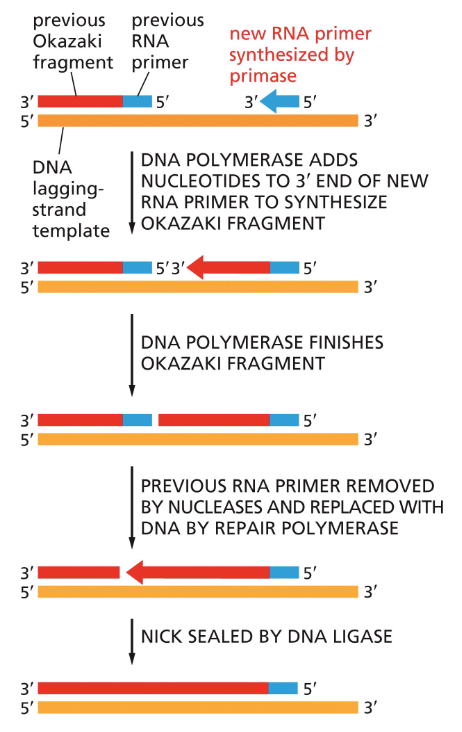
primase makes a new RNA primer
DNA polymerase extends it to form an Okazaki fragment
the previous RNA primer is removed by nucleases
a repair DNA polymerase replaces that RNA with DNA
DNA ligase seals the remaining nick in the backbone
lagging strand needs a new primer for every okazaki fragment
ligation of okazaki fragments
RNA primers removed and replaced with DNA → all nucleotides are present, but the sugar-phosphate backbone isn’t fully connected (nicked)
ATP supplies energy to activate 5’ phosphate at the nick
ligase forms a phosphodiester bond between 5’ P and adjacent 3’ OH
AMP is released, leaving a continuous backbone

draw

end-replication problem
linear chromosomes can get shorter each time DNA is copied
When the last primer at the chromosome’s end is removed, there is no neighboring 3’ OH for DNA polymerase to extend, so that gap can’t be filled. The new strand is shorter at its 5’ end. In the next replication round, that shortened strand serves as a template, causing further loss
solution: telomerase
How does telomerase help elongate chromosome ends?
Telomerase adds repetitive nucleotide sequences to the 3' ends of chromosomes, extending telomeres and preventing loss of genetic information during DNA replication.
when is DNA replicated?
during cell division
permanent changes in DNA sequence; can be deleterious, neutral, or even beneficial (evolution); not always easy to distinguish between deleterious and beneficial; can occur despite proofreading
mutations/ replication errors
an unpaired mismatch can become a permanent ______ after another replication
base-pair substitution
chemical modifications that lead to mutations
deamination: changes C to U; U then pairs with A during replication => substitution after 2 rounds of replication (C-G —deamination changes C into U→ U-G —U pairs with A→ U-A —T is opposite to A→ T-A
depurination: a purine base ( A or G) is lost; the copying machinery skips the missing base, producing deletion
can accumulate mutations over a lifespan that may impact health
somatic cells
excision, replacement, ligation
DNA repair mechanisms
a nuclease will remove the damaged/wrong region
excision
DNA polymerase will synthesize new strand
replacement
the enzyme ligase will connect the newly synthesized nucleotide with the next one (nick repair)
ligation
mutations drive _____ across species
genetic diversity
DNA can help uncover ____ relationships
phylogenetic
_______ mutations that disrupt DNA areplication would be expected to be _____
disease-associated (pathogenic variants); cell lethal
_____ variants likely to be _____ mutations
disease-causing; hypomorphic (partial loss-of-function)
microtia (small ears), distinct facial features, absent or small patellae (kneecaps), short stature, pathogenic variants impair proteins needed to load helicase onto DNA, disrupting replication initiation and normal growth
Meier-Gorlin Syndrome
psychomotor regression (loss of previosuly attained developmental milestones), seizures, liver disease, pathogenic variants in mito polymerase genes, mitochondrial DNA depletion
alpers syndrome
aplastic anemia: underproduction of blood cells, pathogenic variants in telomerase
telomere shortening, cancer, premature aging, alzheimer’s and parkinson’s disease
telomere-related disease
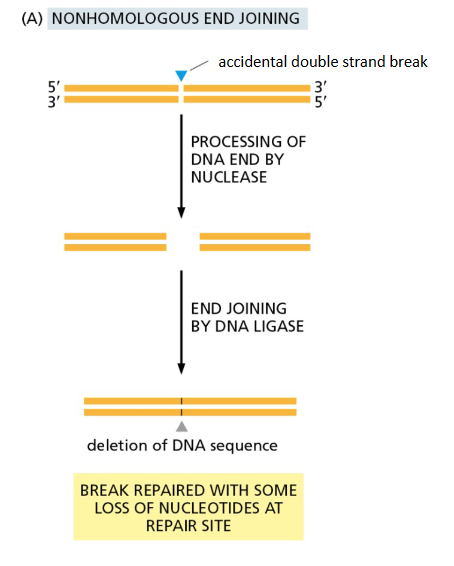
How does nonhomologous end joining (NHEJ) repair a double-strand break?
The broken ends are processed, sometimes removing nucleotides, and DNA ligase joins the ends. No homologous template is required, but repair can cause a deletion.
How does homologous recombination repair a double-strand break?
It aligns the damaged DNA with an undamaged homologous DNA molecule, usually a sister chromatid, and uses it as a template to restore the missing sequence accurately.
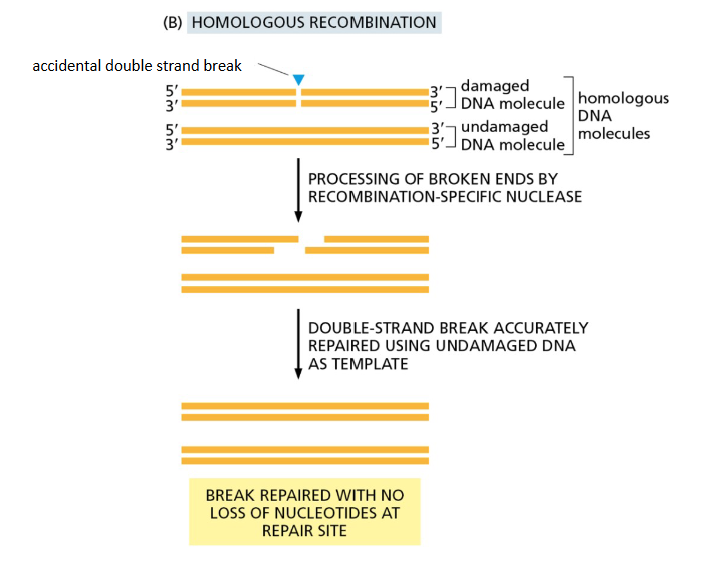
What are the steps of homologous recombination shown in the diagram?
A nuclease removes DNA from the 5′ ends, exposing 3′ overhangs.
A 3′ end invades matching DNA and pairs with its complementary strand.
DNA polymerase extends that end using the undamaged DNA as a template.
The extended strand returns and pairs with the other broken end.
DNA synthesis fills the remaining gaps, and ligase seals the nicks.

When does homologous recombination usually occur, and why?
After DNA replication, when an intact sister chromatid is available as a matching repair template.
What is the main difference between NHEJ and homologous recombination?
NHEJ directly rejoins ends without a homologous template and can lose nucleotides. Homologous recombination copies a matching template and generally restores the sequence accurately.
What could happen if a cell receives foreign DNA with homologous ends?
The matching ends can align with the target DNA, allowing the foreign DNA to serve as a repair template and introduce a specific sequence change through homologous recombination.
How does homology-directed repair (HDR) allow precise genome editing?
Cas9 creates a double-strand break. A supplied DNA repair template contains the desired change between two homology arms, which match DNA on either side of the break. The cell uses this template during HDR to copy the desired change into its chromosome.
How does CRISPR–Cas9 produce different edits through NHEJ versus HDR?
A guide RNA directs Cas9 to a matching DNA sequence, and Cas9 cuts both strands.
NHEJ: Rejoins the ends without a supplied template and can create insertions or deletions (indels) that disrupt a gene.
HDR: Uses a supplied matching repair template to introduce a specific sequence change.