6 - Gram Positive Cocci
 Call Kai
 Learn
Learn Practice Test
 Spaced Repetition
 Match
Match Flashcards
 Knowt Play
1/126

There's no tags or description
Looks like no tags are added yet.
Name | Mastery | Learn | Test | Matching | Spaced | Call with Kai | Chat |
|---|
No analytics yet
Send a link to your students to track their progress
127 Terms
a. Violet
The color of Gram-positive cocci after Gram staining
a. Violet
b. Red
c. Pink
d. Colorless

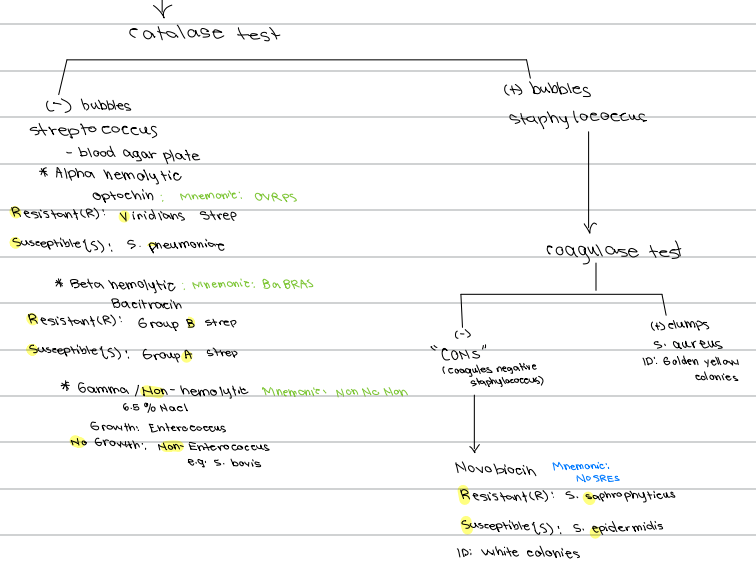
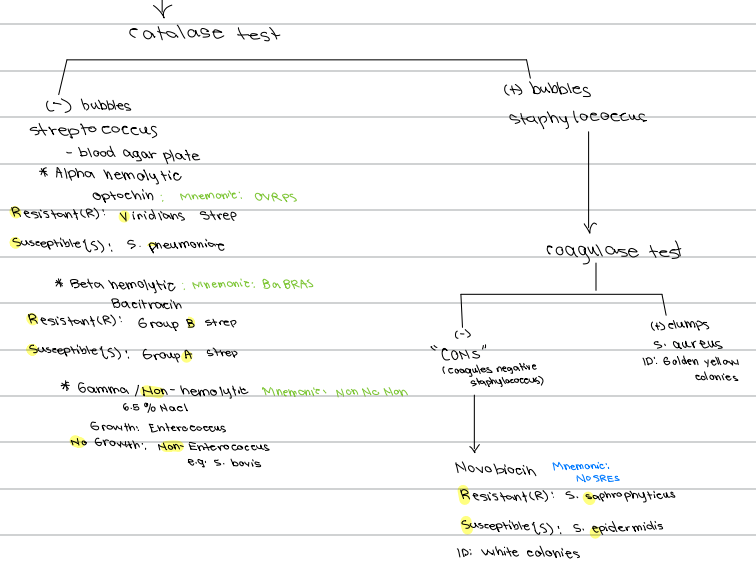
c. Catalase test
[Overview]
Initial test used to differentiate Gram-positive cocci.
a. Coagulase test
b. Novobiocin test
c. Catalase test
d. Optochin test

a. Produces bubbles
[Overview]
Result of catalase test for Streptococcus.
a. Produces bubbles
b. Does not produce bubbles

b. Does not produce bubbles
[Overview]
Result of catalase test for Staphylococcus.
a. Produces bubbles
b. Does not produce bubbles

b. Blood agar plate
[Overview]
Culture medium used to identify Streptococcus hemolytic patterns.
a. MacConkey agar
b. Blood agar plate
c. Chocolate agar
d. Nutrient agar

d. Optochin
[Overview]
Test used to differentiate alpha hemolytic Streptococcus.
a. Bacitracin
b. Novobiocin
c. Coagulase
d. Optochin

Viridians Streptococcus
Streptococcus Pneumoniae
[Overview]
Alpha hemolytic Streptococcus include _____ [2]

d. Viridians strep
[Overview]
Alpha hemolytic Streptococcus that is Optochin resistant.
a. S. pneumoniae
b. Group A strep
c. Group B strep
d. Viridians strep

c. S. pneumoniae
[Overview]
Alpha hemolytic Streptococcus that is Optochin susceptible.
a. Viridians strep
b. Group B strep
c. S. pneumoniae
d. Group A strep
d. Bacitracin
[Overview]
Test used to differentiate beta hemolytic Streptococcus.
a. Optochin
b. Novobiocin
c. Coagulase
d. Bacitracin
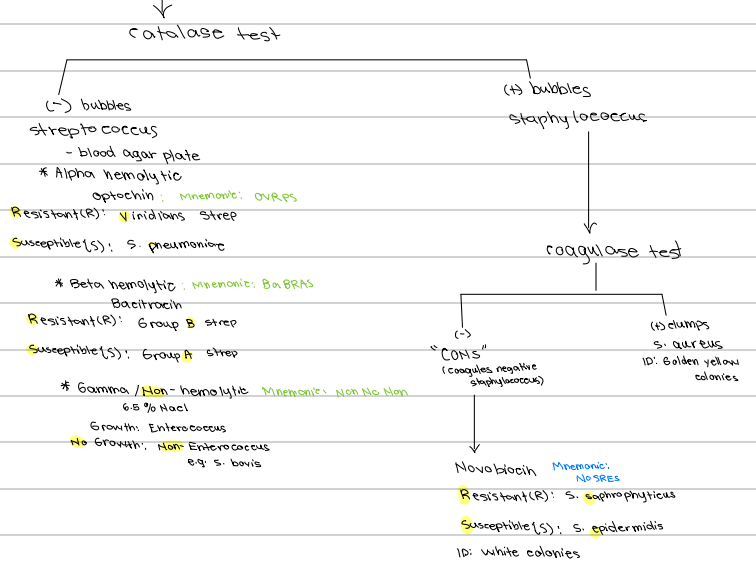
Group A streptococcus
Group B streptococcus
[Overview]
Beta hemolytic Streptococcus include _____ [2]

c. Group B strep
[Overview]
Beta hemolytic Streptococcus that is Bacitracin resistant.
a. Group A strep
b. S. pneumoniae
c. Group B strep
d. Viridians strep

d. Group A strep
[Overview]
Beta hemolytic Streptococcus that is Bacitracin susceptible.
a. Group B strep
b. Viridians strep
c. S. pneumoniae
d. Group A strep

d. 6.5% NaCl
[Overview]
Salt concentration used to differentiate Gamma/Non-hemolytic Streptococcus.
a. 3.5% NaCl
b. 5% NaCl
c. 7.5% NaCl
d. 6.5% NaCl

d. Enterococcus
[Overview]
Gamma/Non-hemolytic Streptococcus that grows in 6.5% NaCl.
a. Non-Enterococcus
b. S. bovis
c. S. pneumoniae
d. Enterococcus

c. Non-Enterococcus
[Overview]
Gamma/Non-hemolytic Streptococcus that does not grow in 6.5% NaCl.
a. Enterococcus
b. S. pneumoniae
c. Non-Enterococcus
d. Viridians strep
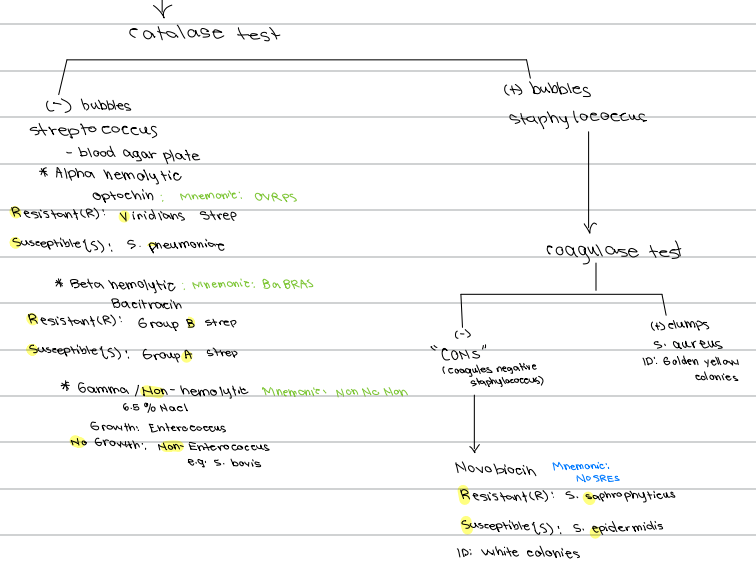
c. S. bovis
[Overview]
Example of Non-Enterococcus in Gamma/Non-hemolytic Streptococcus.
a. Group A strep
b. Group B strep
c. S. bovis
d. S. pneumoniae

d. Coagulase test
[Overview]
Second test used to differentiate Staphylococcus after catalase test.
a. Optochin test
b. Bacitracin test
c. Novobiocin test
d. Coagulase test
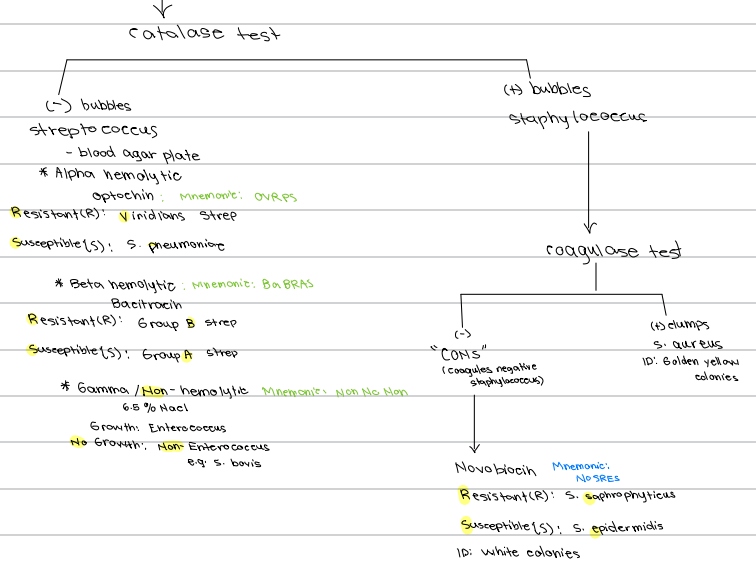
d. S. aureus
[Overview]
Staphylococcus that is coagulase positive with golden yellow colonies.
a. S. epidermidis
b. S. saprophyticus
c. CONs
d. S. aureus
b. CONs
[Overview]
Term for coagulase negative Staphylococcus.
a. S. aureus
b. CONs
c. S. epidermidis
d. S. saprophyticus

c. Novobiocin
[Overview]
Test used to differentiate coagulase negative Staphylococcus (CONs).
a. Optochin
b. Bacitracin
c. Novobiocin
d. Coagulase

c. S. saprophyticus
[Overview]
Coagulase negative Staphylococcus (CONs) that is Novobiocin resistant.
a. S. epidermidis
b. S. aureus
c. S. saprophyticus
d. S. bovis

d. S. epidermidis
[Overview]
Coagulase negative Staphylococcus (CONs) that is Novobiocin susceptible.
a. S. aureus
b. S. saprophyticus
c. S. bovis
d. S. epidermidis

d. White colonies
[Overview]
Colony color used to identify Coagulase negative Staphylococcus (CONs)
a. Golden yellow colonies
b. Green colonies
c. Red colonies
d. White colonies
c. Nose/nares
[Staphylococcus]
BEQ: Reservoir of Staphylococcus aureus.
a. Soil
b. Water
c. Nose/nares
d. Skin
Protein A
Teichoic acid
Capsule
📌Mnemonic: “PTC”
[Staphylococcus]
Virulence factor of S. aureus [3]
c. Acute endocarditis
[Staphylococcus]
Disease caused by S. aureus affecting the tricuspid valve (right side of heart)
a. Mitral valve endocarditis
b. Aortic endocarditis
c. Acute endocarditis
d. Pericarditis
b. IV drug users
Population at risk for acute endocarditis caused by S. aureus
a. Pregnant women
b. IV drug users
c. Elderly
d. Immunocompromised

Salad
Mayonnaise
[Staphylococcus]
Foods sources associated with S. aureus food poisoning [2]

d. Heat stable enterotoxin
[Staphylococcus]
Type of toxin produced by S. aureus in food poisoning.
a. Alpha toxin
b. Heat-labile enterotoxin
c. Botulinum toxin
d. Heat stable enterotoxin

b. 4-6 hrs
[Staphylococcus]
Onset of symptoms in S. aureus food poisoning after ingestion.
a. 1-2 hrs
b. 4-6 hrs
c. 12-24 hrs
d. 24-48 hrs

c. Vomiting, diarrhea
[Staphylococcus]
Clinical manifestations of S. aureus food poisoning due to heat stable enterotoxin
a. Fever and chills
b. Rash and pruritus
c. Vomiting, diarrhea
d. Nausea and constipation
b. No presence of bacteria, toxin only
Management of S. aureus food poisoning; antibiotic is not needed because
a. Toxin is heat labile
b. No presence of bacteria, toxin only
c. Bacteria is not present in food
d. Toxin is destroyed by stomach acid

d. Hydration
Example: ORS 1:1
[Staphylococcus]
Treatment for S. aureus food poisoning.
a. Antibiotics
b. Antitoxin
c. Corticosteroids
d. Hydration
d. S. aureus
[Staphylococcus]
Number one cause of burn infection.
a. Pseudomonas aeruginosa
b. E. coli
c. Streptococcus pyogenes
d. S. aureus
c. Pneumatocele
[Staphylococcus]
Chest X-ray finding in S. aureus pneumonia.
a. Consolidation
b. Pleural effusion
c. Pneumatocele
d. Cavitation
Septic arthritis
Osteomyelitis
[Staphylococcus]
Bone and joint diseases caused by S. aureus
a. Osteosarcoma and gout
b. Septic arthritis and osteomyelitis
c. Rheumatoid arthritis and bursitis
d. Osteoporosis and fracture
a. True
[Staphylococcus]
S. aureus. causes skin and soft tissue infections (SSTI)
a. True
b. False
c. Scalded skin syndrome
[Staphylococcus]
Skin condition caused by S. aureus exfoliative toxin
a. Impetigo
b. Folliculitis
c. Scalded skin syndrome
d. Abscess formation
c. Exfoliatin
[Staphylococcus]
Toxin produced by S. aureus causing scalded skin syndrome.
a. Enterotoxin
b. Neurotoxin
c. Exfoliatin
d. Endotoxin
d. Impetigo
[Staphylococcus]
S. aureus skin infection characterized by honey-colored crust.
a. Abscess
b. Scalded skin syndrome
c. Folliculitis
d. Impetigo
c. Abscess
[Staphylococcus]
S. aureus skin infection characterized by pus.
a. Impetigo
b. Folliculitis
c. Abscess
d. Mastitis
c. Stitch abscess
[Staphylococcus]
S. aureus skin infection occurring at surgical sites.
a. Impetigo
b. Folliculitis
c. Stitch abscess
d. Mastitis
d. Folliculitis
[Staphylococcus]
S. aureus skin infection that progresses to furuncle then carbuncle.
a. Impetigo
b. Abscess
c. Mastitis
d. Folliculitis
c. Furuncle
[Staphylococcus]
S. aureus infection extending up to subcutaneous layer
a. Folliculitis
b. Carbuncle
c. Furuncle
d. Abscess
b. Boils
[Staphylococcus]
Another term for furuncle.
a. Abscess
b. Boils
c. Pus
d. Carbuncle
c. Carbuncle
[Staphylococcus]
Advanced stage following furuncle in S. aureus skin infection progression.
a. Folliculitis
b. Abscess
c. Carbuncle
d. Impetigo
c. Mastitis
[Staphylococcus]
S. aureus infection defined as inflammation of the breast.
a. Folliculitis
b. Furuncle
c. Mastitis
d. Carbuncle
d. Folliculitis → Furuncle → Carbuncle
[Staphylococcus]
Correct progression of S. aureus skin infection.
a. Furuncle → Folliculitis → Carbuncle
b. Carbuncle → Furuncle → Folliculitis
c. Folliculitis → Carbuncle → Furuncle
d. Folliculitis → Furuncle → Carbuncle

c. Tampon
[Staphylococcus]
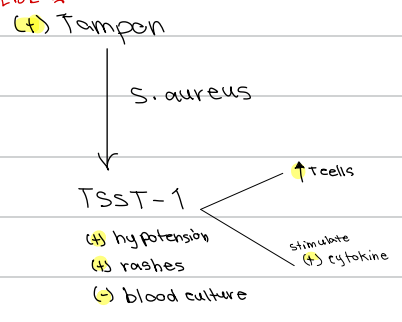
BEQ: Object associated with Staphylococcal Toxic Shock Syndrome.
a. Catheter
b. Surgical suture
c. Tampon
d. IV line
c. S. aureus
[Staphylococcus]
BEQ: Organism that produces TSST-1 via tampon association.
a. S. epidermidis
b. S. saprophyticus
c. S. aureus
d. S. pyogenes

d. TSST-1
[Staphylococcus]
BEQ: Toxin produced by S. aureus in Toxic Shock Syndrome.
a. Exfoliatin
b. Enterotoxin
c. Endotoxin
d. TSST-1

b. T cells
[Staphylococcus]
BEQ: Immune cells increased by TSST-1.
a. B cells
b. NK cells
c. Macrophages
d. T cells

d. Stimulate cytokines
[Staphylococcus]
BEQ: Effect of TSST-1 on cytokines.
a. Decrease cytokines
b. No effect on cytokines
c. Neutralize cytokines
d. Stimulate cytokines

Hypotension
Rashes
Negative blood culture
[Staphylococcus]
BEQ: Effects of Toxic Shock Syndrome [3]
c. MSSA treatment
[Staphylococcus]
Anti-Staph Penicillin
a. Vancomycin-Resistant Staphylococcus aureus (VRSA)
b. Methicillin-Resistant Staphylococcus aureus (MRSA)
c. Methicillin-Susceptible Staphylococcus aureus (MSSA)
d. Decolonization agent
Methicillin
Oxacillin
Nafcillin
📌Mnemonic: “MON”
[Staphylococcus]
Anti-Staph Penicillin include ____ [3]
d. Methicillin
[Staphylococcus]
Methicillin-Susceptible Staphylococcus aureus (MSSA) treatment that can damage the kidney
a. Oxacillin
b. Nafcillin
c. Vancomycin
d. Methicillin
d. Oxacillin
[Staphylococcus]
Commonly used anti-Staph penicillin for Methicillin-Susceptible Staphylococcus aureus (MSSA)
a. Methicillin
b. Nafcillin
c. Linezolid
d. Oxacillin
c. Nafcillin
[Staphylococcus]
Methicillin-Susceptible Staphylococcus aureus (MSSA) treatment that can cause rashes
a. Oxacillin
b. Methicillin
c. Nafcillin
d. Vancomycin
d. Vancomycin
[Staphylococcus]
Drug of choice for Methicillin-Susceptible Staphylococcus aureus (MSSA)
a. Linezolid
b. Oxacillin
c. Nafcillin
d. Vancomycin
Mupirocin
Chlorhexidine
[Staphylococcus]
Methicillin-Resistant Staphylococcus aureus (MRSA) decolonization agents
a. Ciprofloxacin and Doxycycline
b. Mupirocin, chlorhexidine
c. Ampicillin and co-trimoxazole
d. Vancomycin and Metronidazole
c. Bleach Bath (Clorox)
[Staphylococcus]
Alternative to Chlorhexidine and Mupirocin for Methicillin-Resistant Staphylococcus aureus (MRSA) decolonization
a. Vancomycin
b. Linezolid
c. Bleach Bath (Clorox)
d. Oxacillin
d. Linezolid
[Staphylococcus]
Drug of choice for Vancomycin-Resistant Staphylococcus aureus (VRSA)
b. Nafcillin
c. Oxacillin
d. Linezolid
c. S. epidermidis
[Staphylococcus]
The most common normal skin flora
a. S. aureus
b. S. saprophyticus
c. S. epidermidis
d. S. pyogenes
d. S. epidermidis
[Staphylococcus]
Prefers foreign objects such as implant, stent, and prosthetic
a. S. aureus
b. S. pyogenes
c. S. saprophyticus
d. S. epidermidis
d. S. epidermidis
[Staphylococcus]
Staphylococcus species that forms biofilms
a. S. aureus
b. S. saprophyticus
c. S. pyogenes
d. S. epidermidis
b. Stitch abscess
[Staphylococcus]
Complication to watch out for in S. epidermidis infection
a. Toxic shock syndrome
b. Stitch abscess
c. Necrotizing fasciitis
d. Impetigo
c. S. saprophyticus
[Staphylococcus]
Second most common cause of UTI in sexually active young women
a. E. coli
b. S. epidermidis
c. S. saprophyticus
d. S. aureus
d. E. coli
[Staphylococcus]
Most common cause of UTI in all population
a. S. saprophyticus
b. S. epidermidis
c. S. aureus
d. E. coli
a. True
[Staphylococcus]
UTI is more common in females except in very young and very old
a. True
b. False
a. True
UTI is more common in males in the very young and very old
a. True
b. False
a. Pyelonephritis
[Staphylococcus]
UTI involving:
Kidney
With fever
a. Pyelonephritis
b. Urethritis
c. Honeymoon cystitis
d. Cystitis
d. Cystitis
[Staphylococcus]
UTI involving:
Urinary bladder
No fever
a. Pyelonephritis
b. Urethritis
c. Honeymoon cystitis
d. Cystitis
c. Honeymoon cystitis
[Staphylococcus]
UTI from first sexual intercourse
a. Cystitis
b. Pyelonephritis
c. Honeymoon cystitis
d. Urethritis
b. Urinate after intercourse
[Staphylococcus]
Remedy for honeymoon cystitis
a. Increase fluid intake
b. Urinate after intercourse
c. Take prophylactic antibiotics
d. Avoid sexual activity

c. Ascending
[Staphylococcus]
Route of infection of S. saprophyticus in UTI
a. Descending
b. Hematogenous
c. Ascending
d. Lymphatic
b. Carbohydrate (CHO) antigen
[Staphylococcus]
Lancefield classification is based on this
a. Hemolysis pattern
b. Carbohydrate antigen
c. Gram stain morphology
d. Toxin production
b. Group A, B, C
Examples of Lancefield classification groups
a. Group X, Y, Z
b. Group A, B, C
c. Group 1, 2, 3
d. Group I, II, III
Lancefield
Hemolysis
[Staphylococcus]
Two classifications of Streptococcus
a. Lancefield and Gram stain
b. Lancefield and Hemolysis
c. Hemolysis and toxin production
d. Gram stain and hemolysis
d. Alpha hemolytic
Hemolytic pattern of Viridans streptococcus
a. Gamma hemolytic
b. Beta hemolytic
c. Delta hemolytic
d. Alpha hemolytic
c. S. sanguis
[Staphylococcus]
Viridans Streptococcus that can cause subacute endocarditis after oral surgery
a. S. mutans
b. S. intermedius
c. S. sanguis
d. S. pneumoniae
d. S. mutans
[Staphylococcus]
Viridans Streptococcus that causes dental caries
a. S. sanguis
b. S. intermedius
c. S. pneumoniae
d. S. mutans
c. S. intermedius
[Staphylococcus]
Viridans Streptococcus that causes brain abscess
a. S. mutans
b. S. sanguis
c. S. intermedius
d. S. pneumoniae
Viridans Streptococcus
Streptococcus pneumoniae
[Staphylococcus]
Alpha hemolytic Streptococcus species [2]
d. S. pneumoniae
[Staphylococcus]
Also known as Pneumococcus
a. S. mutans
b. S. sanguis
c. S. intermedius
d. S. pneumoniae
d. S. pneumoniae / Pneumococcus
[Staphylococcus]
Identified as lancet-shaped diplococci
a. S. mutans
b. S. sanguis
c. S. intermedius
d. S. pneumoniae / Pneumococcus
c. Droplet less than 1 meter
[Staphylococcus]
Route of transmission of S. pneumoniae
a. Fecal-oral
b. Contact
c. Droplet less than 1 meter
d. Airborne greater than 1 meter
d. S. pneumoniae / Pneumococcus
[Staphylococcus]
Causative agent for community acquired pneumonia (CAP) and Otitis media
a. S. mutans
b. S. sanguis
c. S. intermedius
d. S. pneumoniae / Pneumococcus
d. Beta lactam with/without Macrolide
[Staphylococcus]
Drug of choice for community acquired pneumonia (CAP)
a. Vancomycin
b. Amoxicillin
c. Linezolid
d. Beta lactam with/without Macrolide
Pneumococcal Conjugate Vaccine (PCV)
Pneumococcal Polysaccharide Vaccine (PPV)
[Staphylococcus]
Prevention of community acquired pneumonia (CAP) [2]
c. Otitis media
[Staphylococcus]
S. pneumoniae infection involving the middle ear
a. Pyelonephritis
b. Sinusitis
c. Otitis media
d. Meningitis
d. Amoxicillin
[Staphylococcus]
Drug of choice for otitis media caused by S. pneumoniae
a. Beta lactam with Macrolide
b. Vancomycin
c. Linezolid
d. Amoxicillin
b. Beta hemolytic
[Staphylococcus]
Hemolytic pattern of S. pyogenes
a. Gamma hemolytic
b. Beta hemolytic
c. Delta hemolytic
d. Alpha hemolytic
c. S. pyogenes
[Staphylococcus]
Group A beta-hemolytic Streptococcus (GABHS)
a. S. pneumoniae
b. S. agalactiae
c. S. pyogenes
d. S. mutans
c. M protein
[Staphylococcus]
Virulence factor of S. pyogenes
a. Protein A
b. Coagulase
c. M protein
d. Streptokinase
b. Phagocytosis
[Staphylococcus]
M protein helps prevent______ ,same with capsule
a. Hemolysis
b. Phagocytosis
c. Fibrinolysis
d. Toxin production
d. S. pyogenes
[Staphylococcus]
Source of streptokinase
a. S. pneumoniae
b. S. mutans
c. S. agalactiae
d. S. pyogenes
d. Streptokinase
[Staphylococcus]
_________
Fibrinolytic
Used for Myocardial infarction (MI)
a. M protein
b. Protein A
c. Coagulase
d. Streptokinase
b. Strep. pharyngitis
[Staphylococcus]
Suppurative infection of S. pyogenes characterized by sore throat in patients older than 3 years old
a. Scarlet fever
b. Strep. pharyngitis
c. Strep. TSS
d. Otitis media