Ch. 15 Pt. 4 (nutrient absorption)
 Call Kai
 Learn
 Practice Test
 Spaced Repetition
 Match
 Flashcards
 Knowt Play
1/14

There's no tags or description
Looks like no tags are added yet.
15 Terms
What are the 3 types of Carbohydrates?
1) Starch→plant polysaccharides
2) Disaccharide (sugars)
ex// sucrose & lactose
3) Fiber→plant cellulose
Is Fiber digested in the small intestine?
NO, it is partially metabolized in the large intestine by bacteria
most carbs are digested within the first _______% of the small intestine
20
Explain the steps to how Carbohydrates are digested in the small intestine.
1) pancreatic amylase breaks polysaccharides→maltose
2) brush border enzymes break maltose→monosaccharides(glucose, galactose, fructose)

Explain the steps to how Carbohydrates are absorbed into the blood.
1) Fructose goes thru GLUT5 into intestinal epithelial cells via facilitated diffusion
2) Glucose & galactose go thru SGLT(Sodium-Glucose Cotransporter) w/ Na+ via Secondary Transport
a proton pump use ATP to pump Na+ out the intestine cell and K+ in, so SGLT can use gradient to bring glucose & galactose in
3) All 3 monosaccharides exit→blood via GLUT2 (facilitated diffusion)

Are molecules larger than monosaccharides absorbed?
NO
Explain the steps to how Proteins are digested in the small intestine.
1) pancreatic enzymes(trypsin/chymotrypsin) break proteins→small peptides
2) Brush Border enzyme(aminopeptidase) & carboxypeptidase(pancreatic enzyme) break small peptides→amino acids
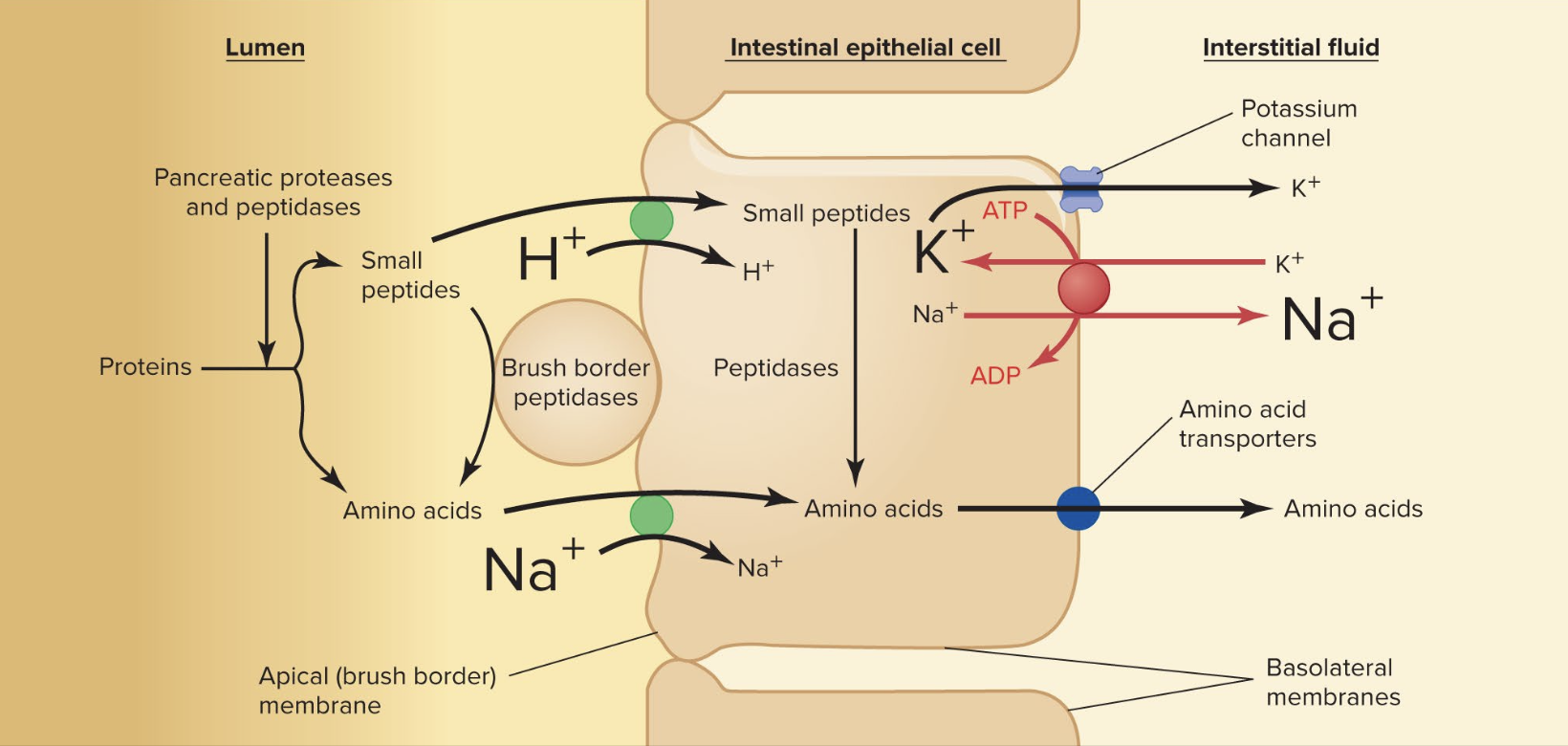
Explain the steps to how Proteins are absorbed into the blood.
1) Amino acids transported w/ Na+ →intestinal epithelial cell (many diff amino acid transporters)
proton pump allows this to happen again(with the Na+)
2) Small peptides transported w/ H+ →intestinal epithelial cell
-once inside, peptidases break them into amino acids
3) amino acids exit →blood via amino acid transporters

What does it mean that fats are lipophobic?
It means fats are insoluble in water
Why does Lipase action only occur at the surface of fat droplets?
Lipase is water-soluble
What increases lipid digestion?
1) emulsification, which is done by bile salts + phospholipids (emulsifying agents) that break large lipid droplets→smaller droplets AND prevents smaller droplets from reaggregating into large droplets
2) mechanical breakdown
What is the purpose of bile salts & phospholipids breaking large fat droplets into smaller ones?
increases SA for lipase action
Role of Colipase & Micelles
Colipase→coats the emulsified droplets & anchors lipase to them
Micelles→phospholipids & bile salts that carry digested fat products to brush border
→help keep fatty acids & monoglycerides soluble in water
Explain the steps to how Fats are digested in the small intestine.
1) Bile Salts & Phospholipids emulsify triglycerides
2) Colipase & Lipase break down triglycerides→2 fatty acids + monoglyceride
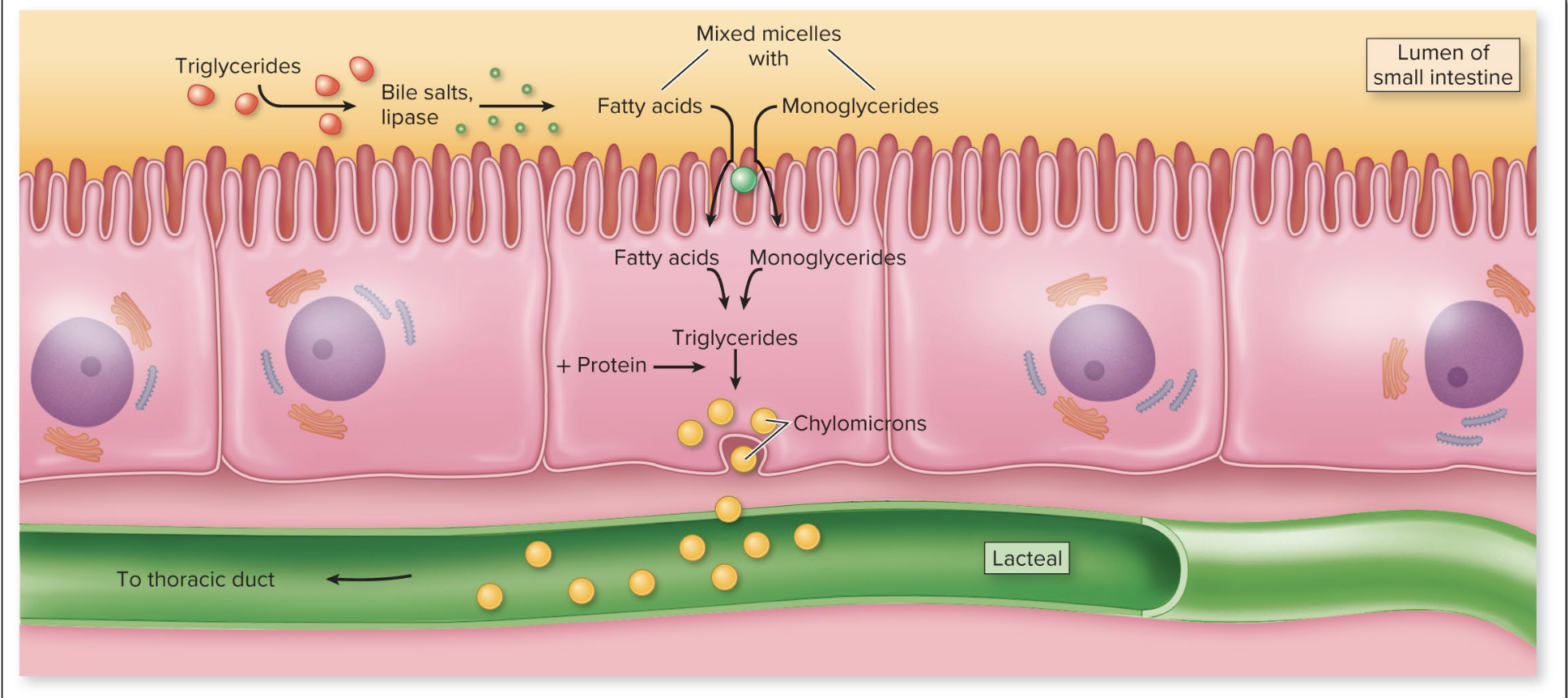
Explain the steps to how Fats are absorbed into the body.
1) fatty acids & monoglycerides are surrounded by micelles & carried to epithelial cells
2) In Epithelium, they are resynthesizes→triglycerides
3) triglycerides form Chylomicrons
4) Chylomicrons travel to Lacteal→Lympathic System→Thoracic Duct→blood→muscles & fats