A.1 - Communication
 Call Kai
 Learn
 Practice Test
 Spaced Repetition
 Match
 Flashcards
 Knowt Play
1/22

There's no tags or description
Looks like no tags are added yet.
23 Terms
What is the nervous system?
The network of billions of neurons throughout the body which allows communication and coordination of all tissues and systems of the body, along with the body and external environment, helping carry out functions like movement and speech, and regulate internal organs like the digestive system and heart.
What are nerves?
The wiring through which electrical signals are sent to and received from tissues.
What is the function of the brain in the nervous system?
Acts as a central computer, integrating information, responding and signaling organs and tissue to action.
What are the 3 basic functions of the nervous system?
Sensory Function - detecting internal stimuli
Integrative Function - analyzing/storing sensory information, and making decisions.
Motor Function - carrying out integrative decision, sending motor neurons to muscle fibers to stimulate movement.
What are the two division of the nervous system?
Central Nervous System (CNS)
Peripheral Nervous System (PNS)
What is the CNS?
Consists of the brain and spinal cord. Processes information, maintains a stable internal environment through homeostasis, and decides certain actions for the PNS to take.
What is the PNS?
Consists of all nerves outside the CNS. It helps inform the CNS about external information, and carry messages between the CNS and rest of body.
The motor nerves of the PNS are split into two divisions:
somatic nervous system
autonomic nervous system
What are the 4 parts of the brain/spinal cord (crucial to CNS), and their functions?
the brain stem - connects the brain and spinal cord, relaying sensory and motor nerves between them, and controls automatic functions like breathing and heart rate.
the cerebellum - controls balance and coordination
the cerebrum - composed of two brain hemispheres which communicate with each other. Contains the cerebral cortex (conscious brain), allowing for awareness and voluntary actions.
the diencephalon - contains the thalamus, crucial for motor control, and the hypothalamus, which maintains homeostasis by regulating processes like blood pressure, respiration, digestion, and body-temperature.
What does the somatic nervous system do (within the PNS)?
Control voluntary movements of muscles.
What does the autonomic nervous system do (within the PNS)?
Regulates involuntary bodily functions, like heart rate, digestion and breath.
It is further divided into:
The sympathetic nervous system - activates “fight-or-flight”
The parasympathetic nervous system - carries out digestion, urination, and energy conservation, helping with relaxation (the body´s “housekeeping” system)
What is the full organization of the nervous system?
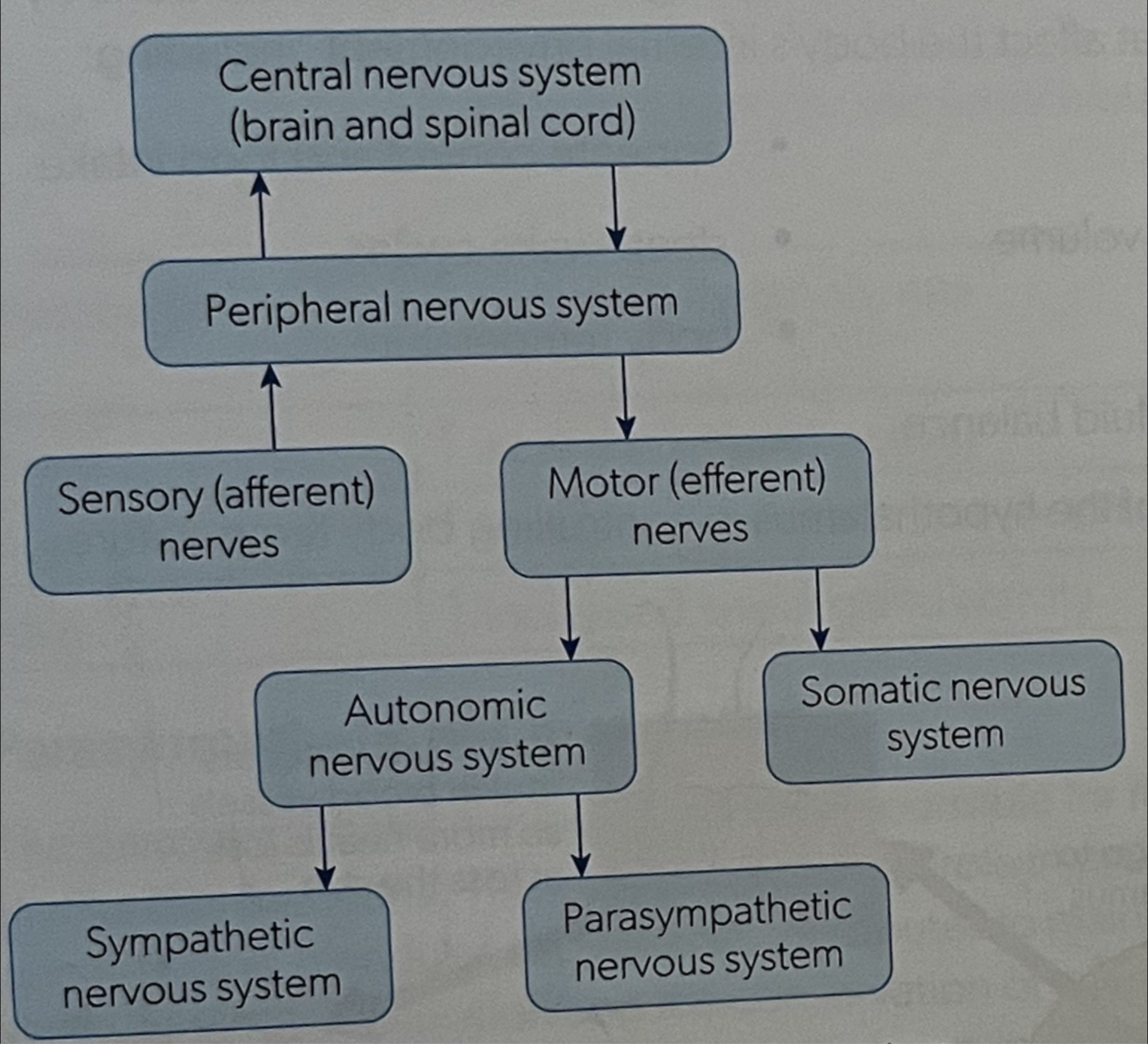
How does sympathetic nervous system stimulation help during sport and exercise?
By increasing the output of bodily functions crucial for exercise like heart rate, blood flow to muscles, metabolism, availability of energy and sweat, and decreasing the output of non-necessary parts like the digestive system to save energy, promoting focus and energy for movement.
How does parasympathetic nervous system stimulation help regulate the body´s involuntary functions?
decreases the output of non-necessary functions during rest like heart rate, blood pressure and ventilation, while increasing the output of functions like digestion and urination, promoting recovery and relaxation.
What are the impulses that make the heart contract?
The sinoatrial (SA) node generates and sends an impulse through both atria to the atrioventricular (AV) node, which contracts both the atria and ventricles, pumping the heart. This heart rate is influenced by the sympathetic and parasympathetic nervous system.
How do the parasympathetic and sympathetic nervous system influence heart rate?
Paraympathetic: stimulates the vagus nerve, which leads to slower electric conduction, and slower heart rate.
Sympathetic: doesn´t stimulate vagus nerve, leading to faster electrical conduction and faster heart rate.
What are proprioceptors?
Specialized cells found in muscles, joints and the inner ear which gather information about the position of different body parts in space.
What are chemoreceptors?
Specialized cells which detect changes in chemicals, like oxygen, carbon dioxide, or hydrogen ions in the body (for this, in the blood), and send messages to the brain about these changes.
What are baroreceptors?
Specialized, pressure-sensitive cells which detect higher or lower pressure. They help send information to the brain about blood pressure, helping maintain homeostasis.
What is the endocrine system?
The partner of the nervous system in regulating physiological changes, done through releasing hormones throughout the body.
What are hormones?
Chemicals released by glands or tissue into the blood to control and regulate activity of cells around the body.
What hormone does the pancreas produce?
Insulin, which slows glucose entry to cells.
What are the hypothalamus and pituitary gland crucial for?
Maintaining homeostasis.
What are the sources of information which increase/decrease hormone secretion?
Neural - signals from the nervous system.
Humoral - signals from changes in blood chemistry (Ex: increase glucose)
Hormonal - signals from other hormone levels.