Chem Unit 4: Organic Materials and Chemical Synthesis
 Call Kai
 Learn
Learn Practice Test
 Spaced Repetition
 Match
Match Flashcards
 Knowt Play
1/35

Earn XP
Description and Tags
Covers the syllabus dotpoints for Organic Materials and Chemical Synthesis
Name | Mastery | Learn | Test | Matching | Spaced | Call with Kai | Chat |
|---|
No analytics yet
Send a link to your students to track their progress
36 Terms
Describe and explain the primary structure of proteins
The primary structure of a protein is its number, type and sequence of amino acids joined by peptide bonds. It influences the secondary and tertiary structure of protein molecules.
Describe and explain the secondary structure of proteins
The secondary structure is the folding of sections of proteins due to hydrogen bonding within different regions of the polypeptide (between the polar NH2 and C=O groups of different peptide links).
α-helices are created when intra-chain hydrogen bonding results in the coiling of a peptide chain. This forms a helical structure. α = trans orientation.
β-pleated sheets form when peptide chains line up parallel to each other. β = cis orientation.

Describe and explain the tertiary structure of proteins
Tertiary structure is the overall 3D shape adopted by a protein when the secondary structures fold (α-helices and β-sheets) and is due to the forces between different functional groups in the R group/side chains of amino acids.

Quaternary structure of proteins
Quaternary structure of proteins is when proteins consist of multiple polypeptide chains that can interact with non-protein molecules to produce large, complex functional units. Typically due to dispersion forces between non-polar side groups.
Explain, in terms of chemical bonding, how the tertiary (3D) structure of a protein depends upon its primary structure.

Explain the effect of an increase in temperature and pH on the molecular structure of a protein.

Describe the structure and function of enzymes.
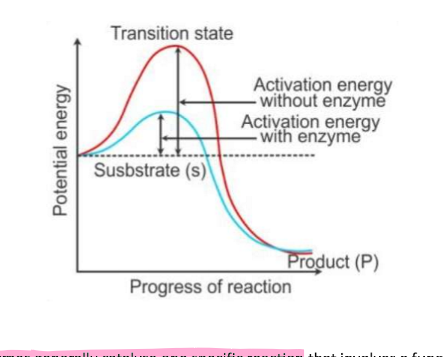
Enzymes are proteins that catalyse biochemical reactions by providing an alternative reaction pathway with a lower activation energy. They are not used up in the reaction & do not alter the equilibrium position.
Enzymes function within very specific pH and temperature ranges as pH and temperature can disrupt the attractions (e.g. dipole-dipole, dispersion forces, hydrogen-bonds) in the protein that determine its tertiary shape.
The shape of an enzyme is determined by the tertiary and quaternary structures of the protein.
Explain the lock and key model of enzyme action

Describe enantiomers (optical isomers)
Enantiomers are mirror image isomers that cannot be superimposed upon each other because the four groups attached to the central carbon (chiral carbon) have different spatial arrangement in the mirror image.
Enzymes can distinguish between enantiomers because of their different 3D shape.

Induced fit model of enzymes
Enzymes have flexible structures meaning the active site can be modified upon binding with the substrate, allowing a better fit of the substrate molecule. The active site returns to its initial shape after the products are released.

Describe the structure and formation of maltose from its monomers.

Describe the structure and formation of lactose

Describe the structure and formation of sucrose

Starch
Cellulose
Glycogen
Addition polymerisation
Occurs when alkenes undergo addition reactions with themselves, forming long chains/polymers.
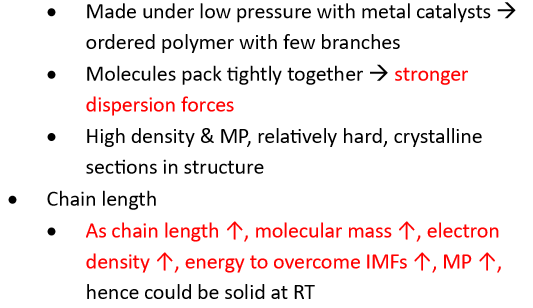
Low Density Polyethene (LDPE)

High Density Polyethene (HDPE)
Note: uses metal catalyst
Show the process of addition polymerisation to form polyethene
Polyethene forms when ethene’s double bonds break and single covalent bonds form during addition polymerisation.

Polypropene formation
Polypropene (polymer) is formed when double bonds in propene (monomer) break & single covalent bonds are formed between carbon atoms & nearby monomers.

Different structural versions of polypropene
Isotactic polypropene (Isolated):
All methyl (-CH₃) side groups are on the same side of the chain.
The regular structure allows chains to pack closely, forming crystalline regions.
Closer packing means stronger dispersion forces between chains, so the polymer has high density, high strength and a high melting point.
Syndiotactic (In sync):
Methyl side groups alternate regularly from one side of the chain to the other.
The regular structure allows chains to pack closely, giving high crystallinity.
Strong dispersion forces between chains give high density, high strength and a high melting point.
Atactic polypropene
Methyl side groups are arranged randomly along the chain.
The irregular structure prevents close packing, so the polymer is amorphous (no crystalline regions).
Weaker dispersion forces between chains give low density, a low melting point, and a soft, flexible, weak material.

Polytetrafluoroethene (Teflon)
Formed by addition polymerisation of tetrafluoroethene.
Properties of Polytetrafluoroethene (Teflon)

Condensation polymerisation
Occurs when monomers with two functional groups on each end of the molecule react, and a small molecule (usually H₂O) is eliminated in the process.
Carbohydrates & proteins are examples of condensation polymers.
Polyamide
A condensation polymer in which monomers are joined by amide links (-CO-NH-). Water is eliminated each time a link forms.
Key points
The monomers are either amino acids (-COOH and -NH₂ on the same molecule) or a dicarboxylic acid + diamine.
The -COOH of one monomer reacts with the -NH₂ of the next, forming the amide link.
Proteins are natural polyamides (the amide link is called a peptide bond). Nylon is a synthetic polyamide.
Hydrogen bonding between the N-H and C=O groups of neighbouring chains gives strength.
Nylon

Polyester
Formed when the carboxyl (COOH) group on monomer 1 reacts with the hydroxyl (OH) group on monomer 2 to form an ester link. Alcohol + acid = ester + water.

Polylactic acid (PLA)
Polylactic acid is a condensation polymer formed from only one type of monomer: lactic acid. Lactic acid has two different functional groups on each end of the monomer. Water is eliminated per ester link formed.

Four types of PLA degradation mechanisms
Describe the Haber process and list the reaction conditions.
The Haber process is the industrial production of ammonia (NH3), described by the equation:
N2(g) + 3H2(g) ⇌ 2NH3(g) ΔH = -91.8 kJ/mol (EXOTHERMIC REACTION)
The reaction conditions are:
Catalyst: Iron oxide (Fe3O4)
Pressure: 150-200 atm
Temp: 350-550oC
Explain how reaction conditions are chosen to optimise the yield of ammonia from the Haber process.

Describe the contact process using equations
The contact process is the industrial method for producing sulfuric acid (H2SO4).

Describe the optimal reaction conditions for the contact process
Step 2 is the equilibrium step where LCP and the yield versus RoR compromise applies, so reaction conditions refer to Step 2 of the contact process.
Step 2: 2SO2 (g) + O2 (g) ⇌ 2SO3 (g) ΔH = -196 kJ/mol (EXOTHERMIC REACTION)
Reaction conditions:
Catalyst: Vanadium pentoxide (V2O5)
Pressure: 1-2 atm
Temp: 400-450oC
Concentration: [O2] in a 1:1 ratio with [SO2]. Excess oxygen shifts equilibrium to the RHS, optimising SO3 yield.
![<p>Step 2 is the equilibrium step where LCP and the yield versus RoR compromise applies, so reaction conditions refer to Step 2 of the contact process.<br><br><strong>Step 2: </strong>2SO<sub>2 (g)</sub> + O<sub>2 (g)</sub> ⇌ 2SO<sub>3 (g)</sub> <strong>ΔH = -196 kJ/mol </strong>(<strong>EXOTHERMIC REACTION)</strong><br><br><strong>Reaction conditions:</strong></p><ul><li><p><strong>Catalyst: </strong>Vanadium pentoxide (V<sub>2</sub>O<sub>5</sub>)</p></li><li><p><strong>Pressure: </strong>1-2 atm</p></li><li><p><strong>Temp: </strong>400-450<sup>o</sup>C</p></li><li><p><strong>Concentration: </strong>[O<sub>2</sub>] in a 1:1 ratio with [SO<sub>2</sub>]. Excess oxygen shifts equilibrium to the RHS, optimising SO<sub>3</sub> yield.</p></li></ul><p></p>](https://assets.knowt.com/user-attachments/986b98c0-040b-4064-8ee1-2aa85d6848cc.png)
Describe the production of ethanol via the hydration of ethene

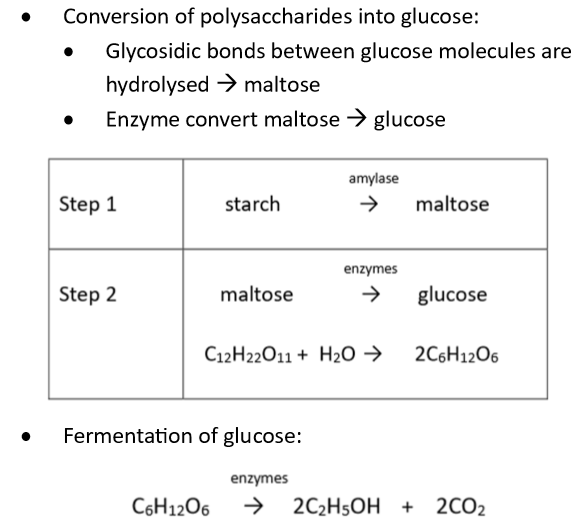
Describe the enzyme-catalysed production of ethanol
The process involves:
The conversion of polysaccharide (starch) to disaccharide sugars (maltose), using amylase enzymes.
Conversion of maltose (disaccharide) to glucose (monosaccharide), using enzymes.
The fermentation of glucose to ethanol, using zymase enzymes.
Note: Fermentation using enzymes is only successful to ~15% ethanol production, since higher concentrations of ethanol poison the yeast (which provides the enzymes for fermentation).