ERTH 460 LEC 19
 Call Kai
 Learn
 Practice Test
 Spaced Repetition
 Match
 Flashcards
 Knowt Play
1/13

There's no tags or description
Looks like no tags are added yet.
14 Terms
How does salt precipitate?
Results from the evaporation of water in marine and non-marine systems.
What do differences in the solubility of salts cause?
Differences lead to a range of precipitate types.
Where are non-marine evaporites typically formed?
in arid to subtropical environments.
What type of evaporite system is most dominant in the geological record?
marine-derived evaporite systems.
What causes difficulty in estimating velocity? (salt interpretation)
Poor images due to poor illumination
• structure variations and complex geometry.
• Strong anisotropy.
• Heterogeneities due to salt composition
Does salt velocity vary with depth?
No, there are no variations in salt velocity with depth.
How can we handle the problem of velocity estimation? (salt interp.)
Dense acquisitions with wide offsets.
Wide-azimuth surveys.
Best possible migration and FWI technology
What is a turtle structure?
a fold that forms in sedimentary layers as underlying mobile material, usually salt or shale, moves away
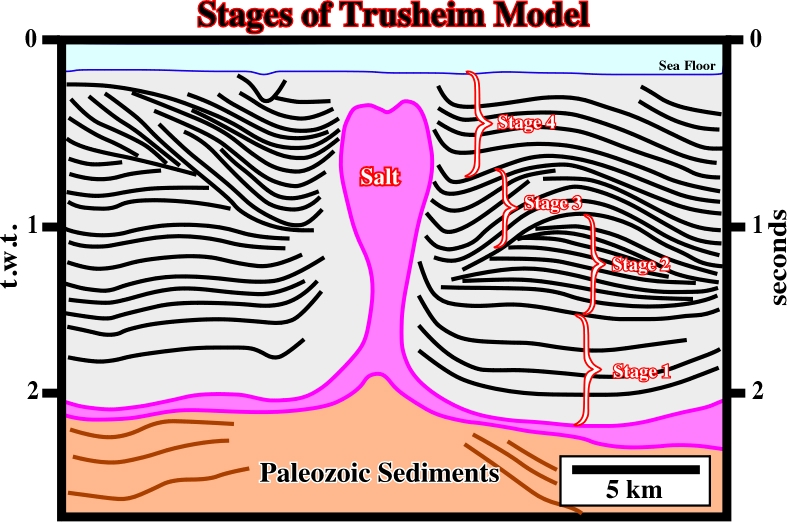
What are some pitfalls of interpreting salt with seismic?
Steep dips
Velocity/density contrasts
raypath bending - ILLUMINATION, positioning, etc.
What are some important characteristics (according to emry) of salt and shale?
act as detachment levels.
can rise in response to shortening
salt can rise above regional datum and extrude. Moderatley overpressured shale cannot.
on seismic data, the volume of truly mobile salt or shale is usually overestimated.
What is a “detachment level”
a weak, slippery rock layer like salt that allows the stronger, stiffer rock layers above it to slide, fold, or fault independently from the rigid basement rocks below