Action Potential 1
 Call Kai
 Learn
 Practice Test
 Spaced Repetition
 Match
 Flashcards
 Knowt Play
1/21

There's no tags or description
Looks like no tags are added yet.
Name | Mastery | Learn | Test | Matching | Spaced | Call with Kai | Chat |
|---|
No analytics yet
Send a link to your students to track their progress
22 Terms
Na+ Channel
Inward current
Membrane depolarization results in the channel opening
Voltage-regulated and time-dependent gates
Fast Response
K+ Channel current, response time, and why it opens/closes
Outward current (K+ leaves the cell)
Both opening and closing depends on membrane potential
Slow Response
Ball and chain mechanism
Na+ channel inactivation
when closed, the balls float freely
When open, one of the balls will enter and block the pore
Conductance of Na+ and K+ Channels
When an axonal membrane is depolarized more, more voltage gated Na+ and K+ channels open
changes for the two channels are very similar
Voltage gated Na+ Channels opening process
Open immediately following depolarization, but then inactivate after less than a millisecond
Voltage gated K+ channels opening process
open after a delay, and do not inactivate
Voltage-gated Na+ Channel states
Deactivated: closed but capable of opening
Activated: open
Inactivated: closed and not capable of opening, inactivation is removed by repolarizeation around -70mV
Voltage-gated K+ Channel states
Deactivated
Activated

Stage 1 of action potential
Cell at resting membrane potential, both voltage-gates are closed (Na+ time dependent gate is open)

Stage 2 of Action Potential
Membrane is brought to threshold voltage by depolarizing stimulus, Na+ voltage-dependent gate opens

Stage 3 of Action Potential
Na+ flows through open gates, cell rapidly depolarizes the membrane, causing more Na+ channels to open

Stage 4
Inactivation of time-dependent Na+ gate and delayed opening of voltage-gated K+ channel halts membrane depolarization

Stage 5
Open voltage-gated K+ channesl continue to repolarize the membrane
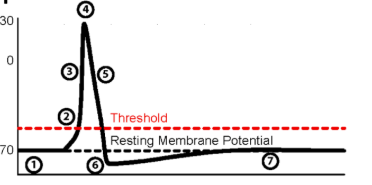
Stage 6
Slowly closing voltage-gated K+ channels hyperpolarize membrane towards Ek; Na+ channels return to closed resting stage

Stage 7
Closure of voltage-gated K+ channels returns the membrane potential to its resting value
The Squid Giant Axon
Action potentials were recorded in a squid giant axon bathed in normal sea water and then in solutions containing lower concetnrations of Na+
What will lowering external Na+ concentrations do to the driving force on sodium ions?
Lower driving force for Na+ to go into cell
Positive feedback in action potentials
Na+ entry causes depolarization, which opens more voltage gated Na+ channels, causing even more depolarization
Negative feedback in action potentials
voltage gated K+ channels bring the action potential to an end and induce their own closing
Rate coding
neural communication where the intensity or strength of a stimulus is represented by the rate of action potentials a neuron fires
Population Coding
Concept where the brain represents sensory, motor, or cognitive information through the collective, simultaneous activity of a group of neurons
Distributed coding
group of neurons fire to encode a sense, rather than relying on just a single neuron