Manual Therapy
 Call Kai
 Learn
 Practice Test
 Spaced Repetition
 Match
 Flashcards
 Knowt Play
1/19

There's no tags or description
Looks like no tags are added yet.
20 Terms
Contraindications of manual therapy
Skin infection
Increased skin breakdown
Presence of fracture
Acute muscle strain
Acute sprain
Unstable joint
Precautions of manual therapy
Informed consent
Connective tissue disorders
Ehlers-Danlos syndrome
Down syndrome
Marfan syndrome
Osteoarthritis
Osteogenesis imperfecta
What is strain-counterstrain? What physiologic effect is happening to the patient where this would need to be used? What is it also known as?
Passive positioning of body segments to encourage relaxation of tense muscles for 90 seconds. Often used with putting pressure on tender/trigger points.
Limited evidence, low risk
The muscle has too much motor input when not needed, manual therapy decreases gamma-efferent gain.
Also called positional release therapy.

What is the muscle energy technique? What is the mechanism of effect for agonist and antagonist muscles?
Passively moving a joint to a barrier of motion and then asking the patient to perform a light, submaximal isometric contraction of agonist or antagonist muscles for 5-10 seconds while moving them in different barriers 3-5 times. Similar to a stretch but not the same.
Limited and conflicting evidence
Agonist: Postcontraction relaxation of muscles that restrict motion
Antagonist: Reciprocal inhibition of muscles that restrict motion

Traditional massage techniques. What are the mechanism of effects? What order do they go in?
Effleurage: Gentle stroking technique that alleviates pain
Blocks a-beta nerve input through dorsal horn of spinal cord
Petrissage: Deep kneading and rolling of tissue. May be painful
Andogenous analgesic pathway
Tapotement: Vigorous stimulation of tissue by light tapping/striking
Vibration: Rocking motion of tissue
Order: Effleurage → Petrissage → Tapotement → Vibration → Effleurage
Non-traditional massage techniques
Trigger point: Putting pressure on a trigger point. Overstimulation causes muscles to release
Transverse friction: Dragging finger perpendicular to the tendon, accelerates healing of tendon. This is painful. Can also be done on muscle bellies. 5-10min treatment
What is myofascial release?
Umbrella term for any manual therapy that releases pain and muscle tension
Direct: Stretching and putting pressure on tissue
Indirect: Moving tissue away from barrier or shortening the tissue to reduce tension

What is instrument-assisted soft tissue mobilization?
Using instrument to provide soft-tissue massage/mobilization. Must be aware of anatomy. Treatment 5-10 minutes, or when skin begins to get red
No better or worse than other manual therapy

What is joint mobilization?
Restores joint ROM by distracting restricted arthrokinematic motion. Alters sensory input to CNS. Low risk compared benefits, recommended in patients with restriction
Take note of typical end-feels and what they should feel like. Typical end feels can be normal or abnormal depending on the situation
Dosage (force used) for joint mobilization
Plane of mobilization: Line of force must be parallel to plane of movement in the joint
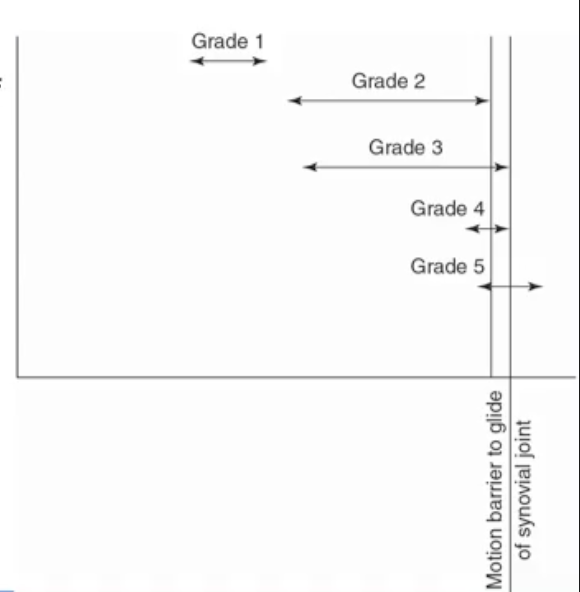
Magnitude of motion:
Maitland (the one we’re using) = Grades 1-5. Completed in 3 sets of 30 seconds (baseline).
Grade 1: Very gentle pulses that don’t do anything
2: Larger oscillations that stay within and do not move past established barrier. This and grade 1 only serve as a sensory stimulus to decrease pain/guarding/tension
3: Large amplitude of motion going through the established barrier
4: Small amplitude of motion going through the established barrier
5: High velocity, low amplitude force. Contain risks (especially cervical) and not typically used unless trained or cleared by state.
Katlenborn = Grades 1-3 that are the same first 3 as maitland.
What is mobilization with movement?
Pain-free sustained accessory glide at a joint in conjunction with active or passive movement. Has some evidence of pain reduction and improved joint ROM and function
How does exercise relate to manual therapy?
Manual therapy must be accompanied by exercise to capitalize on the transient (temporary) gains from MT