Chapter 5 (epidemiology)
0.0(0)
Studied by 0 people Call Kai
 Learn
Learn Practice Test
 Spaced Repetition
 Match
Match Flashcards
 Knowt Play
Card Sorting
1/12

Earn XP
Description and Tags
Last updated 3:09 PM on 3/5/23
Name | Mastery | Learn | Test | Matching | Spaced | Call with Kai | Chat |
|---|
No analytics yet
Send a link to your students to track their progress
13 Terms
1
New cards
Causal association
exposure x really does lead to outcome y, x→y
2
New cards
Non-causal association
Association that is due simply to chance, disease actually causes the exposure (y→x)
3
New cards
Necessary Cause
factor needs to be present in order for disease/condition to develop, does not mean the person will automatically get the disease
4
New cards
Contributory Cause
a factor or characteristic that facilitates the development of a disease/condition, (overweight → type 2 diabetes) isn't full proof
5
New cards
Sufficient Cause
level in which all contributory and necessary causes required to bring about a disease/outcome in a given individual are present
6
New cards
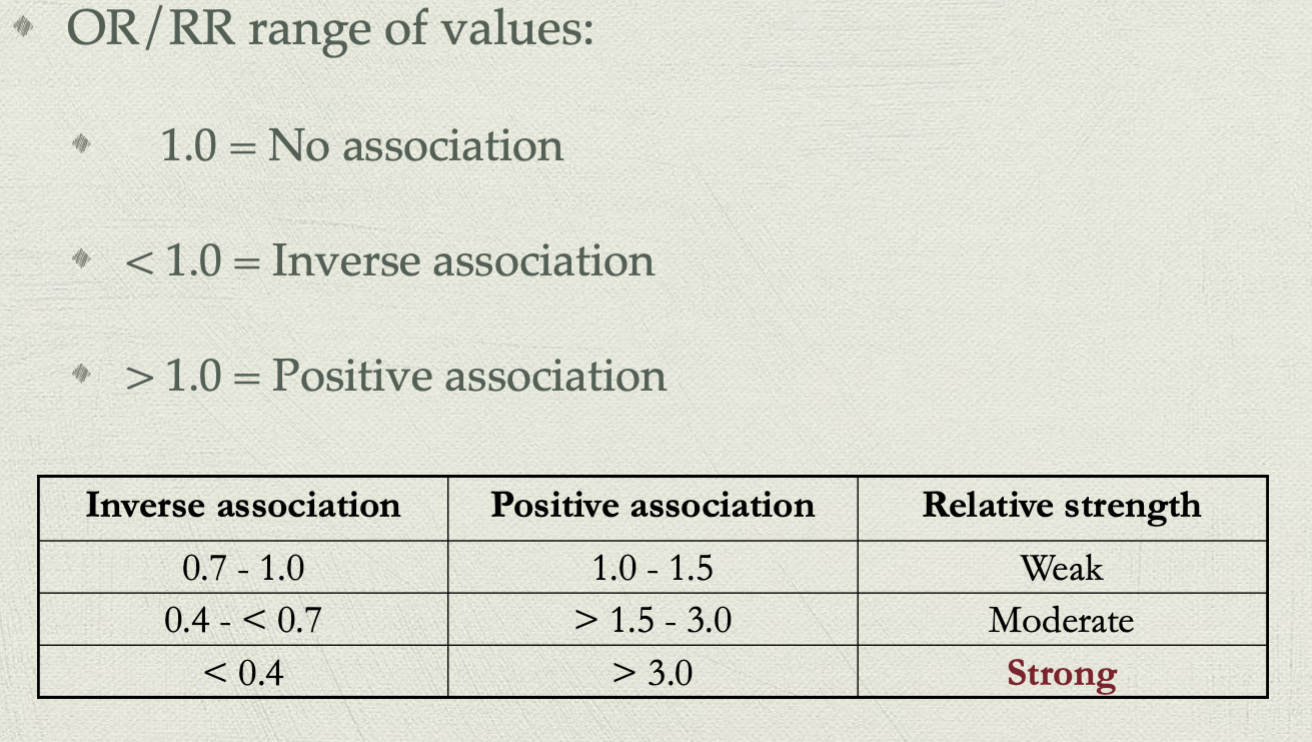
Strength
The stronger the association is the more likely it is to be casual
7
New cards
Consistency
is association found (replicated) in other studies?
8
New cards
Temporal Sequence
exposure must proceed outcome
9
New cards
Dose-response
if the severity of outcome increases or decreases as exposure increases or decreases
10
New cards
Biologic Plausibility
explains how the exposure can cause the outcome due to understanding human body
11
New cards
Analogy
Have other studies have similar effects from the exposure?
12
New cards
Reversibility
If you remove the possible cause does the disease decrease as well
13
New cards
Consideration of alternative explanations
Looks at confounding variable, bias, reliability, efficiency, and effectiveness for casual agents