chemmat exam
 Call Kai
 Learn
 Practice Test
 Spaced Repetition
 Match
 Flashcards
 Knowt Play
1/174

There's no tags or description
Looks like no tags are added yet.
Name | Mastery | Learn | Test | Matching | Spaced | Call with Kai | Chat |
|---|
No analytics yet
Send a link to your students to track their progress
175 Terms
At the atomic level, how do the mechanisms of elastic and plastic deformation differ, and why does one become permanent?
Elastic deformation involves reversible bond stretching within the lattice; when stress is removed, atoms return to equilibrium positions. Plastic deformation occurs when stress exceeds the yield point, allowing dislocation motion (slip) so atomic planes shift irreversibly permanent shape change remains.

What physical phenomena correspond to the yield point, ultimate tensile stress, and fracture point on a stress–strain curve, and how do they reflect microstructural changes?
Yield point: onset of dislocation movement → start of plasticity.
UTS: dislocation interactions cause work hardening; necking begins.
Fracture: void coalescence and crack propagation cause failure. The curve’s shape reveals ductility, stiffness (slope = E), and toughness (area under curve)
Explain why metals become stronger yet less ductile when plastically deformed.
During plastic deformation, dislocation density rises dramatically. Dislocations entangle and impede each other’s motion, increasing the stress required for further slip (higher yield strength) but reducing mobility therefore ductility drops. This is known as work hardening.
How do Young's modulus and Poisson's ratio jointly describe the elastic behaviour of isotropic solids?
Young’s modulus (E) relates axial stress to axial strain (stiffness). Poisson’s ratio (ν) relates lateral to longitudinal strain, describing volume conservation under load. Together they define the material’s elastic constants, determining deformation in 3-D stress states.
Why do engineers often use engineering stress-strain curves even though they misrepresent material behavior beyond yielding?
Engineering curves assume constant cross-sectional area, ignoring necking; hence they underestimate true stress after yielding. However, since design primarily uses the elastic region, where this assumption is valid, engineering stress–strain data remain practical for most analyses.

Why does FCC typically have higher ductility than BCC or HCP metals?
FCC has more closely packed atoms and 12 slip systems, allowing dislocations to move along many planes and directions; this enhances ductility.
BCC has fewer active slip systems (especially at low T), while HCP has very limited ones, making it more. brittle
How do coordination number and atomic packing factor (APF) influence metallic properties?
FCC & HCP: CN = 12, APF = 0.74 → densest packing → high ductility, lower diffusion.
BCC: CN = 8, APF = 0.68 → less dense → more space for interstitial diffusion and lower ductility. Thus density, diffusion rate, and slip behaviour all depend on crystal geometry
Ductility order: FCC > BCC > HCP
Derive the relationship between atomic radius r and lattice parameter a for cubic structures (BCC & FCC).
BCC: atoms touch along the body diagonal → 4r = sqrt{3}a .
FCC: atoms touch along the face diagonal → 4r = sqrt{2}a .
Why are Miller indices important for understanding deformation?
They define crystallographic planes (hkl) and directions [uvw] that host slip.
Dislocations move on close-packed planes & directions, so knowing Miller indices identifies the primary slip systems—e.g., FCC → {111}
Why are defects necessary for plastic deformation, and how do dislocations enable metals to deform at lower stresses than predicted theoretically?
Perfect crystals would require enormous stress for slip; dislocations allow movement of one atomic row at a time, lowering the energy barrier for deformation.
How does long-range atomic order make crystalline materials stronger than amorphous ones?
In crystals, atoms occupy regular positions, allowing uniform load transfer and controlled slip along well-defined planes. This structural coherence gives predictable yield strength and ductility.
Amorphous materials lack such order; irregular bond angles cause local stress concentrations and brittle fracture once bonds break, leading to lower toughness and poor plasticity.
How can crystal defects both weaken and strengthen a material?
At low concentrations: defects such as vacancies ease atomic movement, promoting diffusion and creep — lowering strength.
At high concentrations: dislocations and impurity atoms interact, impeding further movement and raising yield strength and hardness (basis of work-hardening and solid-solution strengthening).
Thus, controlled defects tune the balance between strength and ductility.
Why does dislocation motion allow metals to plastically deform at much lower stresses than predicted theoretically?
In a perfect crystal, an entire plane must shear simultaneously, requiring stresses ≈ E/10.
Dislocations localise this movement, letting rows of atoms shift sequentially with far less energy. This explains why real metals exhibit finite yield strength and considerable ductility instead of brittle failure.
Why do smaller grains increase the strength of a metal?
Grain boundaries impede dislocation motion. More, smaller grains mean more boundaries that interrupt slip paths.
How does dislocation density affect mechanical properties?
Increasing dislocation density through cold work causes dislocations to entangle and block each other, raising yield strength and hardness.
However, this also reduces the ability of new dislocations to form and move → decreased ductility.
How does annealing reverse work hardening?
Recovery – dislocations rearrange into lower-energy structures.
Recrystallisation – new, strain-free grains form.
Grain growth – larger grains reduce total boundary energy.
This restores ductility and reduces hardness.
Why does grain growth after recrystallisation reduce strength?
Larger grains mean fewer grain boundaries to block dislocations.
Why does recrystallisation restore ductility but not shape?
Annealing removes stored strain energy and dislocations, restoring the microstructure's equiaxed state. However, geometry changes (like sheet thinning) from rolling are permanent because bulk shape deformation isn't reversed by heating.
What makes grain boundaries "high-energy regions"?
At the junctions between grains, atomic planes don’t line up perfectly. This mismatch leaves unbonded or distorted atomic sites, creating non-equilibrium bonds and therefore higher stored energy compared to the ordered grain interior.
Serving as nucleation sites during annealing or recrystallisation.
What is metallography and how does it reveal a metal's microstructure?
Grinding – using abrasive papers to remove surface irregularities.
Polishing – with fine compounds (e.g., diamond paste) to create a mirror-like finish.
Etching – applying an acid or alkali that attacks high-energy sites (grain boundaries) slightly faster, leaving dark lines visible under a microscope.
Why do etched grain boundaries appear darker under a microscope?
Etching solutions preferentially attack high-energy regions (grain boundaries). These sites corrode or dissolve slightly faster than the grain interiors, forming shallow grooves that scatter light rather than reflect it directly.
Hence, under reflected-light microscopy, etched boundaries appear dark, outlining the grain network clearly.
Why do metals conduct electricity so well?
Delocalised electrons in metallic bonds form a conduction "sea." Under an electric field, these electrons drift freely, giving metals high conductivity. Fewer defects → less scattering → higher σ.
Why does increasing temperature reduce conductivity in metals?
Higher T → more lattice vibrations → more electron scattering → reduced mean free path → higher resistivity. Thus, conductivity drops linearly with T.
How do cold work and annealing affect electrical conductivity?
Cold work introduces dislocations and strain, increasing electron scattering and lowering conductivity. Annealing realigns the lattice and removes many dislocations, restoring conductivity.
How do semiconductors differ from metals in their temperature–conductivity relationship?
In metals, conductivity ↓ as T ↑ (scattering ↑).
In semiconductors, conductivity ↑ as T ↑ (more electrons excited into conduction band).
How does grain size affect electrical conductivity in metals?
Grain boundaries act as barriers to electron flow because atomic misalignment causes electrons to scatter when crossing from one grain to another.
Fine-grained metals → more grain boundaries → more scattering → higher resistivity.
Coarse-grained metals → fewer boundaries → less scattering → higher conductivity.
What is electron drift velocity, and how does it relate to current flow and material structure in metals?
Electron drift velocity (v_d) is the average velocity of electrons as they move through a conductor under an applied electric field. Although individual electrons move rapidly in random directions, their net drift due to the field is very slow — typically on the order of millimetres per second.
What is the standard definition of the recrystallisation temperature?
The temperature at which a 50% cold-worked metal fully recrystallises in one hour.
How does the amount of prior cold work control the final recrystallised grain size?
More cold work → more stored strain energy → more nucleation sites → grains meet sooner → finer grain size at “just fully recrystallised.” Less cold work → coarser.
Define hot work and explain why work hardening isn't observed.
Hot work = deformation above Tᵣₑₓ, so recrystallisation occurs as you deform; dislocations introduced by deformation are continuously removed, preventing build-up of work hardening.
This means they tend to be weaker but more tough.Ok
If two sheets are both "just fully recrystallised," which is stronger: the one that had 20% CW or 70% CW initially?
The 70% CW sheet — its finer recrystallised grains provide more grain-boundary barriers to dislocations (Hall–Petch), hence a higher yield strength.
What are interstitial solid solutions, and how do they affect the properties of metals such as iron–carbon alloys?
An interstitial solid solution forms when small solute atoms occupy the interstitial (void) spaces between the larger solvent atoms in a metal’s crystal lattice — without replacing them.
These will always have limited solid solubility.
What are substitutional solid solutions ?
A substitutional solid solution forms when solute atoms replace host (solvent) atoms in the crystal lattice, maintaining the overall crystal structure.
Depending on the temperature it can have both limited and unlimited solid solubility.
What are binary isomorphous alloys, and what key features define their phase diagram and mechanical behaviour?
A binary isomorphous alloy system is one in which two metals are completely soluble in each other in both the liquid and solid states.
solid (α).
Lever Rule
Plot point at chosen temperature and overall composition this is our pivot point.
Draw tie-line through point to both phase boundaries on either side of pivot point.
Find % of lengths on each side of the line.
The % found on each side of the line represents the opposite sides phases contribution to overall composition.
What is the solubility Limit?
The solubility limit is the maximum amount of solute atoms (say, B) that can dissolve into a solvent metal (A) to form a single, homogeneous solid solution.
On the graph its the boundary around the solidus line.
Microstructure Development Binary Isomorphous Alloys
Above Liquidus - Completely liquid (duh!)
@ Liquidus - L with small alpha.
@ Alpha - Alpha with L within grains.
Below Solidus - Completely alpha (duh!)
Binary Eutectic Alloys
3 Phases - Alpha, Beta, and Liquid.
When temperature changes, the solubility limit changes.
Eutectic Composition
The alloys melts at a specific temperature, the eutectic composition.
At every other composition, the alloy melts across a range of temperatures.
Handy Reminder 1
Yay

Wt% composition in each phase.
Lever to determine composition of phases.
Follow the lines to the solidus and liquidus lines. Then follow the lines down to the wt%. The wt% will correspond to the wt% for the phase that the boundary is on.
Eutectic Reaction
When the alloy melts at a single temperature, creating the eutectic structure/solid. Liquid is required to form it.
Hypoeutectic vs Hypereutectic alloy.
Hypo - Less/to the left of the eutectic.
Hyper - More/to the the right of the eutectic.
Proeutectic Solid
Solid that forms first
Microstructure Development
Proutectic Solid forms larger grain, the eutectic solid forms within the remaining space.
When going through the single solid phase areas, we initially get the entire composition as one phase, but then the non-proutectic solid forms at the grain boundaries.
Determining Eutectic Solid in Final Microsrtucture
We CANNOT apply lever rule below the eutectic temperature. Instead we apply lever rule just above the temperature, the amount of L% is how much eutectic solid will form.
This is because it is the L% that will transform into eutectic solid.
Given composition but not Wt%
Apply lever rule depending on whether alpha or beta forms. Apply algebra with given percentages.
Austenite
γ - FCC lattice.
Can accommodate up to 2.1 wt% C, exists above 723 Degrees.
Ductile.
Ferrite
α - BCC lattice.
0.02 wt% C.
Ductile.
Austenite vs Ferrite
Due to their lattice structure, Austenite is stronger and less ductile.
Even though FCC has a higher APF it can accommodate more C, this is because of the interstitial sites are actually larger.
Cementite (Fe3C)
Compound with a fixed composition of 6.67 wt% Carbon.
No slip systems, very brittle and hard.
EutecTOID Point/Reaction
Created through the slow cooling of the single solid phase Austenite. Forming 2 solid phases, Ferrite + Cementite. This forms what the eutectoid solid which is known as Pearlite. The EutecTOID solid is made of alternating layers of the 2 phases, they grow outwards.
Hypoeutectoid vs hypereutectoid
Hypo - Less than/ to the left Hyper - More than/ to the right
Proeutectoid Solid
The first solid that forms before pearlite is formed.
Steel Lever Rule
Exact same as with everything else.
Hypoeutectoid Steel Microstructure
In Austenite - All Austenite (Duh!) Just under Single Austenite - Austenite with Proeutectoid Alpha at boundaries. Just above pearlite - Austenite with slightly larger Proeutectoid Alpha at boundaries. Into pearlite - Austenite becomes Pearlite, Proeutectoid alpha remains.

Hypereutectoid Steel Microstructure
In Austenite - All Austenite (Duh!) In Austenite + Cementite - Proeutectoid Cementite forms at grain boundaries. Just above pearlite - Proeutectoid Cementite elongates along boundaries. Into pearlite - All of the Austenite becomes eutectoid solid.
Draw the final forms of Hyper, Hypo, and Eutectoid solid.

Steel Summary
[Image-only answer on the Quizlet card]
Solid Solution Strengthening
Alloys with both smaller and bigger solute atoms lead to the dislocations having to move further, making the alloys always stronger than the pure metals.
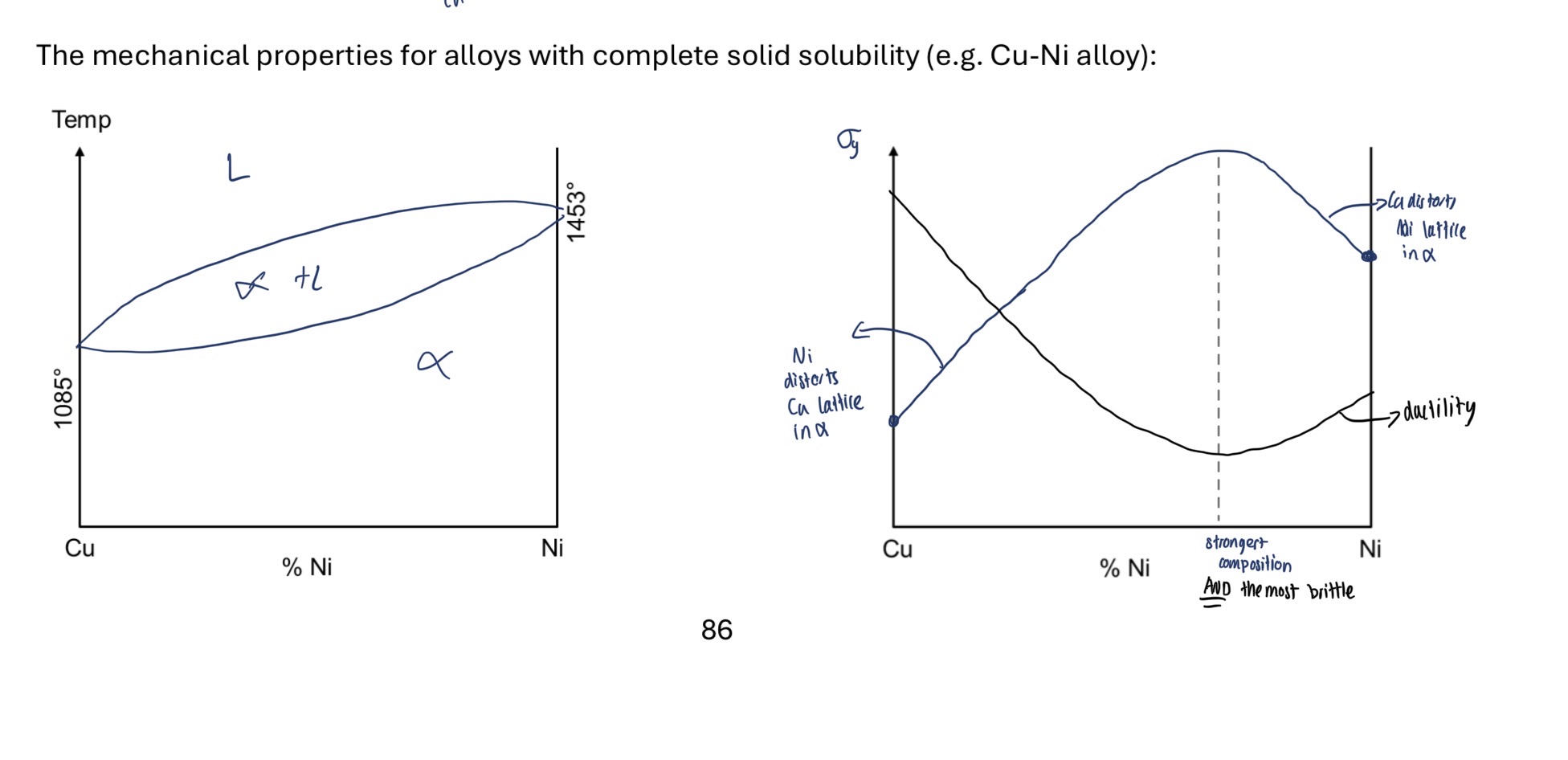
Strength of alloys with complete solid solubility
Rises rather linearly then curves down.
Ductility of alloys with complete solid solubility
Opposite of strength.
Resistivity of alloying components.
Follows a similar pattern to the strength. If it's harder for dislocations to move, it's also harder for electrons to move.
Maximum Lattice Distortion = Maximum Resistivity
Multiphase Strengthening
Phase boundaries are also capable of stopping dislocation movement. The structure with the most phase boundaries is eutectic solid, making it the strongest but most brittle.
BCT
Body Centered Tetragonal.
This has no slip systems, meaning is very strong but brittle.
Compare the 3 options for steel slow cooling from the liquid phase.
Proeutectic Alpha/Ferrite - Low Strength, Very Ductile Eutectic Solid - Moderate strength, moderately Ductile Proeutectic Cementite - High Strength, Very brittle.
Precipitation Strengthening
Stops movement of dislocations directly. & Disturbs parent lattice.
Slow Cooling of Alloys
This leads to the formation of brittle parts near the high energy regions of the grade boundaries, leaving the alloys to be very weak in certain positions.
Precipitate formation method
Solution Heat Treatment → Dissolve all of the atoms into a single state alpha solution.
Quenching → Rapidly cool to room temp, this prevents diffusion from occurring, creating a supersaturated single phase alpha.
Ageing → Heat below solvus temperature, this allows for some diffusion, even though the grain boundaries are high in energy, the supersaturated alpha is even higher, leading to precipitates forming throughout the alpha matrix.
Draw a diagram showing the effects of Ageing temperature on the properties of the alloy.
Higher temperature means less time is required to reach the maximum strength, but this maximum strength itself is also lower. This comes as a result of the formation of less and larger precipitates forming compared to the more favored more and smaller precipitates forming.

How are different kinds of pearlite formed?
This depends on the speed and hence the temperature at which the pearlite is formed. At higher temperatures coarse pearlite is formed, while at lower temperatures fine pearlite is formed.
Fine pearlite forms as a result of less diffusion occurring. Recall, to form pearlite carbon must diffuse out of ferrite into Cementite, this can't happen as much when cooled faster so the layers of pearlite form closer together. this fine pearlite is slightly stronger and less ductile.
How does Carbon diffusion work?
When Austenite is cooled, it wants to transform into ferrite. So it wants to go from FCC to BCC. However, BCC can hold much less carbon, hence, it normally diffuses out to form Cementite, if this isn't possible, we get BCT.
How is martensite formed?
When steel is rapidly cooled, no carbon is able to diffuse at all, this prevents the Cementite from forming. Instead the lattice distorts instantly into BCT structure, which is very hard and brittle.
If we allow heating then the martensite will transform into ferrite + Cementite, this is because solid state diffusion will occur.
More carbons means a harder martensite as there is a greater lattice distortion.
TTT (5 key points)
Eutectoid Start: Is how long it takes for pearlite to start forming for that given temperature.
Eutectoid Finish: Is how long it takes for the pearlite to be completely gone and everything's turned into pearlite.
50% Transformation Line: Self explanatory.
Coarse/Fine Pearlite: Based of temperature we get varying levels of fineness in our pearlite.
Bainite: Irrelevant
Martensite Start/Finish: These lines are mean to be drawn to show that the only way to reach this by cooling down without crossing the eutectoid start line.
Nose of the curve: This is the earliest eutectoid transformation point.
Martensite Structure
Could be considered as needle like or acicular.
TTT Rules
Once pearlite is formed, it does not change.
Only Austenite can change its form.
If we transform some Austenite slowly to form pearlite, then hold it, then cool it quickly ; the remaining austenite will become martensite. Despite the graph not making mulching sense, the second decline can be visualized to begin at the start of the graph again.
Tempered Martensite
This forms when we allow for solid state diffusion.
We allow for the formation of ferrite and Cementite, this leads to a ductile matrix with strong precipitates throughout.
Higher temperatures can lead to lower strengths.
Incorrect Quenching consequences
When we take too long too quench, we can get a variety of different properties throughout the steel, leading to structural variation.
This occurs as the center takes far longer to cool down compared to the outside.
Solution to Quenching time requirements
Adding magnesium allows us to slow down the carbon diffusion in the iron lattice substantially.
Spheroidised Steel
This is similar to relating larger precipitates for martensite. By heating pearlite we can transform the Cementite layers into spheres, creating a soft matrix with more brittle spheres.
This is driven by the reduction in Cementite area.
Influence of Carbon on all types of steel
Quenched Steel Martensite - More carbon = More distortion = Stronger
Quenched & Tempered - More ppts = Stronger
Slow Cooled Pearlite - More Cementite, more spheroidised parts.
Steel summary

Conditions for ability to age harden (4).
Must be able to quench from a single solid phase region to a 2-solid phase region. The solidus line must curve in a lowercase r shape.
The parent matrix should be soft and ductile, while the precipitates should be hard and brittle, this prevents the dislocation from deforming the precipitate.
Precipitates should be coherent, if the parent lattice tries to form bonds with the ppt this will create a strain field, which makes it harder for dislocation to move.
The alloy should be able to survive the sudden temperature changes of the quenching process.
Drawbacks/conditions of age hardened alloys
Cannot be welded as it will lead to potential overageing and form brittle theta at the joints.
Instead rivets, joints or glue could be used.
What is the general structure for a polymer?
Polymers have structures with many repeating molecular units, these are called mers or monomers.
How do polymers chain together?
Polymers are long chains of covalently bonded carbon backbones, initially the carbon is double bonded to each other, but to create a chain they create the single bonded covalent backbone.
This process is known as polymerisation.
Degree of of polymerisation
Avg molecular weight of the chains / Weight of mer
Or
Avg number of mers / monomers in each polymer chains
Shape of Polymers
The C - C bond has a fixed angle of 109.5 degrees, though this can be rotated about, this allows the chain to take on a variety of shapes and configurations.
Micro vs Bulk chain structure
The micro chain structure shoes that many different polymer chains are piled on top of each other in a variety of different direction.
The bulk chain structure reveals the overall shape of the polymer, for PE, looking like a spaghetti.
Effects of chain length on polymer strength
Shorter chains = Less tangling, Fewer secondary bonds, easier for chains to slide = Weaker
Longer chains = more tangling, greater secondary bonds, harder for chains to slide = Stronger
DP vs Strength Graph
Fast increase - From very short chains to relatively long
Plateau - Maximum strength is reached from the secondary bonding and tangling, failure instead occurs as a result of the covalent bonds and hence the chain breaking.
Homopolymer vs Copolymer
Homopolymers share the same repeating unit along the chain.
Copolymers do not: Alternating, block, Random, and Graft (Different unit attaches off of the homopolymer).
3 Key trains of linear polymers
Repeating units joined end to end with no branching.
Long chains which are flexible.
Can pack closely together = High density.
Branched Polymers
A main polymer chain to which side branches are connected.
Reduces the ability for chains to pack together = Lower density.
Cross-Linked Polymers
Linear polymer chains which are cross linked by covalently bonded chain segments.
Tend to be stiff hard and strong as there is little movement for the chains relative to each other.
Thermoplastics
Linear and Branched Polymers.
Softens with increasing temperature.
Higher temps lead to softer material and vice versa.
Recyclable because it can be reheated and reshaped.
Thermosetting Polymers
Cross Linked Polymers.
Cannot be softened with heating.
Harder and stronger.
Don't melt, instead they burn, degrade and char.
Elastomers
Highly coiled but also occasionally cross linked.
Elongates under load, springs back when load is removed.
More cross links leads to greater hardness but less extensibility, also cross links prevent permanent relative movement of chains.
Amorphous Polymers
Polymer chains mixed together with no long-range order, or just randomly.
Partially Crystalline
Some parts are crystalline, crystallites, while other parts are not. Due to more secondary bonds, higher crystallinity = higher strength.