Psych 201 Exam 3
 Call Kai
 Learn
 Practice Test
 Spaced Repetition
 Match
 Flashcards
 Knowt Play
1/101

There's no tags or description
Looks like no tags are added yet.
102 Terms
How might you be able to describe consciousness?
One’s moment-to-moment subjective experience, resulting from brain activity.
A state in which a person is awake, aware, alert, and responsive to stimuli while not asleep (or one of the recognized stages of normal sleep from which the person can be readily awakened).
What are the contents of consciousness?
perceptions of the world around us
memories of past events
intentions concerning future actions
imagery of some event that could occur
These can be subliminal or supraliminal.
What is qualia?
Our subjective conscious awareness/experience
What are disorders of consciousness?
different levels of awareness and wakefulness/arousal

What is a coma in terms of arousal and awareness?
When a patient do not respond to external stimuli.
Arousal and awareness are both at zero.

What is a vegetative state/unresponsive wakefulness syndrome in terms of arousal and awareness?
The patient may emerge from coma. Eyes open + sleep/wake cycles. But unresponsive to external stimuli. Not aware/conscious.
High arousal, zero awareness.

What is a minimally conscious state in terms of arousal and awareness?
The patient is in a coma but some awareness/consciousness.
High arousal, fluctuating awareness.

What is locked-in syndrome in terms of arousal and awareness?
The patient is fully conscious (awake & alert) but paralyzed (except perhaps eye movements).
High arousal and high awareness (same as normal consciousness).

How might you be able to detect awareness in someone in a minimally conscious state?
By asking them to imagine either playing tennis or walking through the rooms of their house. Brain activation reflected the same differences in these tasks as those seen in healthy controls.
SMA = Supplementary Motor Area
PMC = Pre-Motor Cortex
PPC = Posterior Parietal Cortex
PPA = Parahippocampal Place Area

How could you tell the difference between someone in a vegetative vs. minimally conscious state?
Perform an fMRI test asking the patient to imaging different scenarios, such as playing tennis or walking through their house, and compare their brain activation to someone with normal consciousness
How might you describe attention?
Increased awareness of a subset of stimuli/responses/memories/ideas at a cost to others.
What is selective attention?
When you focus on one source of information while ignoring others
What are the two types of selective attention?
Overt attention/orienting: directing attention by moving the eyes (and head/body).
Covert attention/orienting: directing attention without moving the eyes (and head/body).

What is divided attention?
When you also monitor (to a certain extent) unattended stimuli & use them as a basis for shifting attention
What is the spotlight (searchlight) metaphor of attention?
When you focus on one source of information while ignoring others.
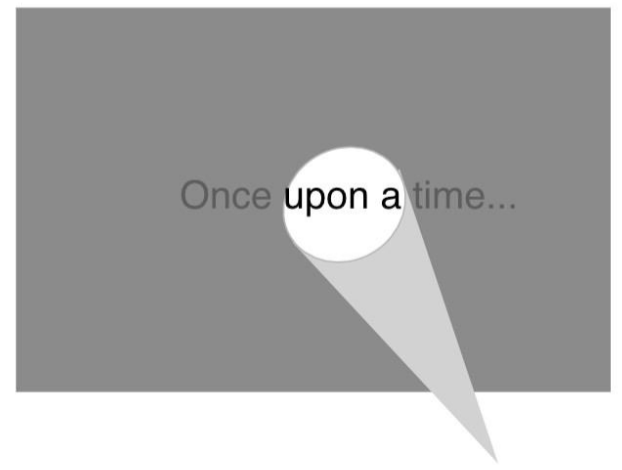
What is stimulus-driven capture? Is it reflexive or voluntary? Endogenous or exogenous?
When your attention is captured automatically. Is it reflexive and exogenous.
What is goal-directed selection? Is it reflexive or voluntary? Endogenous or exogenous?
When you deliberately choose to direct your attention somewhere. It is voluntary and endogenous.
E.g., cocktail-party effect--can listen to and understand one person’s voice while ignoring all others.
What is shadowing? What can and cannot someone doing it detect?
A way to prove goal-directed selection. The participant receives different auditory messages in each ear, but is required to repeat (“shadow”) only one.
Cannot report the content of the unattended input.
Cannot report oddities (e.g., repeated word) in the unattended input.
Can report change in pitch or disappearance of unattended input. Suggests low-level sensory processing is completed.
Can report the occurrence of the subject’s own name in the unattended input. Suggests some amount of semantic processing (meaning) is completed.

What does the Posner task prove?
That events attended (cued) to can be responded to more quickly.
Cued (fastest) < Neutral < Incorrect Cue (slowest)

What is true about the difficulty of divided attention?
The more the 2 tasks differ, the easier it is to carry them out simultaneously.
Practice does not increase the amount of information to which a person can attend (does not make dividing attention easier) but rather increases the amount of information that they can analyze automatically, without attention.
What does the stroop interference effect demonstrate?
A perceptual skill (reading) that has become automatic (to the point of being obligatory) with practice such that it interferes with the task at hand.

What are the differences in the dangers of drunk and cell phone driving?
Drunk Driving => Impaired motor skills & decision making.
Cell Phone Driving => Inattention. Slower reactions times & greater chance of getting into an accident.
We can orient attention _________ with eye movements, or _________ independent of where the eyes are directed.
overtly, covertly
You are at a party talking with a group of friends when you find you attention ripped away from the conversation. What is most likely to have pulled you attention away?
Someone in another group mentioning your name.
What is change blindness?
Failure to notice large changes in the environment, when there is no sudden transient (stimulus) in the image to draw our attention to the change. Only detect changes in attended items.
Do we fully process all of the rich details in the scenes that we experience?
No! Change blindness proves that our internal model or representation of the world is sparse, consisting only of a model of attended information. Information not attended is extracted as a gist vs. a detailed representation.
What is the influence of attention on neural responses?
Attention can enhance the processing of (and neural activity for) a specific type of stimulus or the location of a stimulus.

What is learning (from a behaviorist’s perspective)?
How experience (e.g., a reward) changes behavior.
What are the two types of “associative” learning?
Classical conditioning:
One stimulus predicts another.
Operant conditioning:
A behavior (response) leads to a certain outcome/consequence.
What are the different types of learning?
Associative (Behaviorism) (includes classical and operant conditioning)
Representational/Cognitive (explicit knowledge)
Symbolic (meaning of arbitrary symbols, such as words)
Observational (imitation)
Skill (complex actions)
Specialized Learning Abilities (e.g., bird song, human language)
What is classical (Pavlovian) conditioning?
Repeated pairing of a neutral stimulus (e.g., bell) with one that evokes an automatic/reflexive response (meat => salivation) eventually causes the neutral stimulus by itself to elicit the automatic/reflexive response (bell => salivation). Helps an organism to prepare (respond to) for the arrival of an unconditioned stimulus.
U = un C = conditioned S = stimulus R = response
UCS → UCR NS + UCS → CR CS → CR

What is temporal contiguity?
Conditioned stimulus (CS) must precede unconditioned stimulus (UCS) by a very short time (1/2 – 1 sec).
What is contingency (i.e. predictability)?
Conditioned stimulus (CS) must reliably predict unconditioned stimulus’ (UCS') occurrence.
What is extinction?
The disappearance of a conditioned response (CR) to the conditioned stimulus (CS) when the unconditioned stimulus (UCS) is withheld.
This is different from forgetting.
What is spontaneous recovery?
A reemergence of the extinguished conditioned response (CR) after the presentation of the conditioned stimulus (CS) resumes. Indicates that the association is not forgotten, just temporarily suppressed

What is stimulus generalization?
The tendency for a learned response (CR) to occur to stimuli that are similar to the original conditioned stimulus (CS). Promotes flexibility.
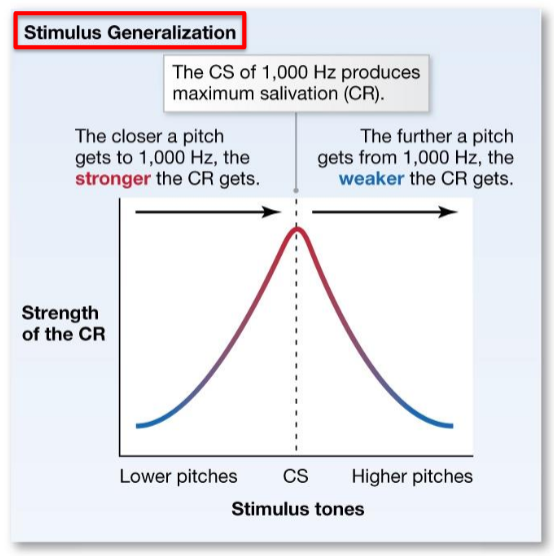
What is stimulus discrimination?
The process of learning to distinguish between the conditioned stimulus (CS) and other similar but irrelevant stimuli. Promotes precision.

What is operant conditioning?
Learning process by which the consequences of a response/behavior changes (increases or decreases) the likelihood that the response will occur again.
What is the law of effect?
The behavior of an organism is controlled by the effects (or consequences) it produces.
B => S => increase or decrease B
(R => S => increase or decrease R)
What is shaping?
Successively closer approximations to the desired response are reinforced until the response finally occurs.
What are the different types of partial reinforcement schedules?
Reward only some of the responses. Learning isn’t faster, but it is better (more resistant to extinction).
ratio (#) = reinforcement after certain # of responses
Interval (time) = reinforcement after certain # of seconds
fixed = reinforcement after x amount
variable = reinforcement after x amount, on average

How do you get faster learning?
With continuous reinforcement vs. partial reinforcement.
How do you get more persistent learning?
With partial reinforcement vs. continuous reinforcement (more resistant to extinction).
How do you get a faster rate of responding?
With ratio schedules vs. interval schedules.
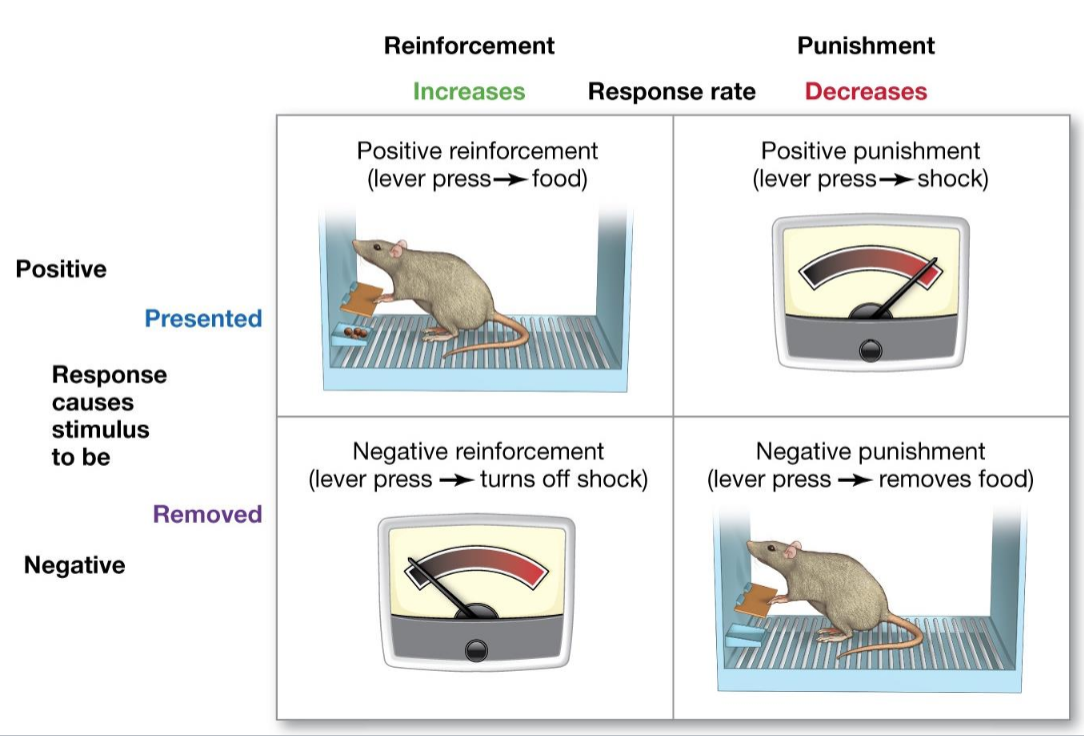
What is the difference between reinforcement and punishment?
Does a stimulus increase or decrease the response/behavior?
If it increases, it’s a reinforcer.
If it decreases, it’s a punishment.

What is the difference between positive and negative stimuli?
Is the stimulus presented or removed after the initial response/behavior?
If presented, it’s positive.
If removed, it’s negative.

What kind of reinforcement is being used to produce the desired behavior change?
B (take aspirin) => S (reduce pain) => B (take aspirin again)
Negative Reinforcement

What kind of reinforcement is being used to produce the desired behavior change?
B (pigeon pecks key) => S (gets food) => B (pecks some more)
Positive Reinforcement
What kind of reinforcement is being used to produce the desired behavior change?
B (dog chews shoe) => S (is shouted at) => B (stops chewing shoes)
Positive Punishment

What kind of reinforcement is being used to produce the desired behavior change?
B (dog chews shoe) => S (gets no dinner) => B (stops chewing shoes)
Negative Punishment

What type of conditioning is Little Albert/fear conditioning a part of?
Classical Conditioning
What is counterconditioning?
Allows for the reduction of a phobia by pairing the feared conditioned stimulus with a favored stimulus

What type of conditioning are drug addiction, the development of tolerance, & overdosing part of?
Classical Conditioning:
Tolerance = a decrease in responsiveness to a drug (helps protect body from drug)
Drug (UCS) => tolerance response (UCR) (reflex)
NS (familiar setting) + UCS (drug) => UCR (tolerance response)
CS (familiar setting) => CR (tolerance response)
No tolerance response before taking the drug can result in an overdose.
What is the cognitive view of learning?
Animals and humans develop an explicit mental model or representation of the relationship between events in the environment vs. develop unconscious robot-like reflexes.
What are cognitive maps?
An internal representation of space (i.e. rats in a maze don’t just memorize turns)
What is latent learning?
Learning not immediately demonstrated in behavior. Learn things that are not reinforced (i.e. being able to figure out a maze path when things are blocked off).
What is observational learning?
Monkey see, monkey do (i.e. bobo doll & aggression).
What is “misbehavior of animals” AKA instinctive drift?
Some rewards lead to a disruption of training (i.e. pigs being trained to put coins in a box for a food reward, but then associating the coins with food and rooting them even though that disrupts their ability to get actual food)
The activation of dopamine neurons in the ______ _________ (part of the limbic system) is associated with the experience of pleasure.
nucleus accumbens
What is intracranial self-stimulation (ICSS)?
A procedure where animals self-administer electrical stimulation to the brain’s reward centers in “pleasure chambers.” This stimulation is so rewarding that they will do it to the point of exhaustion.
What is symbolic learning?
Learning the meaning of arbitrary symbols, such as words.
What is skill learning?
Learning complex action sequences (e.g., playing piano, riding a bike)
What are biologically-based specialized learning abilities?
i.e. bird song, human language, food-aversions
An example(s) of cognitive/representational learning is/are:
Cognitive maps and observational learning
An example(s) of biologically-based specialized learning abilities is/are…
Instinctual drift and food aversions
In the context of reinforcement, what effect does increased dopamine release have?
It increases a reinforcer’s reward value
Why are near misses particularly powerful in maintaining gambling behavior?
They activate the brain’s reward system almost as strongly as actual wins
What is memory?
The acquisition, storage and retention of skills and knowledge.
A record of the past which is constantly used to affect the present.
What are the three different kinds of memory stores?
Sensory Memory => Short Term Memory (STM) <=> Long Term Memory (LTM)
What is sensory memory?
A trace of the sensory input is retained for a brief period.
High capacity and very short duration.
What is short-term memory (STM) (also called “Working Memory”)?
Attentive/conscious processing occurs here.
Information can enter STM from both sensory memory and LTM. Small capacity and short duration.
What is long-term memory (LTM)?
The stored representation of knowledge gained from previous experience.
Unlimited capacity and indefinite duration.

Fill in the blanks

What are the "Control Processes” in memory?
Manipulating information within or between stores
Attention: selects sensory info to enter working/STM
Rehearsal: keeps info active in Working/STM
Encoding: transforms info for long-term storage
Retrieval: brings stored info (in LTM) back to awareness (i.e., Working/STM)
What is implicit/procedural knowledge?
A learned skill or habitual response (e.g., bike riding, conditioning).
Is accessible through performance.
What is explicit/declarative knowledge?
Information you can consciously recall, describe, and communicate (i.e., can be made explicit or "declared" in words or with a picture).
What is semantic knowledge?
General knowledge of the world, facts, concepts (e.g., word meanings such as “bird”).
What is episodic knowledge?
Knowledge of specific personal past experiences/events (know place and time)
Your memory for your high school graduation is an example of a(n) __________ memory, whereas your memory that the capital of Connecticut is Hartford is an example of a(n) __________ memory.
episodic, semantic
Your memory for how to shoot a basketball is an example of what kind of memory?
Procedural memory
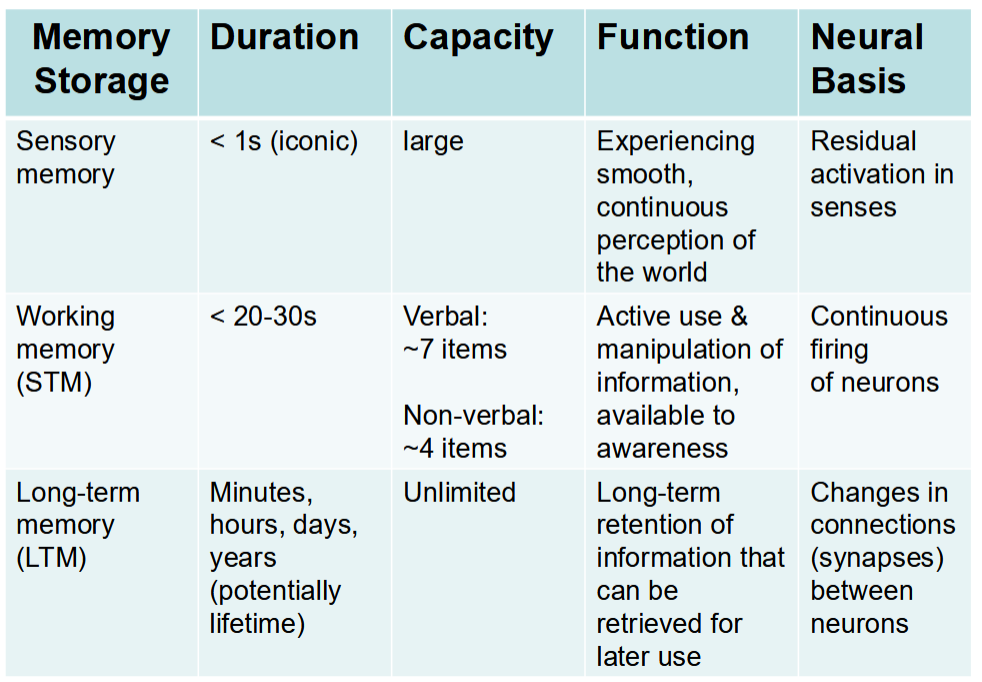
Memory Stores - Summary
What is visual sensory memory called?
Iconic memory
How long does sensory memory last? (Iconic vs. echoic vs. haptic?)
Iconic & haptic: >1 sec
Echoic: 3-4 sec

What is the capacity of sensory memory?
Large
What is the neural basis of sensory memory?
Residual activation in the senses
How long does short term memory last?
< 20-30 seconds unless otherwise rehearsed
What is the capacity of short term memory? (Verbal/rehearsed vs. non-verbal/not rehearsed)
Verbal/rehearsed: ~7 items
Non-verbal/not rehearsed: ~4 items (“true capacity”)
What is the neural basis of short term memory?
Continuous firing of neurons
How long does long term memory last?
Potentially an entire lifetime
What is the capacity of long term memory?
Unlimited
What is the neural basis of long term memory?
Connections (synapses) between neurons (“fire together, wire together”)
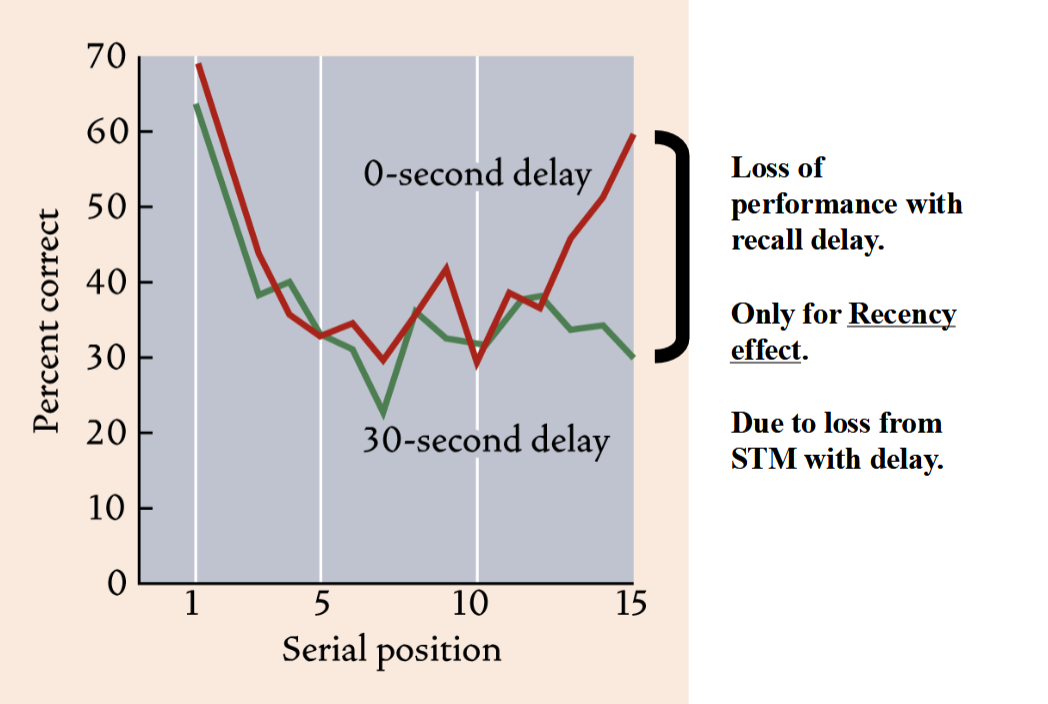
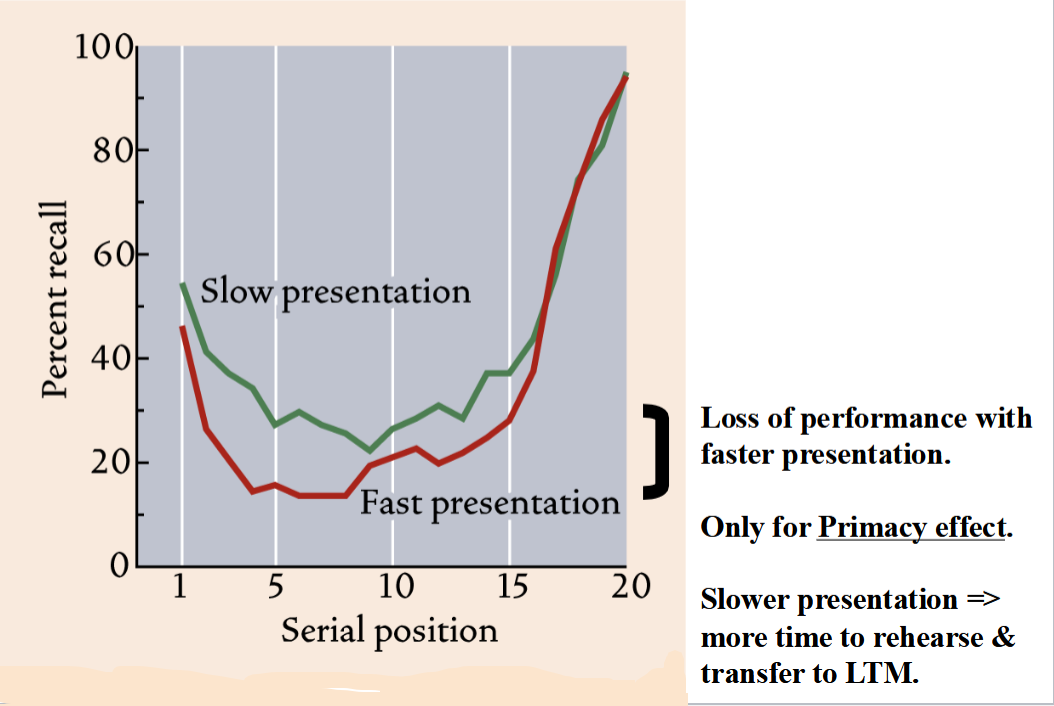
What are the primacy and recency effects? Why do they happen?
Participants are more likely to recall items from beginning (primacy effect) and end (recency effect) of a list rather than the middle.
Early items are recalled because they are rehearsed more than later ones and therefore have a better chance of being encoded into LTM.
Final items recalled because they are still in STM.

How are the primacy and recency effects affected if there is a 30 second delay between seeing a list and recall?
The recency effect will disappear because short term memory only lasts about 30 seconds before degrading, and only the primacy effect will remain (they will only remember words from the beginning of the list).
How are the primacy and recency effects affected if a presentation is slow as compared to fast?
The faster presentation will show a reduction in the primacy effect because they weren’t given as much time to encode information into their long term memory (compared to a slower presentation). The primacy effect will remain unaffected.
What are some ways to increase recall?
Attention
Deep encoding (meaning)
Elaborative rehearsal (chunk/organize knowledge & relate facts to each other and what you know).
Use verbal and visual mnemonics for rote memory.
Practice retrieving information (e.g., answering test questions; recalling the information)
Overlearning (repetition, especially spaced)!
Distributed study time (vs. cramming)
Adequate sleep!
How does depth of processing compare when using visual, acoustic, semantic, and self-relational study methods?

What are the differences in maintenance vs. elaborative rehearsal?
Maintenance rehearsal = basic repetition. The length of time an item is rehearsed (kept in STM) is not related to how well it is remembered.
Elaborative rehearsal= deeply and actively about something/making connections like turning things into a story
What is “method of loci”?
A method of mnemonic memorization: placing a list of items to be remembered on a familiar route
What are peg words?
A method of mnemonic memorization utilizing visualization & rhyming to help encode info into LTM i.e. “one bun (milk), two shoe (bread), three tree (bananas)…”

You are reading a book, and your friend John asks you a question. By the time you ask, “What did you say?” you hear his question. This effect is due to storage of information in the ________ memory for audition known as ________ memory.
sensory, echoic