WFC 120 after midterm
 Call Kai
 Learn
 Practice Test
 Spaced Repetition
 Match
 Flashcards
 Knowt Play
1/31

There's no tags or description
Looks like no tags are added yet.
32 Terms
Teleosts
• Jaws + bones + fin rays
Typically less bone mass
• Thinner, more flexible scales
• More lightweight
• More advanced jaw mobility
Moveable premaxilla
• Homocercal tail
Teleost most ancient superorder
Osteoglossomorpha
Elopomorpha
Teleost Jaw
Flexible premaxilla & maxilla

Osteoglossomorpha: Main characteristics
Relatively ‘primitive’ features
Freshwater fishes
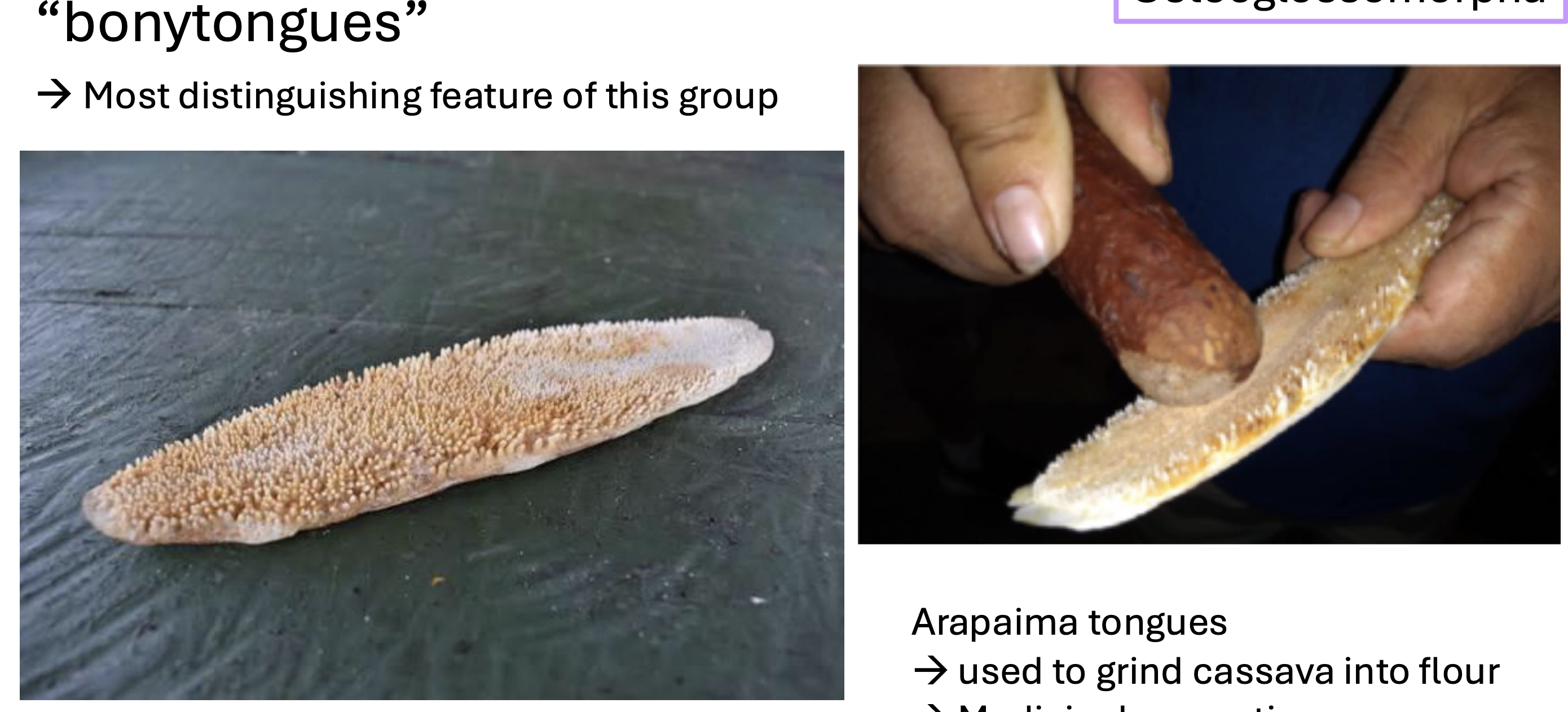
Bony tongues with teeth
bonytongues
Matching set of teeth on roof of mouth
Shear and shred prey
Arapaima tongues
used to grind cassava into flour
Medicinal properties

Osteoglossomorpha - Elephantfish
• Electrolocation
Generate weak electric field
Electroreception
• Large brain to body ratio
• Native to Africa (West/Central)
• Benthic (bottom-dwelling)

Osteoglossomorpha - Arapaima
• Very big!
Up to 10 feet long
One of largest freshwater fish
• Air-breathing (obligate)
Highly vascularized swim bladder
• Surface predators
Fish, birds, mammals
• Mouthbrooders
Males incubate eggs in mouth
• Native to South America
• Have been introduced
Thailand + Malaysia
Considered invasive in some cases
Bolivia; India
Osteoglossomorpha - Arowanas
• Surface predators
Fish, insects, shrimp
Birds (jump up to 6 ft in air)
• Air-breathing (facultative)
Highly vascularized swim bladder
• Mouthbrooders
Males incubate eggs in mouth


Elopomorpha
• Mostly marine
• Flat, transparent larvae
Called Leptocephalus larvae
Unique to Elopomorphs
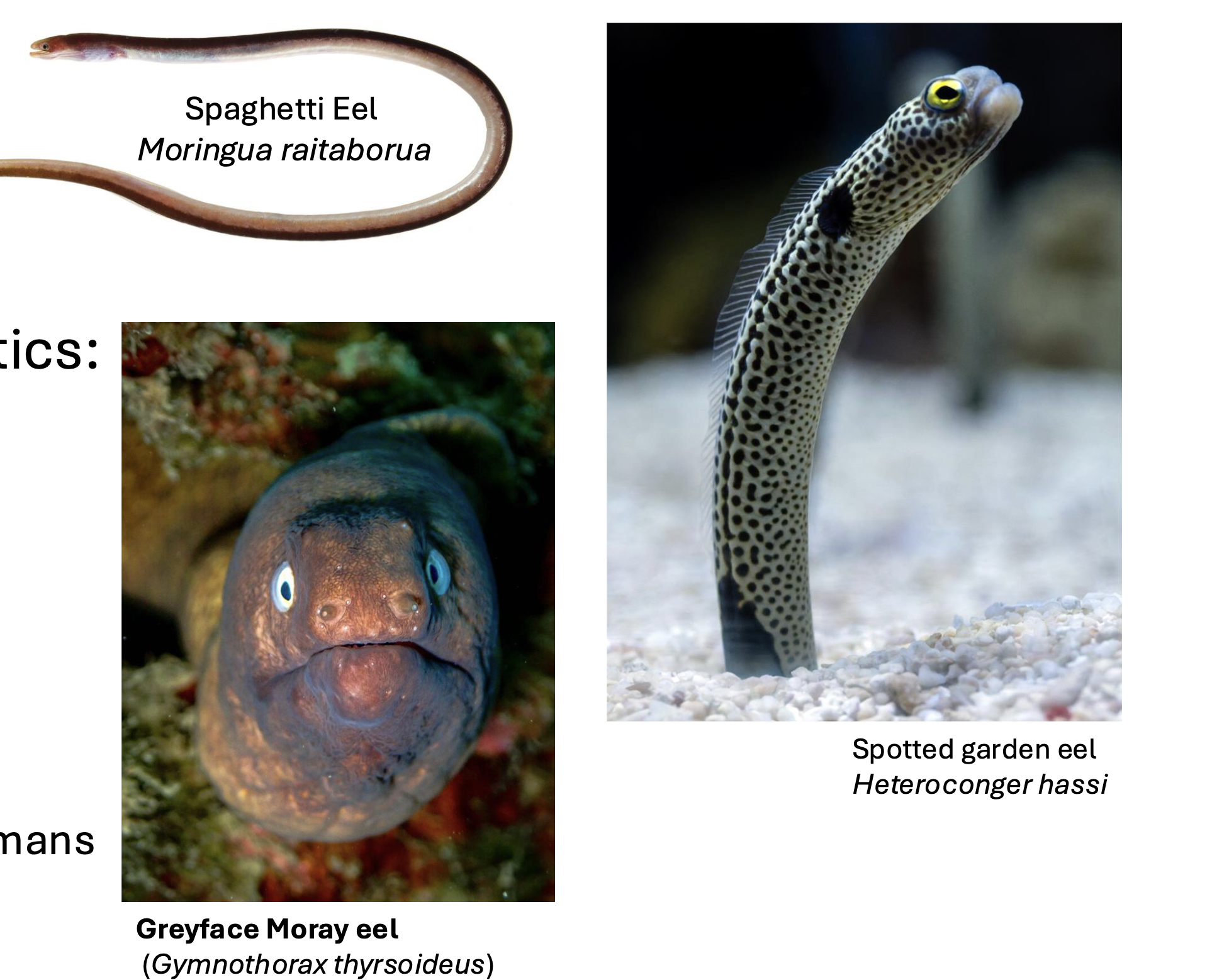
Elopomorpha - Eels
• Leptocephalus larvae
• Anguilliform body shape
• Swim bladder
• Usually predatory
• Mostly nocturnal
• Popular food item for humans
American & European Eel catadromous life cycle
• Silver eels mature
• Physiology shifts to saltwater
• Digestive tract degenerates
• Return to ocean 5-25 years
• Semelparous
spawn once in their lifetime

Elopomorpha - Tarpons
Mostly found in Atlantic Ocean
Air-breathing
Vascular swim bladder
Tarpons are a major sport fish
known for leaping out of water
when hooked on a line
Up to 8 feet
Move between salt/freshwater
How do non-native fishes get introduced
Often on purpose
Fish stocking by govt. agencies
Illegal introductions
Sometimes on accident
Fish stocking by govt. agencies
• improve fishing/recreation
• Biological control (i.e. mosquitofish)
Mule packing/plane dropping

Sometimes on accident - fishes get introduced
• Boats/vessels carry organisms
• Changing waterway connections
• Pet/aquarium trade
• Live bait release
Potential negative impacts of non-native species introductions
Degradation of habitat required by native species
Increased competition with native species
Increased predation of native species
Hybridization between non-native + native species
Introduction of novel disease/parasites
Degradation of habitat required by native species
ex) Carp uproot plants, increase turbidity, contribute to HABs
Hybridization between non-native + native species
Issues with ‘purity’ for legal purposes
Can lead to maladaptive genotypes
Hybrid individuals can be sterile
are non-native species introductions always bad
Not necessarily!
• Many introduced species:
• Don’t survive in novel environment
• Most introduced species don’t become ‘invasive’
• Especially in our ultra-modified ecosystems, introduced species can become “naturalized” (i.e. integrated into biotic community)
• can fill an empty ecological niche, provide food for native fishes, or provide biological control
Salmoniformes
• Very popular game fish
• Adipose fin present
• All spawn in freshwater
Many anadromous
• Single row of sharp teeth
Salmoniformes - Native in California
Salmon
Chinook
Coho
Trout
Rainbow
Costal Cutthroat
Salmoniformes - Native trout
Steelhead - anadromous
Coastal cutthroat trout - anadromous
Rainbow trout
McCloud River Redband Trout
Lahontan cutthroat trout
Paiute cutthroat trout
CA golden trout
Salmoniformes - Non-native trout
Brook trout
Brown trout
Native salmonids in California
Chinook salmon
Coho salmon
Rainbow trout
Coastal cutthroat trout

Salmon are anadromous
Anadromous = born in freshwater, migrate to ocean, migrate upstream to spawn in freshwater
Timing + duration of each stage varies across species
Usually spend more time in ocean than freshwater
Critical life stages (spawning + rearing) occur in freshwater
Turn red during spawning
Many species
males usually brighter red
Why might it be advantageous for salmon to keep their silvery color until they begin their spawning migration?
A) Silvery color attracts a mate
B) Silvery color provides camouflage during pelagic marine phase
C) Silvery color catches the light and draws attention from other species
D) Silvery color mimics other fish that are poisonous
B) Silvery color provides camouflage during pelagic marine phase
Chinook salmon
Largest salmon in Pacific
• Juveniles eat insects, plankton, small crustaceans
• Adults are piscivorous (mostly eat forage fish)