Exam three genetics
 Call Kai
 Learn
 Practice Test
 Spaced Repetition
 Match
 Flashcards
 Knowt Play
1/190

There's no tags or description
Looks like no tags are added yet.
191 Terms
In bacterial cells, the DNA is not enclosed by a nuclear membrane but is instead condensed and localized within an irregularly shaped region of the cytoplasm. What is this region called?
Nucleoid
Chromosomal puffs observed on polytene chromosomes indicate the regions that are most likely _____.
transcriptionally active
A 400 bp circular B-DNA molecule has 40 complete turns in its fully relaxed state (using the approximation of 10 bp per turn). A researcher isolates the same 400 bp molecule and finds it now has 44 complete turns, with no change in the number of base pairs. How would this molecule be classified?
Positively supercoiled (overrotated relative to the relaxed state)
An Alu sequence is an example of which type of DNA sequence in eukaryotes?
short interspersed elements
What is the name of the multiprotein complex that binds telomeric DNA and protects chromosome ends from being mistakenly recognized and repaired as double-stranded breaks?
Shelterin
A cell begins as heteroplasmic, containing a mixture of normal and mutant mitochondrial DNA molecules. After many rounds of cell division, some of its descendant cells are found to be almost entirely normal, while others are found to be almost entirely mutant. What process best explains how this shift toward homoplasmy in individual descendant cells occurs?
Replicative segregation, the random partitioning of mitochondria (and their mtDNA) into daughter cells during division
When comparing the three key models of DNA replication, the model that included the synthesis of a brand new double-stranded DNA molecule from an original molecule was named:
conservative replication.
DNA polymerase I has 5′ → 3′ exonuclease activity, but DNA polymerase III does not. Why is this activity important for DNA polymerase I?
It lets polymerase I remove the RNA primers that primase lays down on each strand
Which of the following proteins’ primary function is unwinding the double-stranded DNA at the replication fork?
helicase
When chromatin from any eukaryote is digested with a small amount of micrococcal nuclease (an endonuclease) and fractionated using electrophoresis, DNA fragments of approximately _____ base pairs in length are observed.
200
Which of the following descriptions is NOT true of heterochromatin?
It makes up most chromosomal material and is where most transcription occurs.
Which type of chromatin remains highly condensed throughout the entire cell cycle, including interphase?
Heterochromatin
A researcher studies globin gene expression in chick erythroblasts at several developmental time points. At day 5, she finds that the embryonic globin gene is highly sensitive to digestion by DNase I, while the two adult globin genes show only moderate sensitivity. By day 14, the embryonic gene has become resistant to DNase I digestion, and one of the adult globin genes is now the most sensitive gene of the group. Which interpretation best accounts for this shift in sensitivity?
By day 14, active transcription of the embryonic globin gene has ceased and its chromatin has become more condensed, whereas an adult globin gene is now being actively transcribed and its chromatin is correspondingly more relaxed and exposed.
How many complete rotations would MOST likely correspond to a relaxed DNA molecule that is 100 bp in length?
10
Cells lacking a functional shelterin complex would be expected to show which outcome at their chromosome ends?
Chromosome ends would be inappropriately repaired as double-strand breaks, causing end-to-end fusions.
Telomeres exist to help with the _____ of the ends of eukaryotic chromosomes.
Replication
Highly repetitive DNA is frequently transcribed into RNA and makes up the majority of protein-coding genes in the human genome.
False
Two denatured DNA samples are allowed to slowly cool and renature. Sample 1 renatures much more quickly than Sample 2 at an equivalent DNA concentration. What is the most likely explanation?
Sample 1 contains a higher proportion of highly repetitive sequences, so a complementary partner for any given strand is more likely to be nearby and available for base pairing.
A tRNA gene is an example of which type of DNA sequence in eukaryotes?
Moderately repetitive DNA
Which statement about mitochondrial genomes is NOT true?
All copies of the mitochondrial genome within a cell are identical.
Which of the following statements is TRUE?
Most proteins in the human mitochondrion are encoded by nuclear genes.
According to the endosymbiotic theory, mitochondria and chloroplasts originated as
Free-living bacteria that became internal inhabitants of early eukaryotic cells.
Paternal transmission of chloroplast DNA is common in which group?
most gymnosperms
A 45-year-old woman presents with progressive muscle weakness and reports that several of her maternal relatives have similar symptoms, though with severity ranging from mild to severe. Her husband and all of her paternal relatives are unaffected. Genetic testing reveals a point mutation in one of her mtDNA-encoded genes, present in varying proportions among her affected relatives. Which explanation best accounts for both the maternal-only transmission pattern and the variable severity of symptoms among affected relatives?
The mutation resides in mtDNA, which is transmitted almost exclusively through the maternal line, and differences in the proportion of mutant versus wild-type mtDNA inherited by each relative (heteroplasmy) account for the variation in severity.
A forensic geneticist wants to confirm that a set of decades-old skeletal remains belong to a specific historical individual by comparing mitochondrial DNA (mtDNA) extracted from the bones to mtDNA from living relatives, using the same overall logic applied in the Tsar Nicholas identification case discussed in recitation.
-The individual's sister (sharing the same mother).
-The individual's sister's daughter (the individual's niece, through the sister).
-The individual's maternal grandmother's other daughter (the individual's maternal aunt).
Which of the following histone proteins would you NOT expect to find in a nucleosome "core," but rather functioning in nucleosome packaging within chromatin?
H1
Chromosomal puffs observed on polytene chromosomes indicate the regions that are most likely _____ (Select all that apply.)
-DNase I sensitive
-Transcriptionally active
A student is studying two types of chromatin. The first type is "open" or loosely packed, and would be referred to as _____. The second type is "closed" and tightly packed, and would be considered _____.
Euchromatin; heterochromatin
You are studying a small eukaryotic gene of about 2000 bp in length. Estimate how many copies of histone H4 you would find along this region of the chromosome.
20
Which of the following is an example of an epigenetic change in eukaryotes?
The addition of methyl groups to cytosines in the promoter region of a gene
Where would you expect to find the variant histone CENP-A?
Centromere
What is the primary function of the centromere?
It is the attachment site for the kinetochore and spindle microtubules.
A gene-encoding sequence is an example of which type of DNA sequence in eukaryotes?
Unique-sequence DNA
Which of the following statements is TRUE?
Most proteins in the human mitochondrion are encoded by nuclear genes.

The pedigree shown here is for a disease caused by a mutation in the mitochondrial DNA. The affected woman in the third generation is married to an unaffected male, whose family does not have any cases of this disease in the past. What is the chance that they will have an affected child?
100%
According to the endosymbiotic theory, mitochondria and chloroplasts originated as
Free-living bacteria that became internal inhabitants of early eukaryotic cells
Which of the following terms describe the feature(s) of mtDNA and cpDNA that differ from the eukaryotic nuclear DNA? (Select all that apply.)
-Uniparental inheritance
-High copy number
-Circular
-Heteroplasmy
Jack and Jill's son Jake has a severe case of myoclonic epilepsy and ragged-red fiber (MERRF) syndrome. His case includes frequent and disabling myoclonic seizures (involuntary twitching of the muscles) along with hearing loss, exercise intolerance, and poor night vision. Like most cases of MERRF, his case is associated with a mitochondrial mutation that he inherited from his mother Jill. His mother doesn't know that she harbors the MERRF mutation among her mtDNA molecules, but she has experienced occasional mild muscle twitching throughout her life and she does not see very well at night. What is/are the MOST likely explanation(s) for the difference in the severity of MERRF between Jake and his mother? (Select all that apply.)
-It is likely that Jake has a higher proportion of mutant mtDNA molecules in his cells compared to his mother.
-Heteroplasmy for mtDNA molecules in the cells of his mother is responsible.

The figure below shows DNase I sensitivity (an indicator of open, accessible chromatin) at the embryonic globin gene (U) and the two adult globin genes (αᴰ and αᴬ) across several chicken cell populations.
Based on the figure, which statement correctly describes the adult globin genes (αᴰ and αᴬ) in erythroblasts across chicken development?
They remain DNase I resistant (condensed) through the first 5 days, then become DNase I sensitive by 14 days, coinciding with when the adult genes are switched on.
Which of the following is an example of an epigenetic change in eukaryotes?
The addition of methyl groups to cytosines in the promoter region of a gene
Where would you expect to find the variant histone CENP-A?
Centromere
What is the primary function of the centromere?
It is the attachment site for the kinetochore and spindle microtubules.
Which of the following has/have repetitive DNA sequences in heterochromatin state? (Select all that apply.)
-Centromere
-Telomere
Copies of a gene that arose by gene duplication are part of a gene:
Family
A telomere is an example of which type of DNA sequence in eukaryotes?
Highly repetitive DNA
What term describes the presence of two or more genetically distinct types of mtDNA (or cpDNA) within the cytoplasm of a single cell?
Heteroplasmy
Which structure in chloroplasts bears the pigments and enzymes required for photophosphorylation?
The thylakoid membrane
What kind of gene would NOT be found in a chloroplast genome?
A gene for a histone protein
Which of the following does NOT fit the description of euchromatin?
Transcriptionally inactive
How many complete rotations would MOST likely correspond to a positively supercoiled DNA molecule that is 100 bp in length?
15

DNA can be isolated from cells, and the different types of DNA from the cell can be separated by density gradient centrifugation. The following figures show the density gradient centrifugation profiles for DNA isolated from four different cell types: plant, animal, wild-type yeast with a plasmid, and petite yeast.
Which figure has the DNA profile for the petite yeast?
Figure 2
Human mtDNA
16,569 bp; highly economical, with very little noncoding DNA
Yeast (Saccharomyces) mtDNA
About 78,000 bp, nearly five times the size of human mtDNA, but encoding only six additional genes
A typical plant chloroplast genome
Typically 120,000 to 160,000 bp
Polytene chromosomes in D. melanogaster salivary gland cells result from multiple rounds of _____ without chromatid separation. The puffed areas in polytene chromosomes indicate the areas of _____.
Answer 1: DNA replication
Answer 2: Chromatid separation and high gene expression
When chromatin from any eukaryote is digested with a small amount of micrococcal nuclease (an endonuclease) and fractionated using electrophoresis, DNA fragments of approximately _____ base pairs in length are observed.
200
Which of the following descriptions is NOT true of heterochromatin?
It makes up most chromosomal material and is where most transcription occurs.
You are studying a small eukaryotic gene of about 2000 bp in length. Estimate how many copies of histone H1 you would find along this region of the chromosome.
10
How many base pairs per turn of the helix would MOST likely correspond to a positively supercoiled DNA molecule?
5
In most eukaryotes, the identity of a centromere is determined primarily by a specific, conserved DNA sequence found at that location.
False
Which of the following are true of the t-loop structure found at the ends of some eukaryotic chromosomes? (Select all that apply.)
-It forms when the G-rich 3′ overhang folds back and pairs with an earlier stretch of telomeric DNA.
-It helps protect the end of the telomere from degradation.
-Its formation displaces DNA that was previously paired within the telomeric repeat region.
Highly repetitive DNA is frequently transcribed into RNA and makes up the majority of protein-coding genes in the human genome.
False
A telomere is an example of which type of DNA sequence in eukaryotes?
Highly repetitive DNA
Which of the following statements is TRUE?
Most proteins in the human mitochondrion are encoded by nuclear genes.
Human mitochondrial DNA is a circular molecule of 16,569 bp whose heavy (H) strand serves as the template for both ribosomal RNAs, 14 of the 22 transfer RNAs, and 12 of the 13 proteins encoded by the genome, while a noncoding region called the D loop contains the sites where replication and transcription of the mtDNA are initiated.
Answer 1: Heavy (H)
Answer 2: D loop
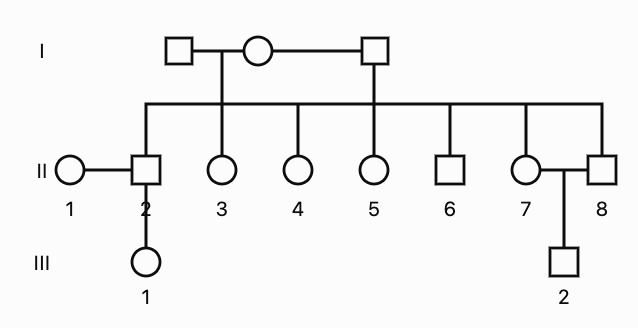
Which pair in the pedigree shares the same mitochondrial DNA?
II-2 and III-2
A circular plasmid contains 500 bp of relaxed B-DNA (10 bp per turn, so 50 total turns in the relaxed state). A researcher treats this plasmid with a topoisomerase that removes 5 turns from the helix without changing the number of base pairs or nicking the circle permanently.
What is the resulting topological state of the plasmid?
Negatively supercoiled, because the helix is now underwound relative to its relaxed state.
What are autonomously replicating sequences (ARSs)?
Yeast DNA sequences that serve as origins of replication
_____ are tandemly repeated DNA sequences located at the ends of eukaryotic chromosomes.
Telomeres
What would be a likely result of expressing telomerase in somatic cells?
Cancer
Some experimental anticancer drugs work by inhibiting telomerase. Based on what is known about telomerase activity in normal and cancer cells, which predictions about such a drug are reasonable? (Select all that apply.)
-Effects that depend on telomere loss would appear only after many divisions.
-Tumor growth might slow even before telomeres become critically short.
-Bone-marrow and intestinal lining cells could also be harmed by the drug.
In meiosis, homologous recombination takes place in prophase I, after DNA replication has already occurred in interphase.
True
Which feature distinguishes the early Holliday model (aka single-strand-break model) of recombination from the double-strand-break model?
Recombination begins with a single-strand break in each of the two molecules.
RecA
Allows a single strand to invade a homologous DNA molecule
RecBCD
Unwinds double-stranded DNA
RuvC (resolvase)
Cleaves Holliday junctions in E. coli
GEN1
Cleaves and resolves Holliday junctions in eukaryotes
A chromosome of a eukaryotic species contains about 28.8 million base pairs. It takes 40 minutes to replicate the entire chromosome. The speed of replication, carried out by a replication fork, is known to be 300 base pairs per second. What is the minimum number of the replication origins present in this chromosome?
20
Which of the following does NOT employ bidirectional replication to copy DNA?
Rolling-circle replication
Which statement CORRECTLY describes why DNA synthesis is discontinuous on one template strand while continuous on the other? (Select all that apply.)
-It is due to the antiparallel nature of the DNA molecule.
-It is due to the nature of the DNA polymerase which can only add new nucleotide at the 3′ end.
When comparing the three key models of DNA replication, the model that included the separation of the two strands of the original DNA (template) and using those strands as templates to synthesize two new DNA strands is called:
Semiconservative replication
If Escherichia coli cells, grown for a period of time in ¹⁵N, are transferred to ¹⁴N for one generation of DNA replication, the resulting DNA should have ¹⁴N added to all "new" DNA. If semiconservative replication is occurring, the ¹⁴N-containing "new" DNA will compose:
One strand of all bacterial chromosomes.

The diagram shown below is one half of a replication bubble. As the DNA template strands unwind towards the right, new strands of DNA get synthesized. Which of the following represents a lagging strand?
B
You are studying a new virus with a circular double-stranded DNA genome of 12 kbp. It can synthesize DNA at a rate of 400 nucleotides per second. If the virus uses rolling-circle replication, how long will it take to replicate its genome?
30 seconds
What is the function of DNA gyrase?
Reduces the torsional strain that builds up ahead of the replication fork as a result of unwinding.
Which of the following enzymes do NOT aid in the unwinding of DNA for replication?
Primase
What is the function of DNA ligase?
Connects Okazaki fragments by sealing nicks in the sugar-phosphate backbone.
What is the function of single-strand-binding proteins during bacterial DNA replication?
They coat exposed single strands and prevent hairpins from forming.
DNA polymerases require all of the following for DNA replication EXCEPT:
3′ to 5′ polymerase activity
If ribonucleotides were depleted from a cell during S phase, how would DNA synthesis be affected? (Ignore energetic considerations.)
Replication would cease because ribonucleotides are required to initiate DNA synthesis.
When transferred from yeast cells to plasmids, these sequences confer the ability to replicate. What are these?
Autonomously replicating sequences (ARSs)
All DNA polymerases synthesize new DNA by adding nucleotides to the _____ of the growing DNA chain.
3′-OH
Which of the following enzyme and function pairs is INCORRECTLY matched?
DNA helicase; rewinding and reforming the DNA double helix as the replication terminates

In the diagram below, which letter indicates the 5′ end of the leading strand?
C
The nuclear genome of a single human cell (i.e., the entire diploid complement) contains about 6.6 billion (6.6 × 10⁹) base pairs of DNA. If synthesis at each replication fork occurs at an average rate of 50 nucleotides per second, all the DNA is replicated in 5 minutes. Assume that replication is initiated simultaneously at all origins. Assuming that the origins are approximately equally distributed across the chromosomes, what is the average number of origins per human chromosome?
4,783
After one round of replication in ¹⁴N medium, Meselson and Stahl observed a single band of intermediate density. What could they conclude from this result alone?
It ruled out conservative replication but not dispersive replication.
Suppose that some cells are grown in culture in the presence of radioactive nucleotides for many generations so that both strands of every DNA molecule include radioactive nucleotides. The cells are then harvested and placed in a new culture medium with nucleotides that are not radioactive so that newly synthesized DNA will not be radioactive. What proportion of DNA molecules will contain radioactivity after two rounds of replication?
1/2
During the initiation of DNA replication in E. coli, what is the role of helicase?
It breaks hydrogen bonds between the two paired DNA strands.
The proofreading function of DNA polymerases involves _____ activity.
3′ → 5′ exonuclease
DNA replication is an incredibly accurate process. When a rare mistake is made, most of the time a 3′ → 5′ exonuclease activity will remove the mismatched nucleotide. In E. coli, this proofreading activity is provided by:
Both DNA polymerase I and III