Week 1 Cell Physiology - Atoms, Molecules, Bonding
 Call Kai
 Learn
Learn Practice Test
 Spaced Repetition
 Match
Match Flashcards
 Knowt Play
1/77

There's no tags or description
Looks like no tags are added yet.
Name | Mastery | Learn | Test | Matching | Spaced | Call with Kai | Chat |
|---|
No analytics yet
Send a link to your students to track their progress
78 Terms
Matter
anything that has mass and takes up space
Solid, Liquid, Gas, Plasma
What are the four states of matter?
Mass
is the amount of matter in a given object
Weight
is a measure of gravity's pull on an object
Volume
amount of space something occupies
Atoms
fundamental unit of matter; smallest particle of an element that retains characteristics of that element
Element
made up of only one type of atom
118
There are currently how many elements?
~40
Around how many elements are used in the makeup of the human body?
Hydrogen, Carbon, Nitrogen, Oxygen, Phosphorus, and Calcium
95% of the body is made up of 6 elements. They are:
Identity
The number of protons determines the _____ of an atom
Ion
If the number of electrons changes, an atom becomes a what?
2
The Level 1 (K) shell can hold _____ electrons
8
The Level 2 (L) shell can hold _____ electrons
18
The Level 3 (M) shell can hold _____ electrons
32
The Level 4 (N) shell can hold _____ electrons
s, 2
What orbital is this? How many electrons can it hold?

d, 10
What orbital is this? How many electrons can it hold?

p, 6
What orbital is this? How many electrons can it hold?

f, 14
What orbital is this? How many electrons can it hold?

Mendeleleev
Who created the periodic table?
118
How many elements are in the periodic table?
Atomic mass
Elements are placed in order of increasing _____ _____
Periods
horizontal rows of elements

Same energy level is being filled
Across a period, what remains the same in each element?
Groups
Vertical columns of elements
Same number of valence electrons
Down a group, what remains the same in each element?
Valence electrons
Electrons in the outermost shell
Cations
Positive ions are called
Anions
Negative ions are called
Gain
Nonmetals tend to _____ electrons (think fluorine)
Lose
Metals tend to ____ electrons (think Lithium)
Na+
Ion of biological significance; important in creating action potentials; drives movement of particles across membrane (ion exchange)
K+
Ion of biological significance; action potentials; graded potentials; water balance in the kidneys; reestablishment of resting potentials
Ca2+
Ion of biological significance; stored in bones; second messenger in cells; release of neurotransmitters; muscle contraction (part of sliding filament process)
Mg2+
Ion of biological significance; common cofactor in enzymatic reactions
Cl-
Ion of biological significance; major negative ion; used in action potentials
Transfer, sharing
Ionic bonds involve the _____ of electrons, while covalent bonds involve the _____ of electrons
Ionic bonds
an attraction between oppositely charged ions
Metals and Nonmetals
Ionic bonds form between _____ and _____
Lattice structure
a systematic, symmetrical network of atoms forming an ionic solid
Dissociate
Ionic compounds _____ in water
Electrolyte solutions
a solution that conducts electricity; is a solution with ions in it
It's polar
What property about water allows it to dissolve ions?
Nonmetals and nonmetals
Covalent bonds form between _____ and _____
Sigma bond
The strongest or most "perfect bond"

Pi bond
Exist in double bonds. 1 sigma and 1 pi bond
Weaker
1 Pi bond is (weaker or stronger) than 1 sigma bond
Single bonds
generally consist of sigma bonds
Double bonds
generally consist of 1 sigma bond and 1 pi bond
Typically made up of 1 sigma bond and 2 pi bonds
Acids
covalent compounds that produce H+ ions
hydrogen, anion
HCl, HNO3
Most acids contain a covalent bond between _____ and some stable _____
Electronegativity
"the ability of an atom to attract bonding electrons"
Fluorine
_____ is the most electronegative element
Pauling Scale
The _____ Scale gives electronegativity values between 0 and 4
Dipole moment
Covalent molecules have different geometries. Geometry can affect the _____ _____ of a molecule
nonpolar covalent bond
EN difference 0.0-0.4
polar covalent bond
EN difference is 0.5-2.0
ionic bond
EN difference is 2.0-4.0
Nitrogen, Oxygen, Fluorine, Chlorine
Physiologically important polar covalent bonds - an H or C bonded to what four elements?
Intramolecular forces
the force that binds one atom to another

Intermolecular forces
the forces that mediate interaction between molecules

Hydrogen bond
A H atom is covalently bonded to an electronegative N, O, F and that H interacts with a different N, O, or F

Weaker, longer
Hydrogen bonds are (stronger or weaker) and (longer or shorter) than covalent bonds
Hydrogen bonds
DNA is held together by what type of bond?
Salt bridge
describes ionic bonds within the same protein molecule

Dipole-Dipole
describes the attraction of neighboring polar groups to one another
London Forces (Van der Waals)
weak electrostatic interaction between all types of atoms
~3.4
An water molecule forms hydrogen bonds with ~_____ other water molecules
4
When water is frozen, each molecule forms _____ hydrogen bonds
Hydrophilic
"water loving"
Hydrophobic
"water fearing"
Hydrophobic effect
The tendency for nonpolar molecules to aggregate in water solutions; tends to occur in protein folding
Hydrophobic effect
Because of the _____ _____, ingested fat must be surrounded by polar/charged molecules for transport
Amphipathic molecules
Molecules that contain regions that are polar and regions that are nonpolar

Micelles
Thermodynamically stable structures of amphipathic compounds in wtaer
Hydrophobic
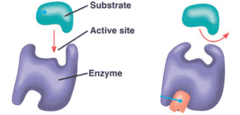
Enzyme bonding sites often have a (hydrophobic or hydrophilic) binding site. This site is perfect for things like steriods