Kap. 4 - External attention
 Call Kai
 Learn
Learn Practice Test
 Spaced Repetition
 Match
Match Flashcards
 Knowt Play
1/15

There's no tags or description
Looks like no tags are added yet.
Name | Mastery | Learn | Test | Matching | Spaced | Call with Kai | Chat |
|---|
No analytics yet
Send a link to your students to track their progress
16 Terms
What is the distinction between internal and external attention?
Are they completely unrelated to each other?
Attention
Family of cognitive mechanisms that combine to help us select, modulate, and sustain focus (vigilance) on information that relevant for behaviour
Helps us select and prioritize information because of our capacity-limited ability to process information
.
External attention
How we attend outwardly/select and modulate sensory information
.
Internal attention
How we select, modulate, and maintain internally generated information
.
Relation to each other
Useful to talk about them separately, but they are closely related
Can influence each other!:
E.g.
Attention on daydreaming (internal) interferes with ability to attend to lecture (external)
Can you always tell where people are paying attention? Why/why not?
Overt attention
“Outwardly observable sign of where people are paying attention”
Measuring overt attention:
Eye tracking
Cameras recording saccades (eye movements)
.
Covert attention
Attention directed in a way that can’t be discerned by observable signs
“Processing an object or location in visual scene without shifting gaze“
.
Does overt attention always correlate with covert attention?
Attention is a function of the mind, not just the eyes
Overt attention often match with covert, but not always!
E.g.
Experiment: Inattentional blindness with radiologists not covertly attending to the monkey, even though overtly seeing it
Describe different ways that attention can select information from the world
Selection
“Singling out certain pieces of information among many
.
Spatial attention
“The ability to attend to regions in space“
Like a spotlight - illuminating and raising the profile of whatever falls within its focus
Enhances information in specific location and suppress information outside that location
Like a zoom lens - attentional resolution decreases as attentional breadth increases
Consistent with fMRI:
Attention to larger area visually —> spread of corresponding neural activation (in visual system) increased, but neural activity level within spread decreased
E.g.
Posner cueing task
Faster and more accurate at responding to a target (in space) when a cue (in this case and arrow) predicts the target’s location
Slower if cue is invalid and doesn’t predict target
The difference of speed in reaction to valid vs invalid cues is used as index of movement spatial attention
.
Feature-based attention
“The ability to attend to or filter out information based on features like color, shape or motion“
Neuroimaging:
Neural distinction between feature-based attention and spatial attention
Feature-based turning of attention often occur when preparing to search for a target that hasn’t appeared yet
Feature-based attention increase activity in neural regions that are sensitive to the target feature across the visual field
- even in absence of sensory stimulation
Neurons that are not responsive to the feature tuned to be prioritized exhibit suppressed sensitivity
.
Temporal attention
“The ability to pay attention to points in time”
E.g.
Attentional blink
The second of two targets shown in rapid succession of items → more difficult to detect than the first
(within ca ½ a second)
.
Object based attention
“Selective attention to an object rather than to a point in space“
Objects as units of attention - i.e. attention to a part of the object entails attention to the whole object
Evidence
E.g. - reaction to cue and target within the same object vs in different objects (s. 88)
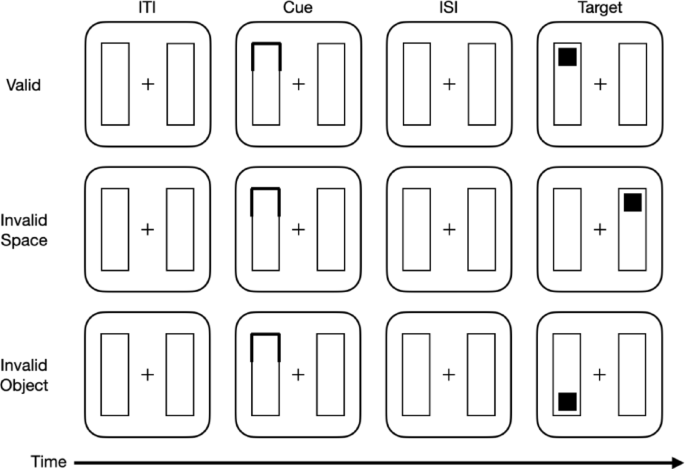
Result: The invalid cues slowed response time more when they appeared on the opposite rectangle than on the same rectangle as the target
Meaning of result: Visual attention is influenced by how we parse the world - (with objects as a unit of attention)
Spatial neglect by lesion in right hemisphere
Fail to process stimuli within left visual field - some fail to process left side of objects!
- even situated in their right visual field
How have researchers distinguished between voluntary and reflexive attention?
Voluntary attention
The effort to select goal-relevant information
Endogenous (central) cues in Posner cueing task
Engages voluntary attention and can appear between the potential target locations and can indicate symbolically where the target is likely to appear
.
Reflexive attention
Attending to a particular stimulus because it has seized your attention
Instead of you actively choosing to attend to it
Exogenous (peripheral) cues in Posner cueing task
Engages reflexive attention and can appear at one of the target locations instead of between them
.
Evidence to distinguish the two attentional mechanisms:
Neural regions involved
Voluntary:
Certain areas along the dorsal portion of brain
Reflexive:
A network alongside the ventral side of brain
Time course
Reflexive attentional shifts:
Transient:
Benefits of reflexively processing stimuli at specific location peak after ca 150 ms
After 150 ms —> inhibition of return
Short period when processing at the location is suppressed
Aiding ability to find things!
What is the biased competition model of attention?
One of the most influential and empirically supported models of attention!
Claims:
“Stimuli in a cluttered visual environment compete with each other to drive the responses of neurons in the visual system”
i.e.
(A given neuron’s preferred region of the visual field is known as that neuron’s receptive field)
The competition among stimuli is particularly fierce when they fall within the same perceptive field
The smaller the distance among the stimuli - the greater overlap in the neuron populations that are activated —> increased competition among neural representations
“Selective attention biases the competition in favor of one stimulus over the others“
Selective attention is biases by:
Bottom-up selection
Salience of the physical features
Top-down selection
Goal-relevance
Bias may be amplified by emotional arousal
.
The model is supported by evidence of neural activity
When competing stimuli simultaneously occupy a neuron’s receptive field, the visual cortical neuron highly sensitive to another stimulus - become less responsive
.
Ambiguity resolution theory (of visual selective attention)
Any one cluster of neurons can actively support several representations
So, presence of multiple stimuli —> ambiguity about which mental representation accurately reflect the external world
Resolution: Attention
How do early selection and late selection accounts of attention differ?
How do load theory and Treisman’s attenuator model fit in with/modify this distinction?
What evidence supports these different accounts?
The relevant question: “at what point in the flow of information processing does attention do its selecting?“
.
Early selection of attention
The attention theory that we attentionally select stimuli on the basis of physical features - such as color, pitch, or location - and that we register their meaning only after we have selected them
.
Late selection of attention
The attention theory that we process the meaning of everything around us before we select what will gain entry to heightened awareness
.
Treisman’s attentuator model
Claims: “Meaningful information needs to meet a lower threshold of processing in order to reach awareness“
.
Load theory of attention: - flexible locus of attention
Availability of mental resources to process information depends partly on the demands of an attended task
If attended task has high load (demanding):
Few spare attentional resources for unattended information - filtering it out at early processing stage
Unattended information will not reach awareness nor interfere with attended task
If attended task has low load:
More spare attentional resources for unattended information - may let attention “spill over” to this
Unattended message more likely to reach awareness + interfere with task
.
Perceptual load
Load is high because of difficult perceptual demands
Processing of non-targets is diminished
.
Working memory load
Load is high because of taxing working memory
Processing of non-target information increase
Since working memory plays role in inhibition - inhibiting distractors is harder if higher load
What is preattentive processing, and what might our experience of the world be like during this stage of processing?
Reality: - a combination of early and late selection!
Attention actually operate at many points in the information processing
Preattentive processing
The extent we process information before attentionally selecting it
Parallell processing
Analyzing of stimuli during preattentive processing - taking in stimuli quickly all at once
Serial processing
Further analyzing of stimuli as they get attentionally selected - more slowly and one bit at a time
.
Evidence for different types/stages of selection
Visual search task - parallel processing
Look for a target embedded in non-targets
Results:
When target is characterized by a distinctive feature (“popping out”): detection is quick — parallell processing
When target is charactarized by a conjuction of features: detection is slower
.
Feature Integration Theory - preattentive processing
Suggests:
During preattentive processing, we experience the world as a jumble of simple features that are not bound together into cohesive objects
Focusing on an object binds the features together - perceiving meaningful object
Evidence/support:
Illusory conjunctions
Incorrect binding of features in front of us
E.g.
Task:
When flashed arrays of four letters - asked to report identities of two digits + the colors and positions of the letters
Result:
Errors tended to reflect the incorrect combining of features presented
Ergo:
We process features prior to selection, but need attention to combine them accurately
.
Dichotic listening - preattentive processing / early selection
Task:
Listening to two different messages played simultaneously - actively only paying one of them attention (repeating this message out loud)
Result:
Barely able to report anything about the unattended message:
Only the physical properties of the stimuli
Like: gender switch / pitch, and replaced voice by a 400Hz tone
Broadbent’s filter model of attention
Describe: “the flow of information processing pre- and post-attention“
Suggests: “information is attended / ignored based on early stimulus characteristics“
i.e. - based on physical properties before prior to semantic processing of meaning
Evidence against this model:
Words with relevant meaning: People noticing their own name when presented to the unattended ear
(Treismann’s attenuator model as resolution to this problem)
How are modulation and vigilance functions of attention different from the selection function of attention?
Selection of attention
Acts like spotlight and filter out information - focusing on specific information
.
Modulation of attention
Attention’s ability to change the way we perceive a stimulus
i.e. Changes strength of neural processing for the selected stimuli
.
Vigilance of attention
Attention’s ability to highten attentional anticitpation, enabling us to better respond to stimuli before they appear
i.e. Maintains readiness over time
What evidence suggests that attention modulates our perceptions?
Study with Gabor patches
Test:
Presented with two Gabor patches, asket to determine which of them had the highest dark/light contrast + the tilt
Patches were preceded by attention-grabbing cue in between flashes or at one of the patch locations
Goal: manipulating where allocating attention
Result:
When cue flashed in between:
bias in reporting the tilt of one over the other
When cue flashed at one of the locations:
Perceive that patch as having higher contrast
So,:
Spatial attention modulates how people perceive the visual qualities (i.e. contrast) of a stimulus
How are measures of attentional vigilance relevant to the real world?
When given information about when a stimulus will appear, people are faster to respond to the target than when they are given no warning
.
E.g.
Continous performance task
Stay “on task” for a prolonged time period
Understanding factors that enable people to stay vigilant during such tasks has real-world importance
Factors e.g.: brain damage or little sleep
E.g. Baggage screeners at airports - looking for specific objects
Bad at detecting targets that appear rarely
Describe at least one way that inattentional blindness and change blindness differ from each other?
Inattentional blindness
When people fail to notice an unexpected item right in front of their eyes when their attention is preoccupied
Influenced by expectations
(i.e. expecting to see the gorilla, but not the color change of the curtains)
i.e. radiologists looking for nodules in lungs, but not covertly seeing the gorilla
Influenced by feature-based attention
i.e. “driving through” imaginary world on video, looking for a road sign with specific color - less likely to collide with motorcycle if it had the same color as the road sign
Difference in overt and covert attention!
What is in covert attention depend on which aspect of visual information we select for further processing
.
Change blindness
Failure to notice large changes from one view to the next, and it reflects another, related failure of awareness in the absence of attention
Difference from inattentional blindness:
Change blindness:
Can occur because people fail to compare two views of a stimulus in memory
Inattentional blindness
Occur because people fail to notice a stimulus at all
E.g. - door experiment: asking for directions and changing the person
Result:
Many didn’t notice
Other suggestions based on results:
Likelihood of noticing the change depends on what aspect of the person’s appearance attended to:
If out-group member —> only encoding features enough to classify as out-group
In-group —> encoded more individuating features
What is one piece of evidence suggesting that attention and awareness may not be the same thing?
Attentional blink
Test - finding two targets in a rapid serial visual presentation task
Pushes attention to its temporal limits
Increasing difficulty of attending to some stimuli because they appear too soon after another
Result:
Typically difficulty reporting the second target, it appearing too soon after the first target
So,
If attention is fully occupied, you can look directly at a stimulus without being consciously aware of it
i.e. focused attention is a required gateway for a stimulus to cross the threshold into conscious perception - without attention, no conscious perception
If we can be aware of only a few things at a time, why do we often feel like we experience a richly detailed world in any given moment?
We can rapidly process the “gist” - the overall idea - of a scene more quickly than we can process a scene’s details
The gist information helps give a sense of a richly perceived world
Perception of the world is a construction of the mind:
Stitches together immediate sensory information with information from immediately preceding views
What are some factors that can guide our attention without our control or intention?
Attentional capture
Stimuli that can draw our attention reflexively
E.g.
Arrows - pointing in a direction
Eyes - looking in a direction
Exogenous cue flashing at location of upcoming target
High salience aspects (very different from surroundings)
Saliency map - some cues have more power than others
In early processing, visual system computes the relative differences between visual signals across the visual field - forming topographical representation
E.g.
Response time slows if high salient distractor is shown (e.g. an irrelevant different color)
Overriding attentional capture by irrelevant information
If tuned attention for a particular feature
(i.e. if they know that a specific type of salient (e.g. sudden onset or different color) distractor will appear )
Describe different ways that emotion and learning appear to influence attention
Experience and learning directs attention
Contextual cueing
Learning where to attend and what to expect based on statistical regularities in past experience
An effect that is observed when people search for a target in an array of non-targets over and over again, across many trials - faster at finding a target in repeated configurations
.
Emotion-driven guidance of attention
Emotion-driven attentional bias
When we show a preference to attend to emotional stimuli
E.g. emotional influence on selection
Emotional disorders:
Heightened tendencies to attend to emotionally negative information
E.g.
Dot probe task
Test:
Try to respond quickly to a target that can appear in one of two locations
Prior to target, locations are occupied - one with threatening stimulus, the other neutral
Result:
Anxious: Respond more quickly if target appears where the threat was
.
Emotion and temporal attention
Attentional blink
If first target is emotional, it causes more impairments for detection of the other stimuli
Connected to amygdala - if lesion, then this effect doesn’t occur
Emotion-induced blindness
The failure to see rapidly presented targets that appear right after a rapidly presented emotional non-target
.
Value-modulated attentional capture
The reflexive allocation of attention based on learned value
E.g.
Doing a task where you know you’ll gain money - higher stakes —> worse performance
.
E.g. - emotional influence on modulation
Emotional face shown before Gabor patch —> contrast sensitivity increased for the task
Effect was independent of spatial location - when faces appeared in different location as Gabor patch
.
E.g. - Broaden-and-build theory on emotional states affecting attention
Positive emotions —> widen range of information people readily consider and attend to (global bias)
But if positive emotion is an “approach motivation” —> less likely to have global bias
Negative emotions —> narrow range of information people consider