AeE 418: Human Systems Engineering
 Call Kai
 Learn
Learn Practice Test
 Spaced Repetition
 Match
Match Flashcards
 Knowt Play
1/78

There's no tags or description
Looks like no tags are added yet.
Name | Mastery | Learn | Test | Matching | Spaced | Call with Kai | Chat |
|---|
No analytics yet
Send a link to your students to track their progress
79 Terms
Reliability Engineering
evident in regulatory mandates and prescribed standards, through Reliability Programs and Continuing Airworthiness Mgt.
CAAP’s PCAR Part 9 - AOC
(b) The Authority will require an operator to include a reliability program when the Authority determines that such a reliability program is necessary. When such a determination is made by the Authority the operator shall provide such procedures and information in the operator's maintenance control manual
(c) Each operator shall ensure that each aircraft is maintained in accordance with the operator's aircraft approved maintenance program as required by Subpart 9.4.1.3, which shall include:
(1) Maintenance tasks and the intervals in which these are to be performed, taking into account the anticipated utilization of the aircraft:
(2) When applicable, a continuing structural integrity program,
(3) Procedures for changing or deviating from subparagraphs (c)(1) and (c)(2) and
(4) When applicable, condition monitoring and reliability program, descriptions for aircraft systems, components, and power-plants (for helicopters: power
CAAP’s PCAR Part 9 - AOC
9.4.1.2
MAINTENANCE RESPONSIBILITY
(a) Each operator shall ensure the airworthiness of the aircraft and the serviceability of both operational and emergency equipment by
(1) Assuring the accomplishment of preflight inspections;
(2) Assuring the correction of any defect and/or damage affecting safe operation of an aircraft to an approved standard, taking into account the MEL and CDL if available for the aircraft type;
(3) Assuring the accomplishment of all maintenance in accordance with the approved operator's aircraft maintenance program:
(4) The analysis of the effectiveness of the operator's approved aircraft maintenance program;
(5) Assuring the accomplishment of any operational directive airworthiness directive
Dispatch Reliability
Systems reliability
Component Reliability
Powerplant Reliability
4 Reliability Areas/Scope
Dispatch Reliability
the percentage of total flights that departed on-time within a specified time of the scheduled departure times
Dispatch Reliability
"specified time" margin is first defined - industry practice uses 15-minute margin between actual and scheduled departure time for a flight to be considered "on-time"
15 minutes
what is the margin between actual and scheduled departure time for a flight to be considered “on-time'“
Sample computation...
e.g. Airline XYZ operates only one aircraft, with 10 flights assigned to it yesterday. There were 3 delayed flights (one flight incurred 10 minutes in the morning, another incurred 18 minutes in the afternoon and the last flight was 130 minutes delayed.)
Yesterday's Dispatch Reliability = 80%
Technical Dispatch Reliability
Reliability Engineering Deals only with what in Dispatch Reliability
Technical Dispatch Reliablity
exclude delays/cancellation that were not related to, nor caused by aircraft technical or maintenance situations. (e.g. late arrival of crew member, late catering supplies, etc.)
Sample computation... previous case re-analyzed.
e.g. Airline XYZ's first delayed flight in the morning was caused by the flight crew arriving late, the second in the afternoon was caused by the catering supplies' late provisioning while the last was due to its aircraft's LH MLG Wheel found with worn-out tread, thus leading to replacement that delayed the flight.
Yesterday's (Technical) Dispatch Reliability = 90%
Dispatch Reliability
The level of analysis and technical aviation background of the Reliability Engineer would enable him to quantify and filter out only those delays that were due to engineering & maintenance-related scenarios.
Technical Dispatch Reliability
is given significant consideration and watch by th emanagement, as it directly links Operations and M&E
Technical Dispatch Reliability
as a product of Reliability Engineering, it reflects the impact of maintenance on the airline’s performance
Poor Technical Dispatch Reliability
meansan aicraft/airline(fleet) is not reliable to serve on-time, due to the maintenance of its aircraft
Component Reliability
focuses on the reliability of an aircraft component’s performance
Component Reliability
data is gathered from history of reported defects of a component or times it has been replaced due to failure, etc
Failure
termination of th eability to perform its required function as specified in an engineering specification, drawing and/or certification
Compoment Reliability
measured by quantifying howoften an aircraft component dails, via Mean Time Between Failure (MRBF) expressed in flight hours (FH)
Mean Time Between Failure (MTBF)
how is component reliability measured
Lom Mean Time Between Failure (MTBF)
indicates an un-reliable component
Component Reliability Rate Formula: resulting in XXXX MTBF

R
nuber of times that the component was removed due to failure
FH
duration of time (in flight hours) from installation to removal, of a ll similar components removed due to failure, averaged
Component Reliability
Usually also measured by the number of times a component was reported defective, removed unscheduled, through Pilot Reports (Pireps)
Component Reliability thru Pirep Rate: resulting to N.NN rate (or chance) that the component is reported faulty over the course of 1,000 flying hours

Pr
number of Pireps pertaining to the specific component
FH
time (in fligh hours) accrued by all aircraft wherein the similar specific component is installed
High Pirep Rate
may imply that the component is un-reliable
Approach
is prone to subjectivity - which could not ensure to determine failures’ root causes
Pirep
is a useful tool for detecting poor maintenance/malpractices, coupled with a good quality system
Systems Reliability
Focuses on reliability of individual aircraft systems' performance, measured by how often an aircraft system (e.g. ATA 21) fails.
Poor Systems Reliability
has a safety impact because typically it may cause unexpected transition from one operating mode to another
System Reliability Rate
becomes the reliability indicator, showing an average number of failures (or unscheduled removals’) of components in a system to a thousand hours of flight over a specified timeframe
ATA 100
system reliability is monitored according to what ATA specification
Component Failures (System Reliability)
If through ______________, same approach with MTBF of component failures but must take into account all failed components associated with the aircraft system.
Component Unscheduled Removals (System Reliability)
If through ____________, same approach with MTBUR of components taking into account all Pirep triggers and unscheduled removals c/o maintenance troubleshooting, on such components associated with the aircraft system.
System Reliability thru Pirep Rate
Scope of analysis' timeframe must be considered... in a month? in three moving-months? In twelve months?

Pr
number of Pireps on components of a specified system
FH
time (in flight hurs) accrued by a fleet type having the specified system
Powerplant reliability
Consider its reliability as a component, an expensive aircraft part with due attention - while at the same time monitored as system, with ATA 70+ codes being dedicated to the Powerplant's several systems (Fuel, Indicating, Control, Ignition, etc.) containing numerous components.
Powerplant Reliability
Component Reliability and System Reliability approach are applied
Aircraft Design Phase - Initial Airworthiness
Aircraft Operation - Continuing Airworthiness
2 Art and Science Behind Aircraft Reliability Engineering
Aircraft Design Phase - Initial Airworthiness
no perfect design, most especially for first-time inventions and aircraft/aeronautical products
design mindset of installing only components (or adopting system configurations) with proven desireable reliability
If designing a totally new aircraft however, components and systems are prototyped.
The prototypes undergo numerous tests supported by Reliability Prediction tools such as Empirical Methods of MIL-STD-1629 (Parts Count and Stress), FMEA (Failure Mode and Effects Analysis) and FTA (Failure Tree Analysis).
Maintenance Program (through Maintenance Planning Doc -MPD) developed as part of ICA (Instructions for Continued Airworthiness, required by the applicant's State of Design Authority for the approval of a type design.)
Reliability Engineering processes and principles are involved during design and development of the MPD.
Aircraft Operation - Continuing Airworthiness
Airline operators (AOC) develop their own Maintenance Programs basing on the MPD and all other ICAs provided by the Design Approval Holder / TC Holder.
The Aircraft Maintenance Program (AMP) then requires approval from the relevant Aviation Authority.
AMP establishes the maintenance tasks and intervals for the operated aircraft, in order to maintain its airworthiness.
Through the Reliability Program, the Aircraft Maintenance Program is reviewed, analyzed and improved.
Airline Operators (AOC)
develop their own Maintenance Programs basing on the MPD and all other ICAs provided by the Design Approval Holder/TC Holder
Aircraft Maintenance Program (AMP)
requires approvalfrom the relevant Aviation Authority
Aircraft Maintenance Program (AMP)
establishes the maintenance tasks and intervals for the operated aircraft, in order to maintain its airworthiness
Reliability Program
through the ___________. the Aircraft Maintenance Program is reviewed, analyzed and improved
Hard Time (HT)
item must be removed from service at or before a specified time
Regardless of the component’s condition
Examples:
Engine Life Limited Parts
Landing Gear Components
On-Condition (OC)
Repetitive Inspections or tests
To determine the condition of units, sytems, or portions of structure
Thus ensuring continued serviceability
The condition will determine the subsequent corrective actions
Examples
Engines
Borescope inspection
Oil Analysis
Health Monitoring
Brake Wear Pins
Condition Monitoring (CM)
Not a preventive maintenance process
Allows failures to occur
Data-driven iterative process
Analysis of operating experience determines the appropriate action
Data on the populations of items is analyzed
Examples:
Avionic Computers
Hydro/Mechanical/Electrical Systems
Failure modes
_________ of condition monitored items do not impact safety
Soft Time (ST)
used to recommend ‘opportunity maintenance”
interval above which preventive maintenance is considered to be cost effective
What airlines may choose to implement
The Reliability Program

Speific Flow of Information
Identified data Sources
Procedures for Data Transmission within #1
3 must haves of Data Collection, Sources and System
Typical Sources of Data

Data Analysis
after collecting the data for a given month, they are statistically analyzed and the data of aircraft availability and reliability is obtained
Data Analysis
the process of evaluating mechanical performance data to identify characteristics indicating a need for:
Maintenance Program adjustment
Revision of Maintenance Practices
Hardware improvement (modification) ... and many more.
Data Analysis
the parameters are to be monitored as a large whole, so that the Reliability Program would be as effective as possible.
This may be well illustrated by an "iceberg".
Data Analysis Iceberg
it is evident that the reports and complaints (of pilot/technical staff) themselves do not indicate which problem has the largest effect on aircraft operations and that operative interruptions (technical occurrence, interrupts in flight, failures) show only the tip of the "iceberg" and not the cause of the problem.

Collected Data
is compared against a standard, representing acceptable performance
Performance Standards
acceptable performance
Performance Standards
Can be alert type or non-alert type
Statistical analysis with engineering level of judgment
Reliability core areas considered and utilized in analysis (TDR, Component Reliability, System Reliability, Power-plant Reliability, etc.)
Significant issues are identified and given attention
Alert Type Programs
uses statistical parameters such as per 100 or 1000 departures or 1-month or 90-moving days, removals per 1000FH, etc
When running graphical or tabulated display of performance are compared with a standard level of performance, trends can show if still within or out-of-limits(levels).
Analyzed through System reliability, reinforced by component removals or confirmed failure data
the CM process can be readily accomodated by this analysis program type
Upper Limits
are used to express performance standards
Performance Standards
representing a reliability band or range, by which analyzed data (compared) is interpreted
Alert Type Programs
Alert levels can range from 0.00 failure rate per 1,000 FH both for important components, where failures in-service have been extremely rare; and to perhaps as many as 70 Pilot Reports per 1,000 hours on a systems basis for ATA 25, or 20 removals of PSU in a similar period.
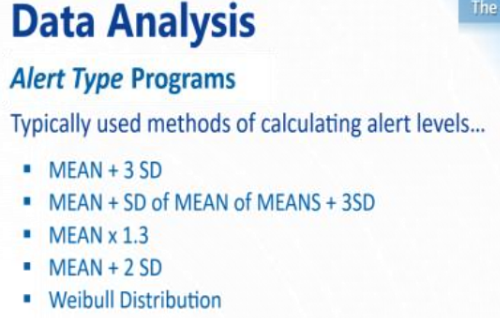
Typically used Methods of Calculating Alert Levels
Alert Levels
must be re-calculated after getting new data, for forecast applications
Non-Alert Type Programs
collected data to assist in the day-to-day operation of the maintenance program may be effectively used as a basis for continuous mechanical performance analysis
Flight service difficulties (RTB, ATB, etc.), ATL review, Engine Monitoring reports, Incident reports, SFR / Component Analysis Reports are suitable data sources.
This is similar to an "Alternative Means of Compliance" approach, whereas reliability data and analysis must be sufficient as equivalent to statistical "Alert-Type" programs.
Corrective Actions (CA)
triggered by identified trendline that exceed alert levels
Reliability Engineer
validates the exceedance and investigates for the root cause that must be addressed
Corrective Actions (CA)
Must effectively restore performance to an acceptable level (based on performance standard) within a reasonable time.
Must address the root cause behind failures/anomalies of a system or component based on reliability "data analysis".
Root Causes
are sometimes identified as several various kinds i.e. technical design weakness, improper operation or maintenance, poor maintenance/servicing, weak maintenance program, human factor-related, etc
Fishbone Diagram
Fault Tree Analysis
Failure Mode and Effect Analysis
Cause Mapping
Keepner Tregoe
etc
6 Methods for Root Cause Analysis
Reliability Program
must include procedures for notification to and mandating the organizational element responsible for resourcing and taking the corrective action
Reliability Engineer
Provides lubrication to the gears or have them replaced, re-designed, etc
Operates the gears to function
Monitors system-wide
Analyzes stuck-ups
No-stuck ups? well, improve
Back to #1
Alert Type Program
CAAP prescribes:
Development of monthly report
To contain all aircraft systems controlled by the Prog.
Highligh Systems that exceeded established Performance Standards, discuss CA taken or planned
Exmplain changes made or planned for the AMP
Discuss continuing ‘over-alert’ conditions from previous reports
Report progress of CA Programs
Non-Alert Type Program
CAAP prescribes:
Consoiidation or summary of significant data/report being used, in controlling their Program
Discuss continuing ‘over-alert’ conditions from previous reports
Discuss continuing ‘over-alert’ conditions from previous reports
Report progress of CA programs
Reliability Program Output
directly affects or will always be involved with the operation, maintenance and/or design & dev’t of Class I & II aeronautical/aerospace products