10. Network Analysis
 Call Kai
 Learn
 Practice Test
 Spaced Repetition
 Match
 Flashcards
 Knowt Play
1/10

There's no tags or description
Looks like no tags are added yet.
11 Terms
The Importance of Network Analysis
Always plays a fundamental role in understanding social structures and relationships.
Basic concepts:
Ego networks = networks formed by a single focal node and its direct ties.
Complete networks = all nodes and all ties within a defined boundary
Steps of network data collection
Questionnaire construction — name generators and questions wording for collecting relational data
Data recording
Analysis
Visualization tools — using Gephi and Pajek to visualize networks
Indices, models — applying statistical and visual methods with tools such as Gephi, Pajek, R and Python
Graph Theory — The Bridges of Königsberg
1736 Leonhard Euler
Question — Is it possible to walk over all the bridges in such a way that I cross each bridge exactly once and return to the starting point?
If every node has an even degree, then such a walk would be possible: an Eulerian graph
Nodes (vertices)
Edges (links)
Directed edges
Undirected edges
Degree
Paths
Two Important Milestones: I. Sociometry
A method for exploring an individual’s system of social relationships
Jacob L. Moreno: spontaneous choices of affinity
Background: Group-dynamics studies, 1917-19, Vienna: “The Theatre of Spontaneity” (Stegreiftheater)
Method: Sociometric Questionnaire
A questionnaire given to all members of a community: Whom would they choose / whom would they reject in important life situations?
Our conclusions are always valid only within the given community
Determines an individual’s position within the social structure and relational patterns
This is How it Started: Moreno’s Sociometric Matrix

Sociogram
A “map” of groupings and connections in the social field (Mérei Ferenc, 1983):
“Informal” connections
The network of spontaneous associations alongside the institutional system of formal statuses
Every person is marked by a circled number
Gender can also be indicated
Mutual choices: double line
Leaders, pairs, excluded individuals
Main groups and subgroups

Theory of Social Influence (Cialdini, 1984; Asch, 1955)
What determines an individual’s opinion?
Opinions of other key individuals
Strength of one’s relationship to these individuals
Degree of attachment to one’s initial opinion
Structure of the group
How do others’ opinions influence us?
In the direction of people we like/who are relevant to us
In proportion to the strength (closeness) of the relationship
Network Data Collection
Steps of Network Data Collection (Statistical methods; Visual methods)
Defining research topic
Defining research question
Formulating research hypotheses
Deciding on the type of network: ego vs. complete network
Questionnaire construction: drafting questions and name generators
Recording data: using matrix tables or edge lists
Analysis: statistical visualization methods
I. Start
What kind of network do we want to collect?
Ego network
Complete (whole) network
Defining the boundaries of the studied group (sample)
e.g.: school class, department, village, etc.
II. Questionnaire construction, Questions and Blocks
Professional trust
Whom do you consider a good professional?
Whose opinion do you rely on in professional decision-making situations?
From whom do you usually ask for professional help?
Personal trust
From whom would you ask for personal (private life) advice?
Whom would you help with their work?
With whom do you usually have lunch?
Trust in leadership
When the boss goes on holiday, whom do they appoint as deputy?
When the boss goes on holiday, whom would you appoint as deputy?
Constructing the questionnaire
Name generators
Listing (how names are elicited)
III. Recording the Data
Creating the data-recording file
Matrix table — adjacency matrix
Edge list
The data can be analyzed on two levels
Software for Social Network Analysis (SNA):
Gephi — for visualizing and analyzing networks
R, RStudio — visualizations and statistical analyses
Python — visualizations and statistical analyses
Pajek — for analyzing large networks
UCINET — for analyzing small networks
Steps of Network Analysis:
Statistical analysis of the network (descriptive statistics) = Shape analysis (morphological analysis): examining network indices
Network size
Degree, out-degree, in-degree
Paths (longest, average)
Network density
Centrality measures
Clusters
Comparing networks (dyads, triads)
Analysing dynamic ahnges (ERGM, positional analysis, SIENA)
The Shape of the Network…
Central Actors Centraility
Degree Distribution in Social Networks: Main Actors in Networks — Positions:
Formal leaders — formal influencers who shape group norms and group behaviour
Bridge actors — information and knowledge transfer cannot take place without them
Central actors, “opinion leaders” — they become visible in the informal hierarchy, and they’re influencers who shape group norms and group behaviour
The Role of Attributes
Elements of statistical analysis in network research — at the individual (and group) level:
Independent variables (e.g.: gender, smoking, ethnicity, type of education, place of residence)
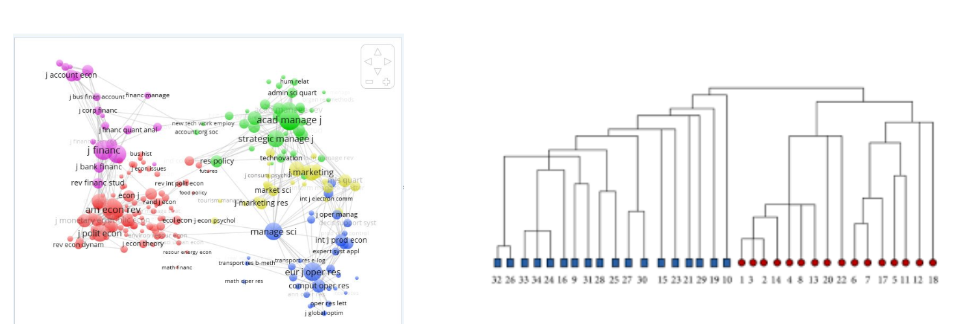
Groups (Community Detection), Cliques, Clusters
Analysis of Dyadic and Triadic Relations
Dyad: mutual, non-mutual, no tie (3 types)
Triad: 16 possible types (based on structural variation, e.g.: mutual, transitive, cyclic, etc.)

Notation of Triad Types: xyzL
The triad codes (e.g.: 003, 021C, 300) describe the pattern of relationships among three actors.
The digits xyz indicate the types of ties:x = number of mutual ties (A ↔ B)
y = number of non-mutual (one-way) ties (A ↔ B)
z = number of dyads with no tie in either direction
L = a letter that distinguishes the exact structure:
C = cyclic
D = “downward”
U = “upward”
T = transitive
Example: 030C
0 mutual ties
3 one-way ties
0 pairs without a tie
C = cyclic: the ties form a cycle — A → B → C → A
Notions of Dyad Types
Reciprocity
The importance of mutual ties:Network theory (Moreno, 1934): Patterns of social relations and their reciprocity.
Social exchange theory (Emerson, 1972): Maintaining mutual exchange relations between individuals
Game theory (Axelrod, 1984): The role of mutual cooperation and feedback in the stability of social relationships
Transivity
If actor A has a strong tie to both B and C, the probability is high that a tie will also form between B and C.Granovetter (1973, 1983): According to the strength of weak ties theory, weak ties play a key role in the flow of information and resources in social networks.
Homophily — Heterophily
Homophily: Individuals with similar characteristics tend to connect with each other (e.g.: similar social background, interests).
Heterophily: Ties between individuals with different characteristics (e.g.: different nationality, educational background).