BIO Exam 3
 Call Kai
 Learn
 Practice Test
 Spaced Repetition
 Match
 Flashcards
 Knowt Play
1/102

There's no tags or description
Looks like no tags are added yet.
103 Terms
Active Transport
pumps material from area of low concentration to high concentration
requires metabolic energy
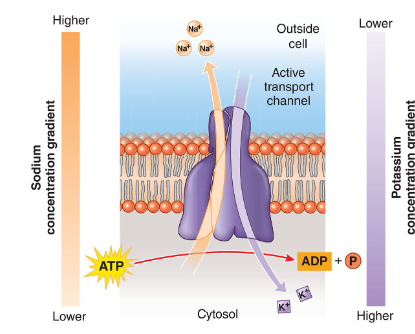
Sodium Potassium Pump (NOKIA Pump)
uses ATP
2 K ions in for every 3 Na out
Membrane becomes polarized and makes and electrochemical gradients that is used to drive other transport systems.
Uniporters (transport protein)
transport one type of substance in one direction
protons pumps
Antiporters (transport protein)
move two substances in opposite directions
sodium-potassium pumps
Symporters (transport protein)
move two types of substances in one direction
cotransported sodium and glucose
Cotransported sodium and glucose
Sodium-potassium pump to generate electrochemical gradient of Na+ → Na+ and glucose bind to carrier protein → carrier protein change its shape and release Na+ and glucose inside cells
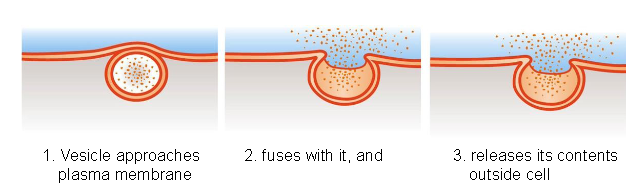
Exocytosis
vesicles export large molecules by the fusion of a vesicle with the plasma membrane
needs energy directly
Endocytosis
the cell imports materials by phagocytosis, pinocytosis, and receptor-mediated endocytosis
needs energy directly

Phagocytosis
ingesting large solid particles (food or bacteria)
Pinocytosis
taking in dissolved materials (“cell drinking”)
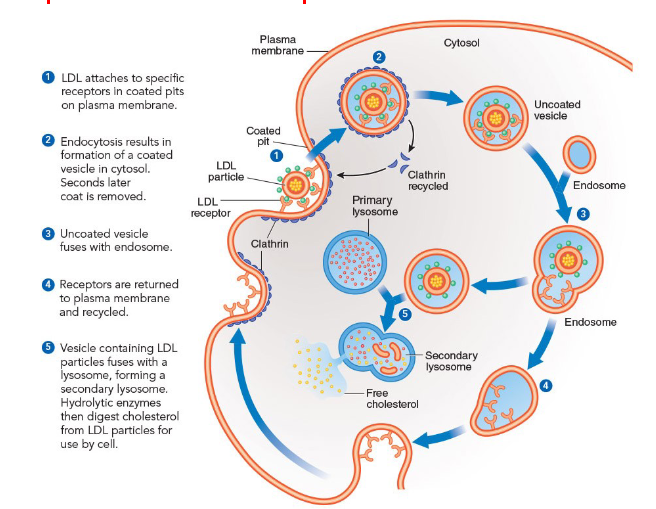
Receptor-mediated endocytosis
specific molecules combine with receptor proteins in the plasma membrane
main mechanism in which eukaryotic cells take in macromolecules
Anchoring junctions
strong junctions that tightly connect adjacent epithelial cells
Types of Anchoring junctions
Desmosomes
Adhering junctions
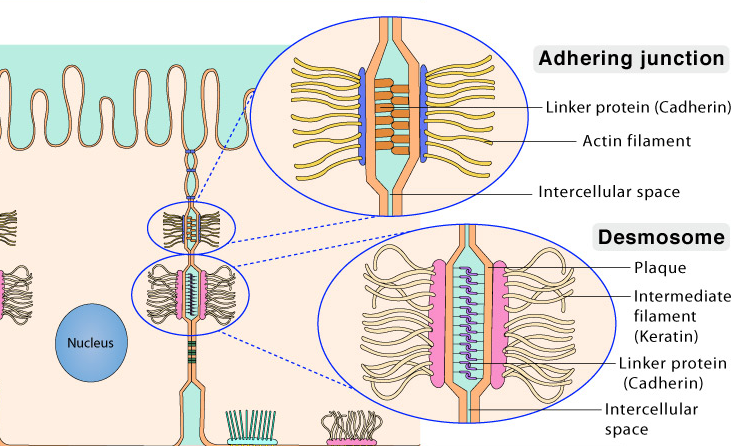
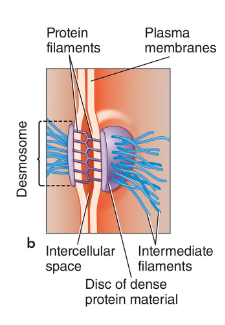
Desmosomes
points of attachment that hold cells together at one spot
cells to form strong sheets, substances still pass freely between membranes
anchored to intermediate filaments of cell = distributes stress
has dense material of proteins that crosses intercellular space between two cell membranes

Adhering junctions
cement cells together as transmembrane protein
Cadherins help form a adhesion belt around each cell, binding the cell to neighboring cell
connects to microfilaments / actin filament
potential path for signals outside the cell to be transmitted to the cytoplasm


Tight junctions
seals of intercellular spaces so no space remains between cells
are present in the capillary cells the line the blood-brain barrier (BBB)

Gap junctions
composed of connexin molecules, which are grouped to form a channel through the plasma membrane of two cells
allows for rapid chemical and electrical communication between cells
cells controls passage of materials ( insulin secretion by pancreatic cells or synchronized contraction of the heart
Plasmodesmata
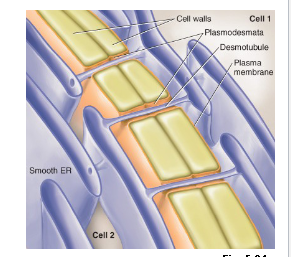
act like gap junctions but for plant cells
channels that pass through the cell walls of adjacent plant cells, connecting the cytoplasm of neighboring cells
Contains a desmotubule = connects the smooth ER of two adjacent cells.

Desmotubule
Connect the smooth ER of two adjacent cells in plasmodesmata junctions
Stages of Cell communication
Signal transmission
Reception
Signal transduction
Response
Signal transmission
a cell must synthesize and release signaling molecules
if target cells are not near by signals must be transported to them
Reception
the process of receiving an incoming signals
Uses receptors that bind to a specific signaling molecule
Signal Transduction
a cell converts an extracellular signal into an intracellular signal
involves a chain of molecules that relay information
Response
signal is converted into a response that alters some cell process
After signaling molecules finish their job, the signal must be terminated
Cell communicate through:
cell junctions
using electrical signals or neurotransmitters at synapses
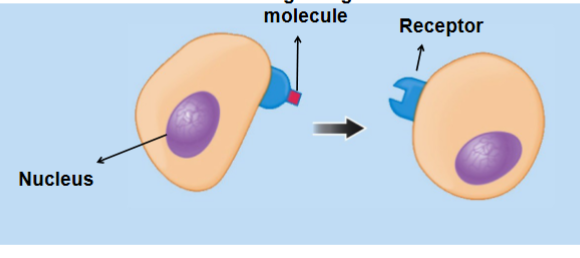
Cell-to-cell direct contact (juxtracrine signaling)
adjacent cells physically touch to exchange signals, ions, or molecules
Endocrine signaling
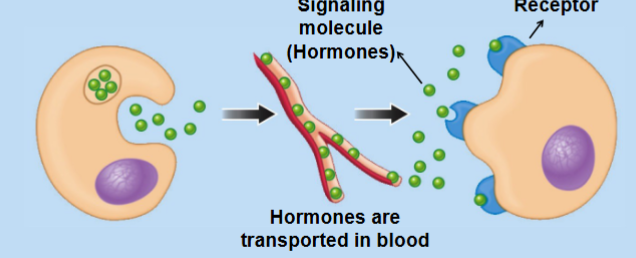
way of chemical signals, targeting long distances
hormones are secreted through the blood stream
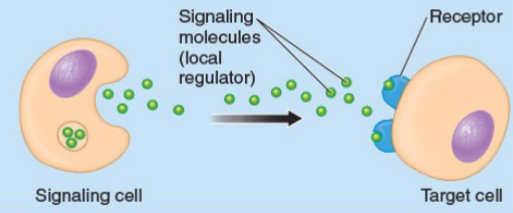
Paracrine
chemical signals targeting cells in close proximity
A local regulator is a signaling molecule that diffuses through the interstitial fluid
Ex of local regulators in paracrine signaling
growth factors, histamine, nitric oxide, and prostaglandins
ligand
a molecule that binds specifically to a receptor (usually a protein), forming a ligand-receptor complex
hydrophilic: bind to receptors on cell surface
hydrophobic: molecules that move through the plasma membrane to bind with intracellular receptors
Intracellular receptors
found in cytosol or nucleus
most are transcription factors that regulate expression of specific genes
signaling molecules are small + hydrophobic
steroids, vitamin A and D, nitric oxide - bind to receptors in the cytosol
thyroid hormone - binds to receptors in DNA/ nucleus
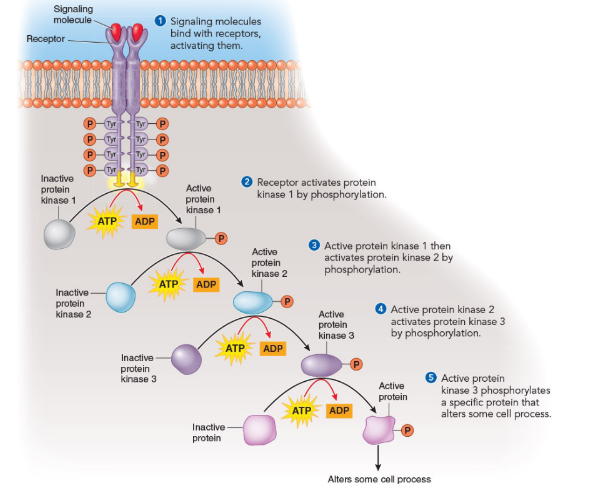
Protein kinase cascade
a signaling pathway in which a series of protein kinase molecules are phosphorylated
used in signal transduction and response
Kinase
enzymes that phosphorylate molecules
Phosphatase
enzyme that catalyzes the removal of a phosphate
Second Messengers
are ions or small molecules that relay signals inside the cell
produced in large quantities
rapidly diffuse trough cell
amplify signals inside the cell
Ex of Second messengers
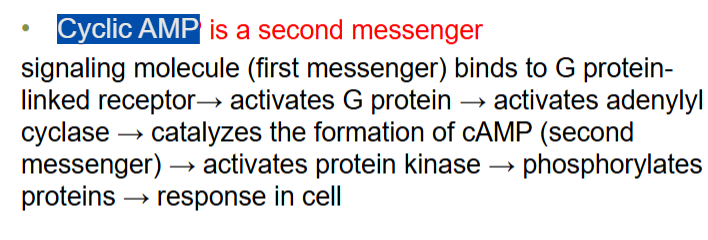
Cyclic AMP
DAG - activates protein kinase enzymes
IP3 - binds to calcium channels in ER —> releases calcium ions in cytosol
Calcium ions
Potential energy
capacity to do work as a result of position or state
Kinetic energy
energy of motion, work is performed
The First Law of Thermodynamics
Energy cannot be created or destroyed
Energy can only be transferred or converted from one form to another
(Organisms cannot create the energy. Instead, organisms must capture energy from the environment and transform it to a form that can be used for biological work.)
The Second Law of Thermodynamics
when energy is converted to one form to another, some usable energy is converted/ lost as heat
the amount of useable energy overtime in the universe decreases
Entropy (S)
The measure of the disorder or randomness of energy
total entropy increases over time
Anabolism
pathways in which molecules are created from simpler substances
energy input required (endergonic)
Catabolism
pathways in which larger molecules are broken down into smaller ones
energy is released (exergonic/cellular respiration)
Free energy (G)
the amount of energy available to do work
As entropy increases
The amount of free energy decreases
Enthalpy (H)
total energy of system
H = G + TS
Total energy of a system = free energy + entropy)
Exergonic reaction
release in energy
free energy decreases
“spontaneous” or “downhill” reaction
high level of energy in reactants to low level or energy in products
ΔG is a negative number
increase in entropy

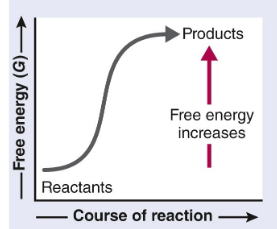
Endergonic reaction
absorbance in energy
free energy increases
requires an input of energy from the environment (not spontaneous)
low level of energy in reactants to high level of energy in products
ΔG has a positive value
entropy decreases
Diffusion is
An exergonic process
entropy increases —> free energy decreases
A concentration gradient
is a form of potential energy
requires cell to expend energy

Effect of Concentration on free energy
The reaction always shifts to reestablish equilibrium
In a living cell the exergonic reaction often involves the breakdown of ATP
Often the exergonic reaction involves the hydrolysis of ATP (large negative ΔG)

ATP Links Exergonic and Endergonic Reactions
1) ATP is broken down (exergonic) to form ADP + Pi
2) Energy released is used to drive another endergonic reaction
3) ADP + Pi are used to build ATP (endergonic) by energy gained from some exergonic reaction
Every cell has
10 ATP molecules for per 1 ADP molecule
hydrolysis of ATP is needed to drive coupled endergonic reactions
An electron loses
free energy as it is transferred from one acceptor to another
Ex of e- carriers
NADH
FADH2
NADPH - is not involved in ATP synthesis
Cytochromes - proteins contain iron
activation energy
the energy required to break existing bonds and begin a reaction
all reactions need to initiate a reaction

An enzyme works by forming
enzyme–substrate complex
Active sites
regions where substrate binds to an enzyme
Induced fit
change in shape of the active site if correct substrate is binded
Oxidoreductases
Catalyze oxidation –reduction reactions
Transferases
Catalyzes the transfer of a functional group from one molecule to another molecule
Hydrolases
Catalyze hydrolysis reactions
Isomerases
Catalyze conversion of a molecule from one isomeric form to anothe
Ligases
Catalyzes reactions in which two molecules become joined through the coupling of the hydrolysis of ATP
Lyases
Catalyze certain reactions in which double bonds form or break
Some enzymes are composed of
apoenzyme (protein portion)
inorganic or organic cofactor

Inorganic cofactors (metal ions)
magnesium
calcium
(iron, copper, zinc, and manganese)
Organic cofactors
know as coenzymes
Coenzyme A
NADH, NADPH, and FADH2
ATP
Vitamins
Optimal pH for most human enzymes
6 to 8


Metabolic pathway
a series of reactions where the product of one enzyme-controlled reaction serves as substrate for the next
Regulation of enzymatic activity
1: Gene control - a gene may be switched on or off by a signaling molecules that regulates the total amount of enzymes in that cell
2: The product of one enzymatic reaction controls the activity of anther enzyme (feedback inhibition)
3: enzyme activation - inactive enzymes are shaped incorrectly, needs right pH or needs to be phosphorylated
4: Allosteric regulation

Enzyme/ Substrate Concentration
With excess substate = enzyme concentration is rate limiting factor
When enzyme concentration, pH, and temp are constant = substate at low concentration is rate limiting factor

Feedback inhibition
accumulation of the product of a reaction inhibits an earlier reaction sequence

Allosteric inhibitors
keep the enzyme in its inactive shape
Allosteric activators
result in a functional active site
cAMP-dependent protein kinase is allosteric
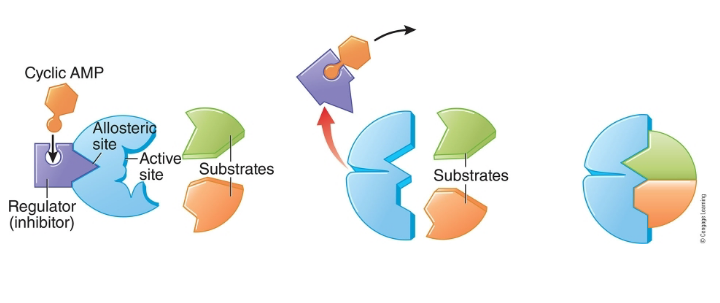
Ex of reversible inhibitor
competitive + noncompetitive
Competitive inhibitor
inhibitor competes with the normal substrate to bind with enzyme active sites
structurally similar to normal substrate
Noncompetitive inhibitor
inhibitor binds with enzyme on a site other than the active site at allosteric site
cause conformational shape change of enzyme
Irreversible inhibition
inhibitor permanently inactivates or destroys an enzyme by forming bonds with the enzymes functional groups
mercury + lead
cyanide
nerve gases
Cellular respiration
Aerobic respiration: oxygen
Anaerobic respiration: no oxygen
Fermentation: no oxygen
is exergonic

aerobic respiration redox
glucose is oxidized —> CO2
oxygen is reduces —> H2O
Stages Of Aerobic Respiration
Glycolysis
Formation of acetyl CoA (pyruvate oxidation)
Citric Acid Cycle (kreb’s)
ETC

Dehydrogenation reactions
removes 2 hydrogen atoms from a molecule which is transferred to NAD+ or FAD
Decarboxylation reactions
carboxyl group (COOH) is removed from a molecule to produce CO2
Glycolysis
occurs in cytosol
no oxygen required
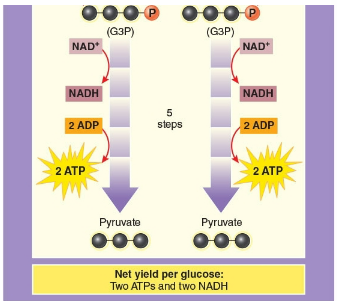
produces 2 net ATP, 2 NADH, 2 pyruvate
Glycolysis energy investment phase
2 ATPs are used to split glucose (6-carbon) in 2 three-carbon molecules, G3P

Glycolysis capture phase
G3P is converted to pyruvate
G3P is oxidizes and transfers e- to NAD+ to make NADH
ATP is formed through substrate-level phosphorylation
Pyruvate oxidation
takes place in the mitochondrial matrix
pyruvate reacts with CoA to produce acetyl CoA
Carboxyl group is removed as CO2
2 pyruvates produce: 2 acetyl CoA, 2 NADH, 2 CO2

Krebs Cycle (citric acid)
the matrix of the mitochondria
8 steps
acetyl CoA (2 carbon) reacts with oxaloacetate (4 carbon) to make citrate (6 carbon)
Citrate is transformed and loses two carboxyl group as CO2
2 acetyl CoA: produces 2 ATP, 6 NADH, 2 FADH2, 4 CO2

Oxidative phosphorylation
couples the transfer of electrons along the ETC with the synthesis of ATP via chemiosmosis
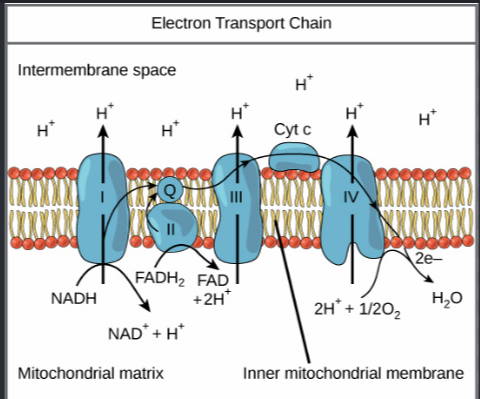
Electron Transport Chain (ETC)
located in in the inner mitochondrial membrane
e- pass down ETC and lose energy each step
Complex 1: accepts electrons from NADH
Complex 2: accepts electrons from FADH2
Complex 3: accepts electrons from complexes I and II
Complex 4: accepts electrons from cytochrome c and reduces O2 to form H2O
Oxygen is
the final electron acceptor in the ETC
Chemiosmosis/ Proton gradient to synthesis ATP
as e- move down the the ETC, the complexes pump H+ from the matrix to the intermembrane space = proton gradient.
H+ the diffuse through ATP synthase to phosphorylate ADP to form ATP (endergonic)


ATP Production
1 NADH = 3 ATP (10 NADH total)
1 FADH2 = 2 ATP (2 FADH2 total)
4 ATP by substrate-level phosphorylation
30 + 4 ATP by oxidative phosphorylation
Phosphofructokinase
regulates Glycolysis by feedback inhibition
1st allosteric site: inhibitors that ATP binds = inactivated
2nd allosteric site: activator bind to AMP = enzyme is activated when ATP is low
Deamination
removal of NH2 (amino group) from an amino acid of digested proteins to from intermediates of glycolysis or TCA
β-oxidation
lipid fatty acids are oxidized to from 2-carbon acetyl groups to become acetyl CoA