AQA Chemistry - Atomic structure and the periodic table
 Call Kai
 Learn
Learn Practice Test
 Spaced Repetition
 Match
Match Flashcards
 Knowt Play
1/73

There's no tags or description
Looks like no tags are added yet.
Name | Mastery | Learn | Test | Matching | Spaced | Call with Kai | Chat |
|---|
No analytics yet
Send a link to your students to track their progress
74 Terms
what are all substances made up of
Atoms
what is an atom
the smallest part of an element that can exist
how can compounds be separated into elements?
by chemical reactions
what happens in a chemicsl reaction
atoms are rearranged to form new substances, usually accompanied by an energy change
chemical reaction
a process that forms new substances, and cannot easily be undone
molecule
any elements chemically combined, even if they are the same element
compound
2 or more different elements chemically bonded together in fixed proportions
what is a feature of an element?
It cannot be broken down into anything simpler
element
a pure substance made up of only one type of atom
How are compounds formed
from elements by chemical reactions
How many different elements are there?
about 100
what is meant by the term ‘fixed proportions’
where every sample of the compound has its elements in the same ratio
balance this equation Na + Cl2 → NaCl
2Na + Cl2 → 2NaCl
make this chemical equation balanced : H2 + O2 → H2O
2H2 + O2 → 2H2O
mixtures
2 or more elements or compounds that are not chemically combined together- each substance in the micture keeps its chemical properties
what are some examples of mixtures
salt solution, air, sandy water
insoluble
a solid that does not dissolve in a specific liquid solvent, even after thorough mixing
filtration
separates an insoluble solid from a liquid
what does filtering do
separates mixtures based on the size of particles

what is number 1
filter paper
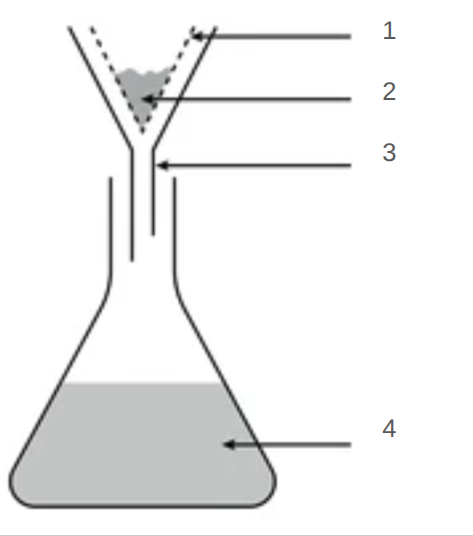
what is number 2
residue
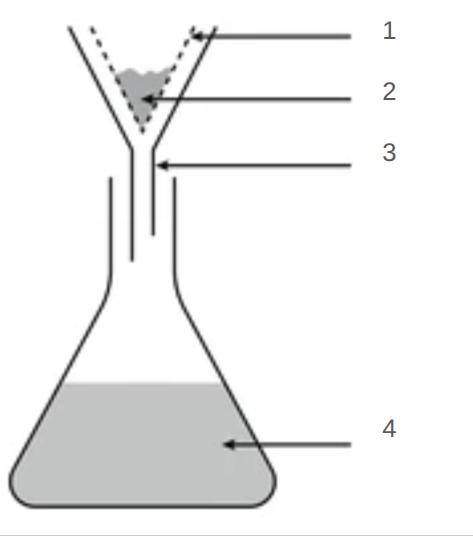
What is number 3
filter funnnel

what is number 4
filtrate
what does crystalisation do?
separates a soluble solid from a solvent
what is Na2O
sodium oxide
periods of the periodic table
horizontal rows
groups of the periodic table
vertical columns
group 1 in the periodic table
very reactive metals
electron
a subatomic particle, with a negative charge and a negligible mass relative to protons and neutrons
what does amu stand for
atomic mass unit
neutrons
particles with no charge that are contained in the nucleus of an atom
How many electrons can the first shell hold?
2
How many electrons can the third shell hold for the first 20 elements?
8
How many electrons does the second shell hold?
8
energy levels
The fixed regions around the nucleus where electrons are found. Electrons in shells further from the nucleus have more energy. Electrons fill the shells closest to the nucleus first.
what is the mass of a neutron
1 amu
what is the mass of a proton
1 amu
protons
positively charged particles that are contained in the nucleus of the atom
how much does an electron weigh?
It’s mass is nearly 0
what does an electron do ?
spin around the positive centre of the atom in energy levels
subatomic particle
a particle smaller than an atom
what are atoms made of
electrons, protons, and neutrons
group 0
a group of very unreactivive non- metals
group 7 in the periodic table
a group of very reactive non-metals
product
the new substance(s) formed in a chemical reaction
How do we know which period an element is in
The number of notations in the electronic configuration tells us the number of occupied shells
when are atoms more stable?
When they completely fill the outermost shell
what is the outermost shell of an atom called?
the valence shell
How do we separate a compound back into its elements?
through a chemical reaction
what do we use if we want to separate a mixture?
we use a physical separation technique
what is meant by ‘fixed proportions’
where the specific ratio of different elements in a compound remains constant
How do compounds differ from their constituent elements?
they usually have different properties from the elements that they are made from
what are the physical techniques that can be used to separate mixtures
chromotography, distillation, filtration, crystallisation
what is the relationship between molecules and compounds
all compounds are molecules but not all molecules are compounds
How are compounds presented?
by using chemical formulas that combine element symbols and numbers to show the exact ratio of different atoms
what is a chemical formula
a combination of symbols that indicates the chemical composition of a substance
what is an ion
an electrically charged particle, formed when an atom or molecule gains or loses electrons
How are ions formed?
when atoms gain or lose electrons
why would an atom gain or lose electrons
to have a full outer shell, so that they are more stable
what does the group number tell us?
How many electrons the atoms of that group have in the outermost shell
what does losing and gaining electrons need?
energy
which atoms are more likely to lose or gain electrons?
the atoms that only need to lose or gain 1 or 2 electrons
which groups can become ions easily
1, 2, 6, 7
how are ionic compounds formed?
when metals react with non metals
What are ions
atoms with a charge
isotopes
forms of the same chemical element that have the same number of protons but a different number of neutrons in their nuclei
what does the atomic number tell us
the number of protons
what is the relationship between atoms and elements
atoms are the particles that make up an element. An element is a type of atom
what is an element defined by?
the number of protons
what is the radius of an atom
around 0.1nm
when is an atom neutral
when the protons and electrons are the same
what does the mass number tell us
the total number of neutrons and protons
How do we find out the number of neutrons
mass number - atomic number