sensory development in infancy
 Call Kai
 Learn
 Practice Test
 Spaced Repetition
 Match
 Flashcards
 Knowt Play
1/22

There's no tags or description
Looks like no tags are added yet.
23 Terms
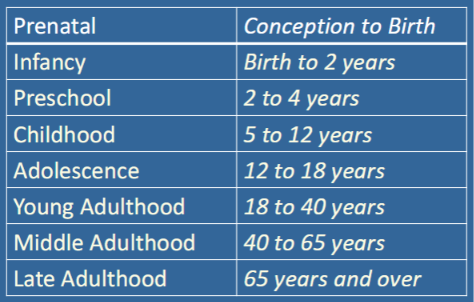
stages of development
working with infants
infants can’t talk and understand little or no language
not capable or producing complex or organised behaviour
often can’t even move around
can get grumpy
can suck
can look
have heartbeat
what do we need to work with infants
need to use methods suitable for non-linguistic populations
need a lot of help from parents
need to take advantage of whatever behaviours or dispositions infants p
infants suck - De Oliveira, Muhammed & Kim (2020)
infants given dummy to suck - baseline sucking rate established
then show infants stimulus and see if sucking rate changes
sucking more = more excited
no change in sucking rate = not noticed anything different
when array changes from 3 to 5 dots:
no change in sucking rate = infant doesn’t distinguish between 3 items and 5 items
change in sucking rate = infant is able to see difference

infants look
infants shown picture until they habituate (get bored)
shown two pictures at once - the old pic and new pic
we measure how much they look at new pic
the proportion of time spent looking at the new picture lets us figure out:
can they tell that two things are different?
can they remember the first picture?

visual paired comparison task
if infants can distinguish between familiar stimuli and unfamiliar stimuli i.e. if they can remember one then they should look at each a different amount
this method relies on habituation
habituation
a decrease in response to a stimulus after repeated presentations
development of vision
takes around one year for the basic perceptual aspects of the human visual system to fully develop
the neural parts of the visual system develop during gestation
vision: newborn infants
generally dim and fuzzy
can see lights, shapes and movement
not yet capable of fixation
range of vision approx 30cm
vision: 1-2 months
can fixate objects
can distinguish high-contrast colours (black/white not red/orange)
vision: 4 months
depth perception improves
colour vision is much better
infants can follow object with their eyes
vision: 8 months
range of effective vision increases
infants can now recognise people across a room
vision: 1 year
basic visual skills are broadly similar to adult levels
seeing faces
from birth, infants show a preferential interest in face-like stimuli
Fantz’s 1961 study showed a series of stimuli to young infants, and observed their looking behaviour
same pattern is seen when presenting moving images to newborns - they follow face-like stimuli for longer (Goren et al., 1975)
seeing specific faces
even within a day of birth, newborns are capable of recognising individual faces
ability to recognise their mother’s face persists even when olfactory cues are removed (Bushnell et al., 1989)…
…and when inadvertent visual cues are controlled for (Walton et al., 1992)
visual recognition in newborns is unlikely to be accompanied by any explicit cognitive insight though early perception will form the basis for later mental representations
perceptual narrowing
with experience, infants’ visual perception gets increasingly attuned to regular features of the child’s environment
very general abilities are more finely tuned following experience - this is particularly seen with facial recognition
the ‘other race’ effect
the tendency to more easily recognise faces of the race one is most familiar with = Kelly et al., 2007
however, it’s possible to retain the ability to distinguish between unfamiliar face types, by shaping the infant’s experience - this has been shown through studies where parents read picture books to their infants (Heron-Delaney et al., 2011)
experience and perceptual narrowing
6 month old Caucasian children were able to discriminate same - and other-race faces
given 70 minutes of picture-book exposure over 3 months
either showed a series of Chinese faces or Caucasian faces
9 month old caucasian babies shown a book with caucasian faces lost the ability to recognise chinese faces
9 month old caucasian babies shown a book with chinese faces retained the ability to recognise chinese faces

development of hearing
unlike vision, sound can be perceived in the womb prior to birth
from 26 weeks, foetuses show changes in heart rate as a direct response to auditory stimuli (Kisilevsky et at., 1992)
full term foetuses can recognise their mother’s voice (Kisilevsky et at., 2003)
hearing - DeCasper & Spence (1986)
asked pregnant women to read a 3-minute story every day for the final 6 weeks of their pregnancy
just after birth, they played each newborn the familiar story and an unfamiliar story
newborn infants preferred hearing the story read while they were in the womb
this was true even when stories were read by a stranger, and not the child’s mother
babies not exposed to these stories while in the room showed no preference
hearing
hearing - particularly speech perception - becomes more specialised with age
infants are initially able to distinguish between phonemes that don’t occur in their native language (Trehub, 1976)
this ability narrows to sounds contained in their own language (Eimas et al., 1971)

perceptual narrowing
infants gradually exchange their vast potential for processing all types of information in return for swifter, greater expertise in processing the information they see most often in their environment
hearing language
infants show a preference for infant-directed speech rather than typical adult like speech (Cooper & Aslin, 1990)
they pay more attention to speech when it has a higher and wider pitch range - exaggerated pitch, range and speed (aka Motherese)